
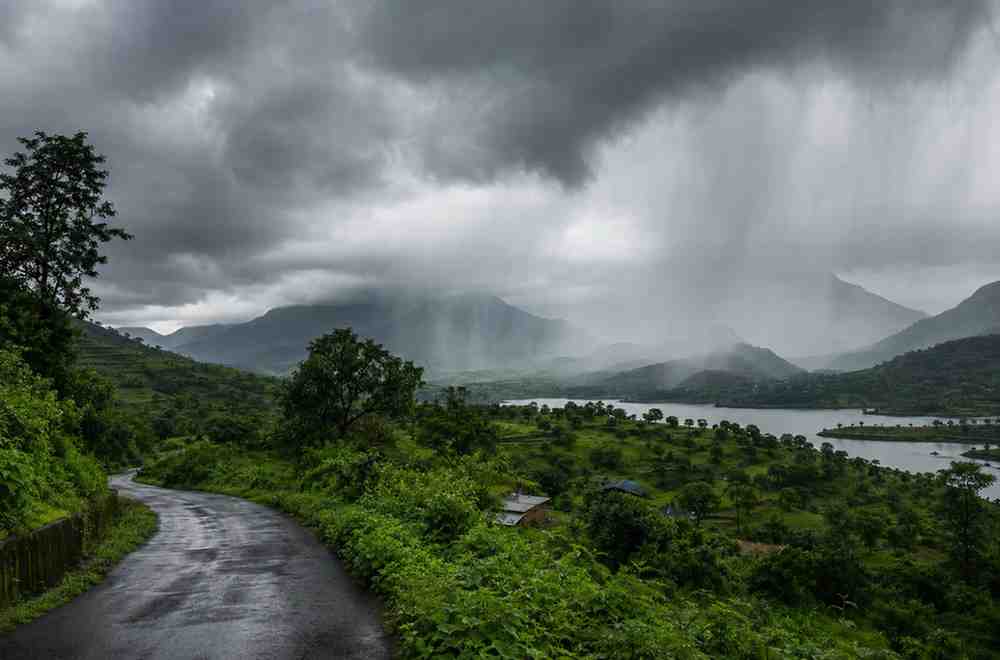
India’s southwest monsoon, often considered the lifeline of the country’s agriculture and economy, has unexpectedly lost momentum after making an encouraging start earlier this month. Fresh satellite imagery and rainfall data from the India Meteorological Department (IMD) indicate a sharp decline in rain-bearing cloud activity over large parts of the country.
According to IMD figures, India has recorded a nationwide rainfall deficit of 64% between June 4 and June 15. During this period, the country received only 19.2 mm of rainfall against the normal average of 53.7 mm.
Satellite Images Reveal Weak Monsoon Presence
Recent images captured by the INSAT-3DS satellite show a striking absence of dense cloud cover over vast stretches of peninsular, central and eastern India.
Typically, an active southwest monsoon produces extensive cloud bands that stretch across the country. However, current imagery indicates that most cloud activity is concentrated over the Himalayan region, northeastern states and areas north of the Indo-Gangetic plains. Large portions of central and southern India appear relatively clear, suggesting a significant weakening of monsoon circulation.
Meteorologists describe the situation as a temporary “monsoon pause” rather than a complete disappearance of the seasonal system.
Why Has The Monsoon Slowed Down?
Weather experts attribute the slowdown to multiple atmospheric factors, particularly the influence of strong western disturbances and disruptions in the normal wind circulation patterns.
Western disturbances, which usually originate around the Mediterranean region and move eastward, have remained active over northern India. Their interaction with monsoon winds has prevented the moisture-laden currents from strengthening over central and southern regions.
In addition, changes in upper atmospheric jet streams have affected the development of low-pressure systems that are essential for sustained rainfall across India. Without these systems, monsoon clouds struggle to organize and spread inland.
Agriculture Sector Faces Growing Anxiety
The abrupt pause has triggered concerns among farmers, particularly as the kharif sowing season begins across several states.
Crops such as rice, cotton, soybean, pulses and maize heavily depend on timely rainfall during June. Any prolonged delay could force farmers to postpone sowing activities, potentially affecting crop yields later in the season.
Agricultural experts note that while a short monsoon break is not unusual, an extended dry spell at this stage could create uncertainty for millions of farmers.
Several regions in central India, the southern peninsula and eastern states are already witnessing below-normal rainfall conditions.
IMD Continues To Monitor The Situation
Despite the current slowdown, IMD has stated that the southwest monsoon continues to advance into additional parts of the country.
On June 15, the monsoon further progressed into remaining parts of Andhra Pradesh and West Bengal, along with additional areas of Telangana, Odisha, Jharkhand and Bihar.
Weather officials are closely monitoring atmospheric developments and expect conditions to evolve over the coming days.
At the same time, isolated heavy rainfall is forecast for sub-Himalayan West Bengal and Sikkim, while northwestern India may continue to experience weather activity linked to western disturbances.
Is This Climate Change?
Experts caution against attributing this single event entirely to climate change. However, scientists have repeatedly observed that climate change is making monsoon patterns increasingly unpredictable.
Instead of steady and widespread rainfall, India is witnessing more episodes of prolonged dry periods followed by intense bursts of rain.
These irregular patterns complicate water management, urban planning and agricultural operations across the country.
What Happens Next?
Meteorologists emphasize that the current phase should not be interpreted as the failure of the entire monsoon season.
Monsoon systems naturally experience active and weak phases throughout the four-month season. The bigger concern will arise if the rainfall deficit continues into late June and early July, which are crucial weeks for crop sowing and reservoir replenishment.
For now, weather agencies remain cautious but optimistic that atmospheric conditions could gradually improve and help restore rainfall activity over affected regions.
However, the coming two weeks will be critical in determining whether the monsoon regains strength or if India faces a prolonged period of below-normal rainfall that could impact food production, water supplies and the broader economy.