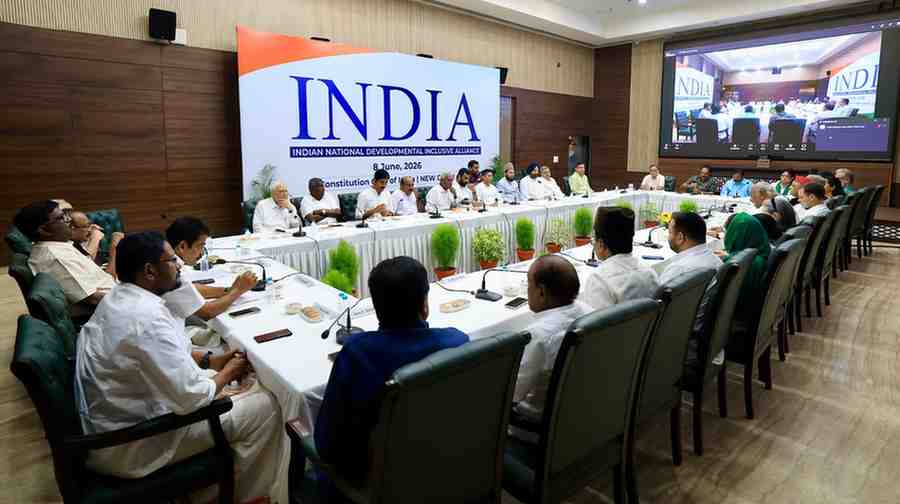
Senior leaders of the opposition alliance INDIA bloc convened in New Delhi on June 8 in a significant political gathering aimed at strengthening coordination among member parties and charting a common strategy against the Bharatiya Janata Party (BJP). The meeting, held at the Constitution Club, brought together some of the most prominent figures from opposition politics as they sought to address internal differences and prepare for future electoral contests.
The discussions assume importance as several regional parties associated with the opposition camp have faced electoral setbacks in recent assembly elections. Against this backdrop, leaders emphasized the need for greater unity and cooperation to effectively challenge the BJP’s growing political influence across the country.
Among those present at the meeting were Congress Parliamentary Party chairperson Sonia Gandhi, Leader of Opposition Rahul Gandhi, and Congress president Mallikarjun Kharge. They were joined by Trinamool Congress chief Mamata Banerjee, Samajwadi Party president Akhilesh Yadav, Rashtriya Janata Dal leader Tejashwi Yadav, National Conference leader Omar Abdullah, and Peoples Democratic Party chief Mehbooba Mufti.
Several leaders from Left parties and other regional political organizations also participated in the deliberations. Nationalist Congress Party (Sharad Pawar faction) leader Supriya Sule, CPI(M) Rajya Sabha member John Brittas, CPI general secretary D Raja, along with representatives of smaller parties, attended the meeting.
Sources within the alliance indicated that representatives from 23 political parties were expected to participate. The objective was to present a united political front and develop a coordinated approach for upcoming state elections while also laying the groundwork for the 2029 Lok Sabha elections.
Political observers view the meeting as an attempt to revive momentum within the INDIA alliance after a period of reduced engagement among its top leadership. The gathering marked one of the most significant interactions among opposition leaders since the conclusion of the 2024 Lok Sabha elections.
The alliance has continued to hold consultations on parliamentary strategy and floor coordination during sessions of Parliament. However, a full-scale meeting involving top leaders from across the opposition spectrum had not taken place for a considerable period.
Participants are understood to have discussed a range of issues, including electoral preparedness, coordination among alliance partners, and concerns related to the electoral process. The leaders are also believed to have exchanged views on strengthening communication and avoiding divisions that could weaken the opposition’s collective challenge to the ruling party.
The meeting follows earlier efforts by opposition leaders to maintain cohesion within the alliance. In August last year, Rahul Gandhi hosted a major gathering of opposition representatives at his residence in New Delhi. That event brought together nearly 50 leaders from more than 25 parties and focused on issues ranging from electoral reforms to alleged irregularities in voter registration processes.
One of the key concerns raised during previous consultations was the Special Intensive Revision (SIR) of voter rolls in Bihar, which several opposition parties argued required closer scrutiny. Such issues continue to feature prominently in discussions among alliance partners as they formulate their political agenda.
Despite the broad participation, the meeting also highlighted changes within the opposition landscape. The Dravida Munnetra Kazhagam (DMK) and the Aam Aadmi Party (AAP) did not take part in the deliberations. Both parties have distanced themselves from the alliance in recent months.
AAP has publicly indicated that it no longer considers itself part of the INDIA bloc. The DMK, meanwhile, chose to stay away after political developments in Tamil Nadu altered its relationship with the Congress. The party had earlier announced its decision to boycott the gathering following the Congress’s move to end its alliance with the DMK and support a government led by the Tamilaga Vettri Kazhagam (TVK).
The absence of these parties underscores the challenges facing the opposition alliance as it seeks to maintain cohesion among diverse regional and national political forces.
Nevertheless, leaders attending the meeting projected confidence about the alliance’s future and stressed the importance of collective action. With several crucial state elections approaching and national political calculations already turning toward the 2029 Lok Sabha contest, the opposition’s effort to close ranks and present a coordinated strategy is likely to remain a central feature of India’s evolving political landscape.