
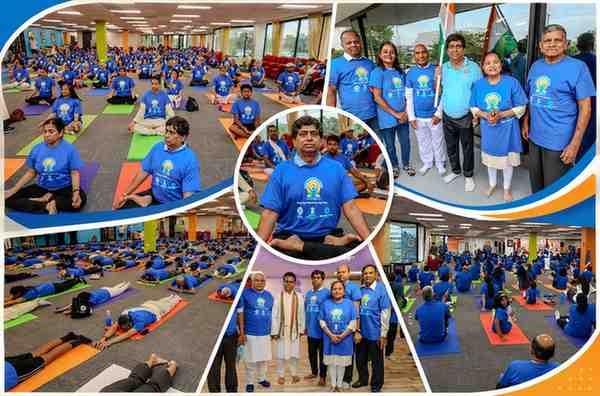
CHICAGO: The debate over preserving the traditional essence of yoga resurfaced during the 12th International Day of Yoga celebrations in the United States, after Chicago-based Indian community leader Hemant Patel publicly voiced concerns over what he described as the gradual dilution of yoga’s spiritual and cultural identity.
Mr. Patel shared his observations after participating in his third International Yoga Day celebration this year. The event was organised at the National India Hub in Schaumburg and hosted by the Consulate General of India with support from various Indian associations across the Chicagoland region.
Concern Over Missing Surya Namaskar
According to Patel, one aspect stood out consistently across Yoga Day celebrations he attended: the absence of Surya Namaskar, one of yoga’s most recognised and foundational sequences.
Patel said he was curious about the omission and sought an explanation. He referred to information indicating that certain religious groups had previously objected to Surya Namaskar and the chanting of “Om”, arguing that they could be interpreted as acts of worship rather than purely physical exercises.
As a result, India’s Ministry of AYUSH had removed these practices from the official Common Yoga Protocol used during International Yoga Day events to make the programme more inclusive for participants from diverse religious backgrounds.
Patel expressed disappointment over this development, saying such changes risk weakening yoga’s original philosophy.
Instructor’s Approach Also Raises Questions
Patel further observed that one of the instructors at the event avoided chanting mantras or uttering “Om” during the session.
He argued that such omissions send an incomplete message to participants, especially to those who may be experiencing yoga for the first time.
“To me, this sends the wrong message to the thousands of participants and feels disrespectful to yoga’s traditional roots,” Mr. Patel said. He further remarked, “Such an instructor should refrain from yog, or at least from being an instructor.”
His comments have sparked wider discussions within sections of the Indian diaspora about balancing inclusivity with preserving cultural authenticity.
Yoga Is More Than Physical Exercise
Patel emphasised that yoga should not be reduced to a series of physical postures and exercises. According to him, yoga is a holistic discipline that integrates the body, mind, breath and spiritual awareness.
“Yoga is not only a physical exercise; it is a holistic spiritual practice that integrates body, mind, and breath, leading to balance, awareness, and inner well-being,” he stated.
He also warned that isolating yoga from its philosophical foundations may create a distorted understanding of the ancient practice. “Just focusing on the physical aspect could be harmful,” Patel added.
Debate Over Inclusivity Versus Authenticity
International Yoga Day, observed annually on June 21, has grown into a global event celebrated across more than 180 countries. However, debates surrounding its presentation have persisted for several years.
Supporters of a simplified approach argue that removing practices perceived as religious helps make yoga accessible to people of all faiths and backgrounds.
On the other hand, cultural preservation advocates believe excessive modifications disconnect yoga from its origins. Patel clearly aligned himself with the latter view.
“If someone has religious objections, they may choose not to participate. However, we should not dilute yoga to accommodate every belief system,” he said.
He further argued that those who voluntarily participate in yoga events should respect its traditions rather than expect alterations. “Those who participate should respect its traditions, while others may refrain. There cannot always be a middle ground on everything,” he stated.
Calling Yoga A Gift From Bharat
Patel also highlighted the importance of defining yoga’s identity globally. He stressed that Indians themselves must communicate yoga’s historical and cultural roots before others reshape its narrative.
“Yog is one of Bharat’s greatest gifts—especially from Hindu traditions—to the world. If we do not set the correct narrative ourselves, others will do it for us,” Patel said.
His remarks reflect a broader sentiment among several diaspora organisations that advocate for presenting yoga in its traditional form while acknowledging its universal appeal.
Appeal To Organisations and Authorities
Concluding his statement, Patel issued an appeal to Indian organisations, Hindu groups and government authorities worldwide. He urged stakeholders involved in organising International Yoga Day celebrations to preserve yoga’s original teachings, practices and symbolism.
“I urge all Indian organizations, Hindu organizations, and government authorities to present Yog in its authentic and complete form,” he said. Mr. Patel also cautioned against compromising yoga’s core traditions to address concerns raised by specific groups.
“Compromising its core traditions to accommodate the concerns of any one group could jeopardize the spirit and future of International Yoga Day,” he added. His remarks have once again brought attention to an ongoing global conversation: how to promote yoga as a universal practice while remaining faithful to its ancient origins and philosophical foundations.



Nicely articulated article. Thank you for amplifying our voice so effectively and eloquently.