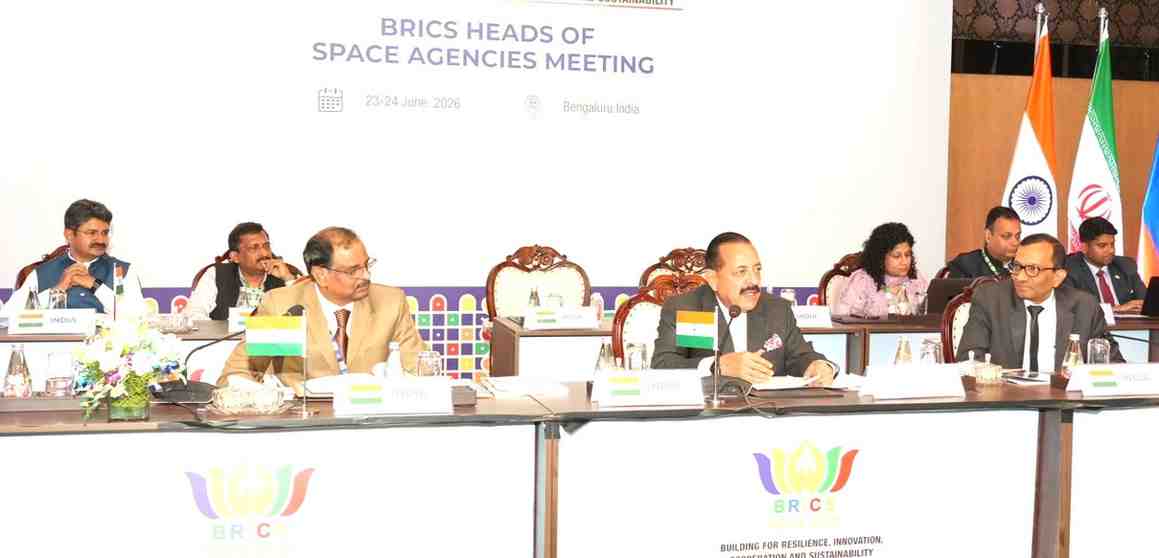
BENGALURU: Union Minister Dr. Jitendra Singh has emphasized that the future of the global space economy will depend on international partnerships rather than countries working independently. He urged BRICS nations to strengthen cooperation and jointly build a resilient and innovation-driven space ecosystem during the concluding session of the BRICS Heads of Space Agencies (HOSA) Meeting held in Bengaluru.
Speaking at the event, Dr. Jitendra Singh highlighted that the space sector is rapidly evolving into a major pillar of economic growth and technological advancement worldwide. He stated that BRICS countries collectively possess the scientific expertise, industrial capabilities and technological strengths necessary to become a significant force in shaping the future global space economy.
Dr. Singh said, “The future of the space economy will not be shaped by nations working in isolation. It will be shaped by partnerships, shared innovation and collective ambition. BRICS countries have the potential to become one of the strongest pillars of this emerging global space ecosystem.”
A Vision Beyond National Boundaries
The minister underlined that future progress in the space sector cannot be achieved through isolated efforts. Instead, countries must adopt a collaborative approach that encourages shared innovation, joint investments and collective ambition.
He said that BRICS nations have the potential to become one of the strongest pillars of the emerging global space ecosystem by combining their strengths and resources. According to him, cooperation among member countries will create opportunities that extend beyond scientific exploration and contribute directly to economic development and societal welfare.
Bengaluru Hosts Major BRICS Space Gathering
The two-day meeting was hosted by Indian Space Research Organisation under India’s BRICS Chairship 2026. Delegations from Brazil, China, Egypt, Ethiopia, Indonesia, Iran, Russia, South Africa and the United Arab Emirates participated in discussions focused on strengthening multilateral space cooperation.
Senior officials, representatives from India’s growing private space industry and emerging NewSpace startups also attended the event. The gathering showcased India’s expanding role as a global space player and highlighted the increasing participation of private enterprises in the country’s space ambitions.
Space Technology Driving Economic Transformation
Dr. Jitendra Singh noted that space technology today impacts several critical sectors, including communication, navigation, disaster management, healthcare, education, agriculture and environmental monitoring.
He stressed that major global challenges such as climate change, natural disasters, food security, water shortages and rapid urbanisation require collaborative solutions backed by advanced space technologies. He said no single nation can effectively tackle these issues alone, making international cooperation essential.
Strengthening Existing BRICS Mechanisms
During the meeting, participating nations reviewed the progress of ongoing BRICS space collaborations. Key discussions revolved around improving space sustainability, promoting debris-free missions and strengthening the BRICS Remote Sensing Satellite Constellation.
Officials also discussed expanding opportunities for newer BRICS members and advancing the proposal for establishing a BRICS Space Council to institutionalise cooperation among member nations. The agenda further included disaster management, Earth observation initiatives, capacity building and knowledge-sharing programmes.
India’s Growing Space Ecosystem
The minister highlighted India’s transformation into one of the fastest-growing space economies globally. He credited recent policy reforms for opening the sector to private companies, startups, academic institutions and international partnerships.
He said the government’s efforts have created unprecedented opportunities for innovation and entrepreneurship. India’s achievements in recent years have significantly elevated its position in the global space landscape.
Dr. Jitendra Singh also pointed to landmark missions such as Chandrayaan-3, Aditya-L1 and the ongoing Gaganyaan mission as examples of India’s scientific capabilities that have opened new avenues for global collaboration.
Focus on Sustainable Space Operations
Another key issue discussed at the meeting was ensuring the long-term sustainability of outer space activities. The minister warned that increasing space traffic and orbital debris present significant challenges for future missions.
He called for responsible behaviour, transparency, international cooperation and stronger capacity-building efforts to preserve outer space as a safe and secure environment for future generations. He welcomed discussions on debris-free missions as an important step toward sustainable space exploration.
From Coordination to Co-Creation
Dr. Jitendra Singh said India envisions BRICS space engagement evolving beyond routine coordination. He urged member nations to embrace co-development, co-innovation and co-creation by bringing together scientists, engineers, industries, startups and young innovators.
He reaffirmed India’s commitment to transforming shared aspirations into concrete outcomes that promote development, resilience, innovation and international cooperation through space technology.