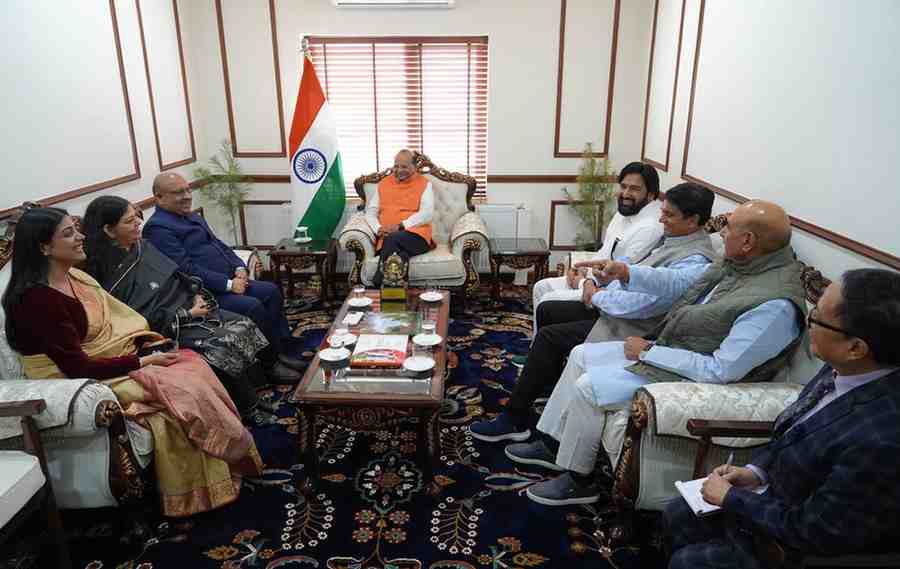
LEH, LADAKH: Delhi Legislative Assembly Speaker Shri Vijender Gupta paid a courtesy visit to the Lieutenant Governor of Ladakh, , during an official study tour to the Union Territory. The meeting focused on governance, sustainable development, environmental conservation, and innovative administrative practices aimed at improving public service delivery.
The Speaker was accompanied by Members of the Delhi Legislative Assembly, Shri Surya Prakash Khatri, Shri Sanjay Goyal, and Shri Aahir Deepak Chaudhary. The interaction took place in a cordial atmosphere and provided an opportunity for both sides to exchange ideas on regional development, sustainability, and future-ready governance models.
Ladakh’s Development Journey After Becoming a Union Territory
During the meeting, Lieutenant Governor Vinai Kumar Saxena briefed the Delhi delegation about the rapid transformation that Ladakh has witnessed since becoming a Union Territory.
He highlighted that administrative reforms have significantly improved governance and developmental outreach. According to him, the number of districts in Ladakh has increased from two to seven, enabling authorities to better cater to the needs of remote communities and accelerate development activities across the region.
The Lieutenant Governor also discussed several strategic infrastructure projects currently underway. These include the construction of important tunnels and enhanced connectivity networks that are expected to provide all-weather access to remote areas, strengthen economic opportunities, and improve the overall quality of life for local residents.
He emphasized that better infrastructure will not only enhance mobility but also contribute to tourism growth, economic resilience, and national security in the strategically important Himalayan region.
Vijender Gupta Highlights Delhi Assembly’s Green Transformation
During the interaction, Delhi Assembly Speaker showcased the capital’s achievements in digital governance and environmental sustainability.
He explained how the Delhi Legislative Assembly has embraced modern technology to create a more efficient, transparent, and environmentally responsible institution.
Speaking about the National e-Vidhan Application (NeVA), Gupta said that the digital platform has dramatically reduced paper usage and improved legislative efficiency.
“The adoption of the National e-Vidhan Application has substantially reduced paper consumption, conserved a large number of trees, and enhanced the overall efficiency of legislative functioning,” Vijender Gupta said.
He added that the initiative represents a significant step towards creating a paperless and environmentally conscious legislature.
Solar Energy Making Delhi Assembly More Sustainable
The Speaker also highlighted the Assembly’s ambitious renewable energy initiatives. He informed the Lieutenant Governor that the installation of a 500-kilowatt solar power system has already resulted in considerable savings in electricity consumption and operational expenses.
According to Gupta, plans are now underway to expand the Assembly’s solar generation capacity by an additional 300 kilowatts. “Our goal is to make the Delhi Legislative Assembly virtually self-sufficient in meeting its electricity requirements while substantially reducing energy costs,” Vijender Gupta stated.
He said the project reflects the Assembly’s long-term commitment to clean energy adoption and environmental stewardship.
A Shared Vision for Sustainable Governance
The meeting underscored the growing importance of sustainable governance practices across India.
Both leaders acknowledged that digital transformation, renewable energy adoption, and environmentally responsible policymaking are becoming essential pillars of modern administration.
The exchange of ideas between Delhi and Ladakh demonstrated how different regions can learn from each other’s experiences to build stronger, greener, and more efficient governance systems.
Officials noted that such interactions are valuable for promoting innovation and encouraging collaborative approaches to common challenges, including climate change, energy management, and infrastructure development.
Strengthening Institutional Cooperation
The study tour also served as an opportunity to strengthen institutional ties between the Delhi Legislative Assembly and the administration of Ladakh.
By sharing successful models of governance and sustainability, both sides expressed optimism about creating future opportunities for collaboration and knowledge exchange.
The visit highlighted how legislative bodies can play a significant role in driving environmental responsibility while simultaneously improving administrative efficiency.
As governments across the country increasingly focus on sustainable development, initiatives such as paperless legislative systems and renewable energy integration are emerging as examples that other institutions may choose to emulate.
The interaction between Delhi Assembly Speaker Vijender Gupta and Ladakh Lieutenant Governor Vinai Kumar Saxena reinforced a shared commitment to innovation, environmental responsibility, and citizen-centric governance, setting the stage for greater cooperation in the years ahead.