Former Pakistan Interior Minister Sheikh Rasheed Ahmed has triggered a major controversy after appearing at a public gathering alongside individuals identified as senior Lashkar-e-Taiba (LeT)-linked figures, openly praising Hafiz Saeed and making inflammatory remarks against India. The episode has once again raised questions over Pakistan’s handling of extremist networks and the continued public presence of figures associated with banned organisations.
Sheikh Rasheed Appears With LeT-Linked Figures
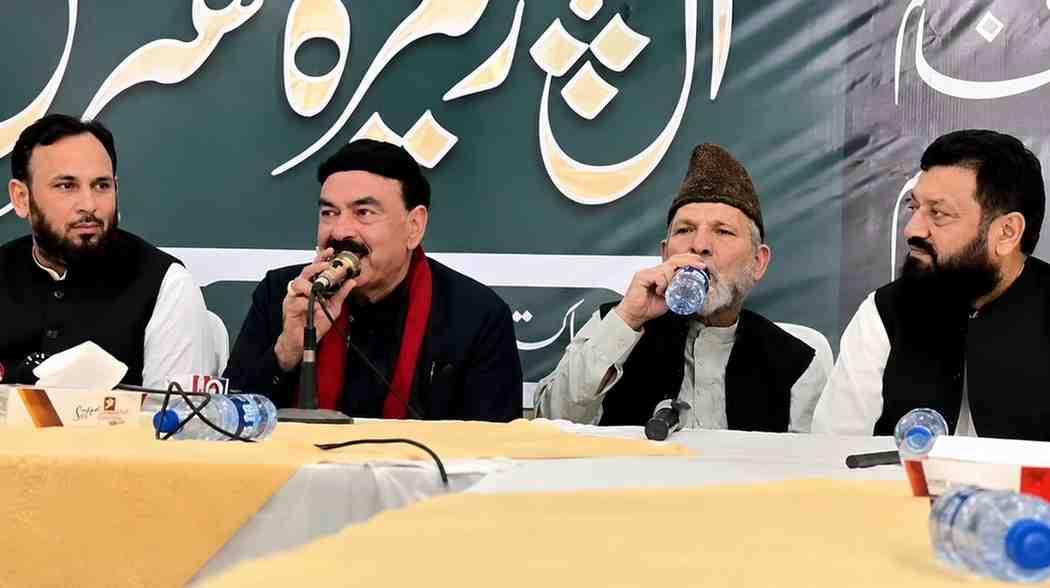
A video from the event shows Sheikh Rasheed sharing the stage with Khalid Masood Sandhu, described as a senior LeT commander and president of the Pakistan Markazi Muslim League, and Qari Muhammad Yaqoob Sheikh, identified as a member of the organisation’s central advisory committee. The appearance has drawn considerable attention because of the political background of Rasheed and the identities of the people seen alongside him.
Rasheed, a prominent Pakistani politician and founder of the Awami Muslim League, previously served as Pakistan’s Interior Minister under former Prime Minister Imran Khan between 2020 and 2022. His latest appearance has therefore generated renewed scrutiny over the relationship between sections of Pakistan’s political establishment and groups linked to extremist organisations.
‘I Am Hafiz Saeed’s Slave’: Rasheed’s Remark
During his address, Rasheed expressed strong support for Hafiz Saeed, the jailed founder of Lashkar-e-Taiba. In the video, he is heard using the phrase “Main Hafiz sahab ka ghulam hu,” which translates to “I am a slave of Hafiz Saeed.”
He also declared his support for both Pakistan and Saeed, reinforcing the impression that his remarks were intended as an open expression of allegiance rather than a casual reference. The comments have sparked criticism because Hafiz Saeed has long been internationally associated with Lashkar-e-Taiba and has been designated under United Nations sanctions.
Rasheed further claimed that Saeed’s phone number had appeared on his mobile phone while he was in the United States and alleged that he was subsequently expelled from the country. The claim was presented by Rasheed during his speech, although the report did not independently establish the circumstances surrounding the alleged incident.
Former Pakistan Minister Issues Threats Against India
The controversy intensified when Rasheed turned his speech towards India and made inflammatory statements against the country.
According to the video and reports, he claimed that Allah would destroy India if it “even looks towards Pakistan.” He went on to make further threatening remarks, saying that birds would no longer chirp in India and temple bells would not ring.
Such statements have added a dangerous dimension to the controversy, particularly amid the already tense political and security relationship between India and Pakistan. The remarks are likely to attract renewed attention in India because of their explicit nature and their apparent connection to a gathering involving individuals identified as LeT figures.
Hafiz Saeed and Lashkar-e-Taiba Controversy
Hafiz Saeed has been a central figure in international terrorism-related investigations for decades. He co-founded Lashkar-e-Taiba, a Pakistan-based militant organisation designated as a terrorist group by the United Nations and several countries.
Also Read: 210 Year Old Sugauli Treaty Vanishes, Reigniting Nepal-India Border War Over Lipulekh
Saeed has also been linked internationally to the 2008 Mumbai terror attacks, in which 166 people were killed. The United States placed a $10 million reward for information leading to his conviction, while the UN Security Council has maintained sanctions against him.
Pakistan arrested Saeed in 2019 and subsequently convicted him in terrorism-financing cases. He has received lengthy prison sentences, including additional imprisonment in 2022.
Against this background, a former Pakistani interior minister publicly praising Saeed and appearing alongside individuals identified as LeT-linked figures is particularly significant.
Political Fallout and Questions for Pakistan
The episode could intensify criticism of Pakistan over allegations that militant-linked personalities continue to find political and public platforms despite formal bans on extremist organisations.
Rasheed’s political history also makes the incident notable. He has been a prominent figure in Pakistani politics for decades and served in several ministerial positions. His tenure as Interior Minister under Imran Khan placed him at the centre of Pakistan’s internal security and counterterrorism establishment.
The latest remarks therefore risk raising questions not only about Rasheed personally but also about Pakistan’s broader approach to extremist networks.
The appearance comes at a time when India and Pakistan remain highly sensitive to security-related statements and activities originating across the border. Any public endorsement of individuals associated with banned militant groups can quickly become a diplomatic and political flashpoint.
India-Pakistan Tensions Under Fresh Spotlight
Rasheed’s remarks are expected to attract significant attention in India, particularly because they combine praise for Hafiz Saeed with direct threats against the country.
The incident also provides fresh ammunition for critics who argue that Pakistan has failed to completely dismantle the infrastructure and public influence surrounding extremist organisations. While Pakistan has formally banned Lashkar-e-Taiba and taken action against some of its leaders, the appearance of politically prominent figures alongside LeT-linked personalities is likely to fuel further debate.
For now, the video and Rasheed’s remarks remain at the centre of the controversy. His appearance, praise for Hafiz Saeed and aggressive statements against India have together created a politically explosive episode that is likely to keep Pakistan’s terrorism record and India-Pakistan security tensions under renewed scrutiny.
Click here to join our WhatsApp Channel for real-time news updates and exclusive coverage.