

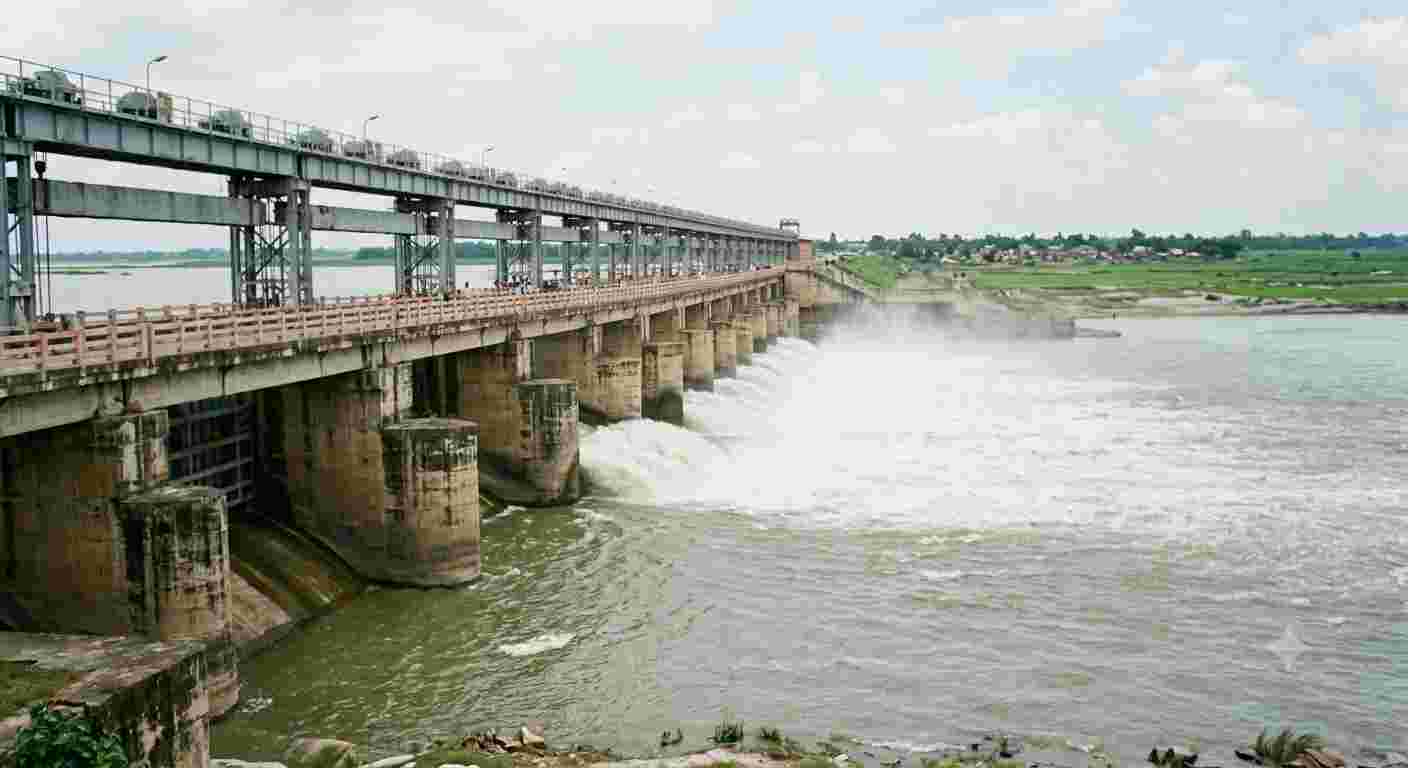
The 1996 Ganga Water Treaty: A Historic Agreement Nears Expiry
On December 12, a document that has quietly kept the peace on one of South Asia’s most contested rivers will reach the end of its life. The Ganga Water Treaty, signed in 1996 by Prime Ministers H.D. Deve Gowda and Sheikh Hasina, expires after thirty years, and Dhaka has made clear that it wants a new or revised treaty that explicitly guarantees its share. New Delhi has said only that such discussions belong within the Joint Rivers Commission. With seven weeks left, the question is no longer whether the two countries will sign something, but whether they will sign something that works.
The 1996 accord was a genuine achievement. It settled a long dispute over the Farakka Barrage in West Bengal by fixing how the river’s lean-season flow would be shared between January and May. When flows at Farakka exceed 75,000 cusecs, India may draw 40,000 cusecs and the rest flows downstream. When they fall below 70,000 cusecs, each side takes half, and between March 11 and May 10, each country is guaranteed 35,000 cusecs in alternating ten-day periods. For three decades, this arithmetic allowed two governments with often strained relations to manage scarcity without crisis.
Climate Change and Declining River Flows Raise Fresh Concerns
But the arithmetic rests on a river that no longer exists. The formula is based on flows recorded between 1949 and 1988, long before climate change began bringing more intense rainfall and longer dry spells. In Bangladesh, reduced dry-season discharge has been linked to rising salinity in coastal areas and pressure on irrigation and fisheries.
Prime Minister Tarique Rahman warned this week that the Padma is drying up, and pledged to speed up work on barrages on the Padma and the Teesta. Dhaka, in other words, is already planning for a future in which it cannot count on Farakka. Its water resources minister has also noted that the 1977 agreement contained a guarantee clause that the 1996 treaty dropped. Renewing the old numbers unchanged would mean promising water that may simply not be there.
West Bengal’s Role and India’s Domestic Water Concerns
The second problem lies closer to home. No Ganga deal can work without West Bengal, which has long raised concerns about dry-season flows and the navigability of Kolkata port. India and Bangladesh reached an understanding on the Teesta in 2011, yet that agreement was never signed, partly because of opposition from the West Bengal government. The episode remains a cautionary tale: a treaty negotiated in Delhi can be stalled in Kolkata, and Bangladesh pays the price in lost trust. This time, West Bengal has provided input on its drinking and industrial water needs. That is a welcome start, but it should be formalised rather than left to informal consultation.
Also Read | AIIA Study Reveals Promising Ayurveda Benefits For Elderly Health, Memory And Quality Of Life
There is also a democratic deficit to address. In India, treaties are negotiated and concluded by the executive, and Parliament has no formal role in approving them. That makes the parliamentary committee led by Shashi Tharoor, which in a July 30 report urged the government to begin talks with Bangladesh, one of the few forums where this treaty receives public scrutiny. Before December 12, the government should brief that committee on its negotiating position and table the final text in both Houses. An agreement that shapes the livelihoods of farmers and fishers, and the water supply of cities, in two countries deserves more than a joint statement. Openness at home would also make the deal harder to unravel later, whoever governs in Delhi, Kolkata or Dhaka.
Four-Point Roadmap for a Fair and Sustainable Ganga Water Treaty
So far, the process has been largely technical. Experts from both sides met in Kolkata in March 2025 for the 86th meeting of the Joint Committee of Technical Experts, and since January, teams from each country have been stationed in the other to observe flows. What, then, should a new treaty contain? First, it should replace fixed historical averages with a formula that adjusts to observed flows. The joint measurements at Farakka and near Hardinge Bridge on the Padma, taken every ten days, offer a foundation; they should become permanent, digitised and openly shared.
Second, it should set a minimum-flow safeguard for exceptionally dry years, with a clear procedure for what happens when that floor is breached. That would meet Dhaka’s demand for a guarantee without binding India to water that does not exist. Third, the treaty needs a stronger institution behind it. The Joint Rivers Commission, which meets only periodically and irregularly, deserves a fixed calendar and a permanent technical secretariat. Fourth, West Bengal should have a formal place in India’s negotiating team and a clear stake in the outcome, including central support for its own water needs.
The diplomatic moment matters too. Dhaka has had an elected government since February, and earlier this month the two countries revived their Joint Working Group on Trade after a gap of about three years. Bangladesh’s water minister has said an agreement will be signed before the treaty lapses, but the substance matters more than the date. Water remains the issue on which Bangladeshi public opinion is most sensitive; even the technical teams measuring the river have needed extra security amid rising anti-India sentiment. A fair, forward-looking treaty would be the most visible proof that New Delhi means what it says about putting its neighbourhood first. A grudging extension would hand ammunition to those in Dhaka who argue the opposite.
As the upper riparian, India holds both leverage and responsibility. With the deadline now close, the temptation will be to roll the old treaty over and move on. That would be a mistake. The Ganga has changed in thirty years, and the agreement that governs it must change too.
Click here to join our WhatsApp Channel for real-time news updates and exclusive coverage.