
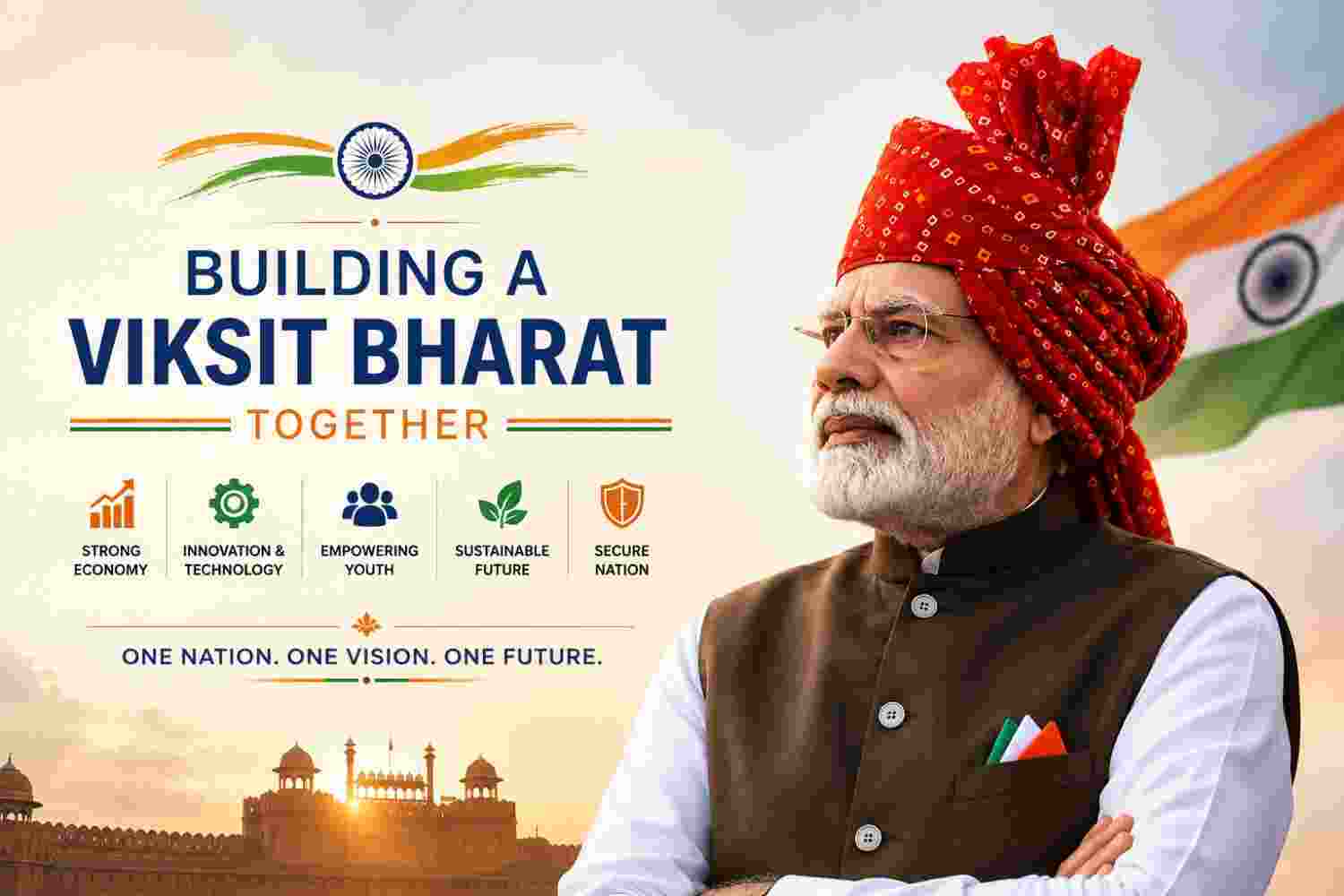
Prime Minister Narendra Modi’s Independence Day 2026 address from the Red Fort presented more than a development roadmap. His ‘Shakti Ki Saptdhara’ — seven streams of strength — also offered clues about the sectors that could shape India’s next employment cycle.
The framework brings together manufacturing, agriculture, technology, infrastructure, defence, the green and blue economy, and India’s soft power. The common thread is clear: India’s future jobs are likely to emerge increasingly from sectors where technology, production, infrastructure and global demand intersect.
The real question, however, is whether this vision can translate into enough quality jobs, industry-linked skills and sustainable employment for India’s growing workforce.
1. Manufacturing: The Foundation of the Jobs Strategy
Manufacturing occupies a central position in the Saptdhara vision. Modi stressed that India needs to move beyond assembling products and develop complete value chains, from components and design to finished goods.
If this strategy succeeds, employment could expand across factory operations, engineering, product design, quality control, logistics, maintenance and supply-chain management.
The bigger opportunity lies in making India a reliable global manufacturing hub. That would potentially generate not only direct factory employment but also thousands of indirect jobs among suppliers, transporters, technology companies and service providers.
2. Agriculture: Turning Farms into Global Businesses
The second pillar focuses on agriculture and food production. Modi highlighted the potential of Indian products such as millets, spices, fruits and vegetables to reach international markets.
This signals a shift from viewing agriculture purely as farming to treating it as a wider economic ecosystem.
Future employment could therefore grow in food processing, packaging, cold-chain logistics, agricultural technology, exports, quality testing and supply-chain management.
The key challenge will be creating enough value addition outside traditional farm employment so that rural youth can participate in higher-income opportunities.
3. Artificial Intelligence and Technology: The New Employment Frontier
Technology could become one of the most transformative elements of the roadmap. The Prime Minister highlighted areas including artificial intelligence, robotics, data centres and next-generation technologies, while also speaking about India’s ambitions in 6G.
This could generate demand for AI specialists, software engineers, cybersecurity professionals, robotics experts, semiconductor talent, data professionals and technicians.
Importantly, the government has also announced an AI training initiative targeting one crore young people, indicating that skilling is expected to play a major role in preparing workers for technology-led employment.
4. Gati Shakti: Infrastructure Could Multiply Employment
India’s infrastructure expansion represents another major employment engine.
Expressways, high-speed rail, ports, logistics networks and digital connectivity require large workforces across construction, engineering, project management, transportation and operations.
Infrastructure also has a multiplier effect. Better connectivity can lower logistics costs, attract businesses and encourage new economic activity in smaller cities and industrial corridors.
Thus, Gati Shakti jobs could extend far beyond construction sites.
5. Defence Manufacturing: From Importer to Global Supplier
Defence is another sector where self-reliance could create specialised employment.
Also Read: Indonesia Earthquake: At Least 20 Dead After Powerful 7.7 Quake Rocks Flores
The government’s emphasis on domestic defence production, drones and counter-drone technologies points towards opportunities in aerospace engineering, electronics, advanced manufacturing, software and research.
If India develops a competitive defence-export ecosystem, employment could expand across both large manufacturers and smaller technology-driven suppliers.
6. Green and Blue Economy: Jobs Beyond Traditional Energy
Green hydrogen, renewable energy and energy storage are increasingly becoming strategic industries. India’s transition towards cleaner energy could create jobs in manufacturing, installation, engineering, research and maintenance.
At the same time, the blue economy — covering fisheries, coastal tourism and ocean-related technologies — offers another employment frontier.
This pillar is particularly significant because it combines economic expansion with sustainability.
7. Soft Power: The Rise of Creative and Digital Jobs
Perhaps the most unconventional part of Saptdhara is the focus on India’s soft power.
Yoga, handicrafts, films, animation, gaming and digital content represent an expanding creative economy. These industries can create opportunities for designers, animators, filmmakers, developers, artists, content creators and tourism professionals.
The global nature of digital distribution also means Indian creative talent can potentially earn from international markets without physically relocating.
The Bigger Employment Question
Saptdhara provides a broad map of where India could seek its next wave of growth. But identifying sectors is only the beginning.
The decisive factor will be whether education and skilling systems can keep pace with changing industry requirements. Manufacturing needs technically trained workers; AI requires advanced digital skills; green energy needs specialised engineers; and the creative economy demands a combination of technology and artistic capabilities.
India’s jobs challenge, therefore, is not simply about creating more employment. It is about creating productive, well-paid and future-ready employment.
If investments, infrastructure, private enterprise and skill development move together, Modi’s Saptdhara could become more than a seven-point economic vision. It could provide the foundation for a broader transformation of India’s employment landscape — from traditional jobs towards technology-driven, globally connected and innovation-led careers.
The success of the roadmap will ultimately be measured not by the number of sectors identified, but by how many young Indians can turn these emerging opportunities into stable livelihoods.
Click here to join our WhatsApp Channel for real-time news updates and exclusive coverage.