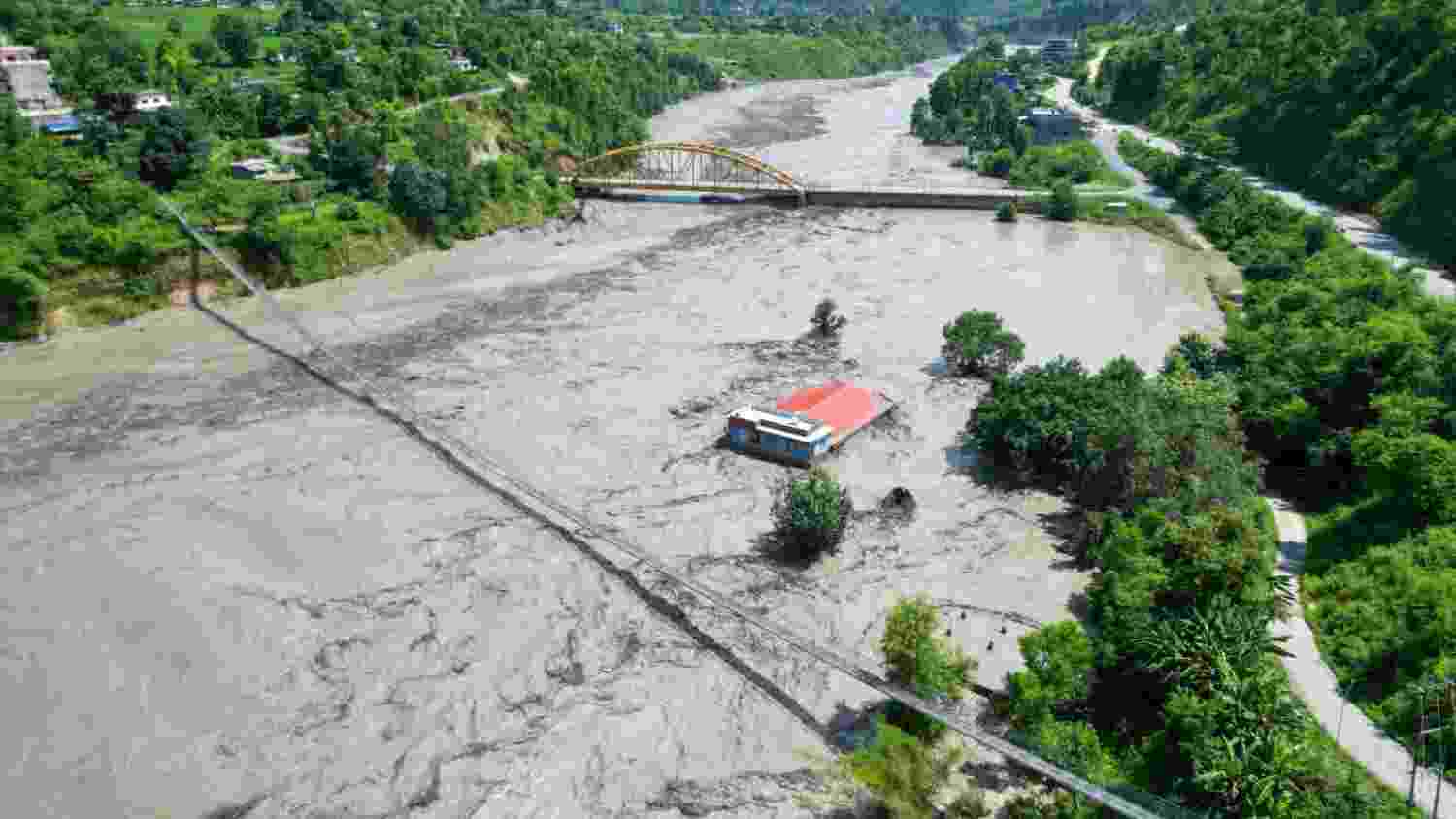
A devastating flash flood swept through Nepal’s northern Rasuwa district near the Tibet border on Wednesday, killing at least 22 people and leaving nearly 400 people missing. Among those reported missing are 133 Indian nationals, according to the latest India Today report.
The disaster unleashed a massive torrent of water, mud and rocks through settlements along the Bhote Koshi River, destroying homes, vehicles, bridges and infrastructure projects. The scale of destruction has triggered a major search-and-rescue operation, while authorities have warned residents downstream to move to safer locations.
Flash Flood Ravages Rasuwa
The flash flood struck the Rasuwa district, particularly the areas around Timure and Syapru Besi, close to Nepal’s border with Tibet. Officials said the surge entered the Bhote Koshi River from the Tibetan side at around 9 am.
The powerful flow swept away settlements, vehicles and other property, while a border market and customs facilities were also extensively damaged. The Friendship Bridge at Rasuwagadhi, which had been rebuilt following last year’s deadly flooding, was again washed away.
Local officials warned that the full extent of the destruction was still being assessed and that the death toll could rise as rescue teams reach areas that remain inaccessible.
133 Indians Among Missing
The humanitarian crisis has raised particular concern in India because a large number of Indian travellers are among those unaccounted for.
According to the latest update carried by India Today, 133 Indians are among nearly 400 people reported missing after the flash floods. Earlier information cited by Reuters had put the number of missing travellers at 384, including 105 Indians, highlighting that casualty and missing-person figures were continuing to change as authorities compiled and verified information.
The missing people include tourists and travellers from several countries. Rescue authorities are working to establish the identities and locations of those who remain unaccounted for.
The situation is particularly difficult because several roads and bridges have been destroyed, while floodwaters and debris have blocked access to some of the worst-hit locations.
Possible Earthquake and Avalanche Link
Authorities are investigating what triggered the sudden and destructive surge.
The German Research Centre for Geosciences reported that a 4.4-magnitude earthquake occurred roughly seven minutes before the timestamp seen on security footage showing the catastrophic torrent near the border.
Experts have suggested that an ice-rock avalanche may have entered the Lhende Khola river system and triggered the enormous downstream surge. However, officials and scientists have stressed that the precise cause has not yet been conclusively established.
There is also concern that the danger may not be over. Experts have warned that a blockage remains upstream along the Nepal-China border river. If that blockage collapses or is swept away, another major flood could occur.
Rescue Operations Hampered
Nepal’s police, Army and Armed Police Force have been deployed for search and rescue operations. However, the difficult terrain and high water levels have severely complicated efforts.
Army helicopters were sent toward the affected region, but they could not land in Syapru Besi and Timure because floodwaters remained dangerously high. Nine Armed Police Force personnel stationed in Timure were also reported missing.
Also Read — Nepal Flash Flood Horror: PM Modi Assures Full Support, Death Toll Rises To 9
The destruction of roads and bridges has further slowed ground-based rescue operations. Authorities have urged people living along the Bhote Koshi and Trishuli riverbanks to evacuate vulnerable areas and remain alert.
Hydropower Projects Severely Damaged
The disaster has also dealt a major blow to Nepal’s infrastructure and electricity network.
According to Nepal’s Energy Ministry, approximately 430 MW of electricity supply was affected, primarily because of damage to hydropower infrastructure. This represents more than 12 per cent of Nepal’s total installed hydropower capacity of around 3.2 GW.
Several roads, bridges and project sites were either damaged or swept away by the powerful floodwaters, adding to the economic impact of the disaster.
Flood Threat Moves Downstream
As the floodwater moved downstream into the Trishuli river basin, authorities issued warnings for several districts, including Nuwakot, Dhading, Gorkha and Chitwan.
The Bhote Koshi originates in Tibet and flows through Nepal before joining the Trishuli river system, which eventually enters India as the Gandak. The downstream movement of floodwaters has therefore also raised concerns in India.
Bihar has stepped up vigilance because several rivers flowing from Nepal enter the state. Authorities in vulnerable districts have been directed to closely monitor water levels and prepare for any deterioration in the situation.
PM Modi Offers India’s Support
Prime Minister Narendra Modi spoke with Nepal Prime Minister Balendra Shah and expressed condolences over the loss of lives. Modi assured Nepal of India’s support and offered all possible humanitarian and relief assistance.
India is coordinating with Nepal as rescue and relief operations continue. India is also preparing to send relief material to Nepal through two flights, according to sources cited by India Today.
With rescue teams still struggling to access some of the hardest-hit areas, authorities remain on high alert. The rapidly changing situation, the threat of another flood and the large number of missing travellers—including 133 Indians in the latest India Today update—have intensified concerns over the humanitarian crisis unfolding along the Nepal-Tibet border.
Click here to join our WhatsApp Channel for real-time news updates and exclusive coverage.