
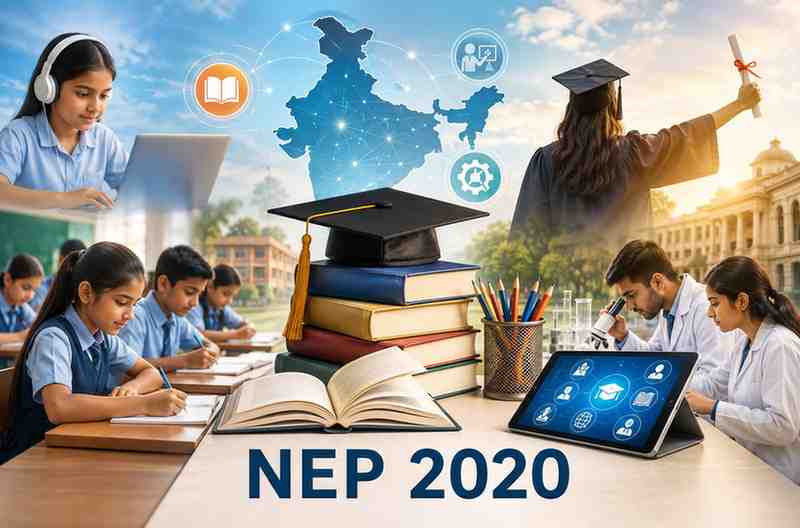
The National Education Policy (NEP) 2020 has triggered a wide-ranging transformation in India’s school and higher education sectors, with the government introducing several reforms aimed at improving quality, accessibility, flexibility, digital learning and employability.
Since the announcement of NEP 2020, the Centre, state governments and education regulators have undertaken multiple initiatives to translate the policy’s vision into action. The reforms span foundational learning, teacher training, digital education, vocational skills, higher education mobility and technology-driven academic administration.
Education is a subject under the Concurrent List, making cooperation between the Centre and states essential for implementing the policy. The Ministry of Education, along with bodies such as the University Grants Commission (UGC), All India Council for Technical Education (AICTE), National Council of Educational Research and Training (NCERT), National Council for Teacher Education (NCTE) and Central Board of Secondary Education (CBSE), has been working on different aspects of NEP implementation.
Major Reforms Transforming School Education
Several flagship programmes have been introduced to strengthen school education under the NEP framework. The PM SHRI (PM Schools for Rising India) initiative focuses on upgrading selected schools and developing them as model institutions aligned with the vision of NEP 2020.
Samagra Shiksha continues to support quality, inclusive and equitable education from pre-school to Class XII. The scheme provides assistance for infrastructure, classrooms, laboratories, libraries, hostels, drinking water, sanitation, smart classrooms, ICT laboratories and digital learning resources.
The NIPUN Bharat mission focuses on foundational literacy and numeracy, with the objective of ensuring that children attain essential reading, writing and mathematical skills by Grade 3. Vidya-Pravesh has also been introduced as a three-month play-based school preparation module for young learners.
The National Curriculum Framework for Foundational Stage and the Jadui Pitara initiative promote play-based learning for children aged three to eight years. Teacher development has also received attention through NISHTHA programmes, while Vidya Samiksha Kendras are being used to strengthen monitoring and data-driven decision-making.
The government has also implemented the New India Literacy Programme, known as ULLAS, targeting non-literate people aged 15 years and above.
Digital Education Expands Across India
Technology has emerged as a major component of the NEP 2020 implementation strategy. Under Samagra Shiksha, financial assistance is provided to states and Union Territories for ICT infrastructure, including smart classrooms and ICT laboratories, based on approved Annual Work Plans and Budgets.
The Digital Infrastructure for Knowledge Sharing (DIKSHA) platform has become a major digital education initiative. Designed as a One Nation, One Digital Platform, DIKSHA provides school-level educational content along with QR-coded Energised Textbooks for different grades.
A key feature of DIKSHA is its ability to support both online and offline learning. Students can download educational material and continue studying even when internet connectivity is unavailable, helping address the digital divide.
PM e-VIDYA has also brought together multiple digital, online and broadcast-based education initiatives to provide students with access to learning resources through different modes.
The government announced in Budget 2025 that broadband connectivity would be extended to all government secondary schools in rural areas under the BharatNet project through BSNL in a phased manner.
Digital learning is also expanding in higher education through platforms such as SWAYAM, SWAYAM Prabha, e-PG Pathshala and the UGC e-resource portal. According to the government, 126 Higher Educational Institutions are offering around 802 online programmes, while 121 institutions are offering approximately 1,699 Open and Distance Learning programmes.
Higher Education Gets Greater Flexibility and Mobility
NEP 2020 has introduced significant changes in higher education, with greater emphasis on flexibility, multidisciplinary learning and student mobility.
The National Credit Framework (NCrF) and National Higher Education Qualifications Framework (NHEQF) have been developed to facilitate the integration of academic, vocational and experiential learning. The Academic Bank of Credits enables students to accumulate and transfer academic credits, supporting greater flexibility in pursuing higher education.
The policy framework also supports multiple entry and exit options in undergraduate programmes. Students can pursue different academic pathways and receive appropriate recognition for their learning. Higher Educational Institutions are also being encouraged to become multidisciplinary institutions.
Other reforms include provisions allowing students to pursue two academic programmes simultaneously, revised regulations for online and distance education, and integration of technology into institutional administration through the SAMARTH platform.
The APAAR ID has been introduced as a lifelong academic identity for students, enabling their educational journey and achievements to be tracked from pre-primary education through higher education.
The PM-Vidyalaxmi scheme has also been introduced to provide financial support to meritorious students, including collateral-free and guarantor-free education loans through a digital application process.
India has further expanded international academic collaboration by allowing partnerships between Indian and foreign institutions for twinning, joint and dual degree programmes. Regulations have also been introduced to facilitate the establishment of campuses of foreign higher education institutions in India.
Skills, Vocational Education and Infrastructure Gain Focus
NEP 2020 places strong emphasis on linking education with vocational training and employability. At the school level, skill education has been integrated into Samagra Shiksha, with NSQF-aligned courses being offered to students of Classes IX to XII.
Also Read- “Reprehensible Act”: India Demands Action After Indian Embassy Is Defaced In Slovenia
Students are being exposed to communication, self-management, ICT, entrepreneurship and green skills. For Classes VI to VIII, the policy promotes pre-vocational exposure through Bagless Days, internships with local vocational experts and experiential learning.
In higher education, UGC guidelines support Internship/Apprenticeship Embedded Degree Programmes, enabling students to gain practical industry experience alongside academic learning.
AICTE has also been strengthening skill development through industry partnerships, online courses, internships, vocational programmes and exposure to Industry 4.0 technologies. The SWAYAM Plus portal has been launched to promote workforce upskilling and reskilling, with more than 500 courses developed or curated with 89 industry partners across 17 sectors. More than six lakh students have registered on the platform.
The National Apprenticeship Training Scheme further connects graduates and diploma holders with industry through structured on-the-job training.
Infrastructure development remains another key component. PM-USHA, the third phase of the Rashtriya Uchchatar Shiksha Abhiyan, was launched in June 2023 with an outlay of Rs 12,926.10 crore to strengthen higher education institutions, particularly in educationally underserved areas.
The government has also announced the Bharatiya Bhasha Pustak Scheme in Budget 2025-26 to make educational books available digitally in 22 Indian languages.
In Budget 2026-27, the government announced plans to establish one girls’ hostel in every district through viability gap funding or capital support to encourage greater enrolment of girls in STEM institutions and courses.
The developments underline the government’s broader effort to implement NEP 2020 through coordinated reforms covering foundational education, technology, skills, infrastructure and higher education. The information was provided by Minister of State for Education Dr Sukanta Majumdar in a written reply in the Lok Sabha.
Click here to join our WhatsApp Channel for real-time news updates and exclusive coverage.