
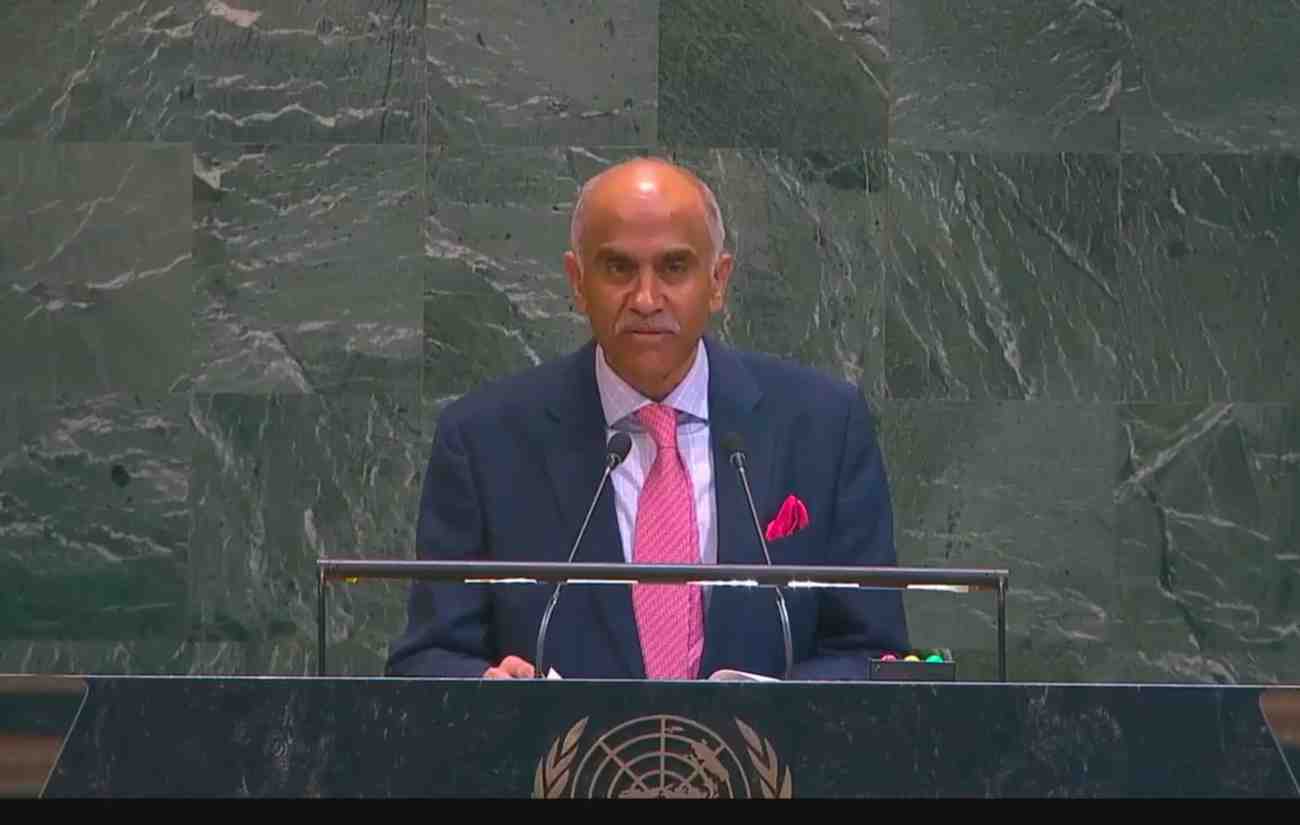
India mounted a sharp diplomatic response to Pakistan at the United Nations General Assembly (UNGA), firmly rejecting Pakistan’s remarks on Jammu and Kashmir and reiterating that the Union Territory remains an integral and inalienable part of India. The response came during discussions on the Annual Report of the United Nations Security Council, where Pakistan once again raised the Kashmir issue.
India’s Permanent Representative to the United Nations, Ambassador Parvathaneni Harish, used the Right of Reply to counter Pakistan’s assertions. Addressing the General Assembly, Harish stated that Jammu and Kashmir “was, is and will always remain” an integral part of India. He described Pakistan’s comments as baseless and inconsistent with historical facts, asserting that repeated attempts to question India’s sovereignty over the region would not alter reality.
The Indian envoy’s remarks came after Pakistan’s Permanent Representative to the UN, Asim Iftikhar Ahmad, referred to Jammu and Kashmir during his address on the Security Council’s annual report. India strongly objected to what it called an “unwarranted reference” to an issue that New Delhi considers strictly internal.
Harish accused Pakistan of repeatedly misusing international platforms to pursue divisive political objectives. According to India, Islamabad has frequently attempted to internationalise the Kashmir issue at multilateral forums despite New Delhi’s consistent position that the matter is internal and not subject to external intervention.
In his statement, the Indian envoy also criticised Pakistan’s conduct as a non-permanent member of the UN Security Council. He alleged that Pakistan had used its position to circulate misleading communications and promote narratives that do not reflect facts on the ground. Harish stressed that membership of the Security Council carries significant responsibilities and should not be used as a platform for advancing partisan or misleading claims.
India maintained that Pakistan’s repeated references to Jammu and Kashmir are part of a long-standing pattern aimed at drawing international attention to an issue that New Delhi considers settled. The government has consistently argued that constitutional and administrative matters related to Jammu and Kashmir fall entirely within India’s sovereign jurisdiction.
The exchange marked yet another chapter in the continuing diplomatic rivalry between the two neighbours at international forums. Over the years, India and Pakistan have frequently clashed at the United Nations over Kashmir, with each side using diplomatic channels to defend its position. However, India has repeatedly rejected attempts to raise the issue at global platforms, insisting that bilateral matters should not be politicised in multilateral institutions.
Beyond the Kashmir issue, India also used the occasion to renew its demand for comprehensive reforms of the United Nations Security Council. Harish argued that the current structure of the Council reflects geopolitical realities of 1945 rather than the contemporary international order. He said the existing framework has struggled to effectively address modern global challenges and therefore requires substantial reform.
The Indian representative emphasized that meaningful reform must include expansion in both permanent and non-permanent categories of membership. According to India, merely increasing the number of temporary members would not be sufficient to make the Security Council more representative, democratic and effective.
India has long advocated reforms through the G4 grouping, which also includes Brazil, Germany and Japan. The group argues that the Security Council should better reflect current geopolitical realities and provide greater representation to emerging powers and developing nations.
The latest exchange at the UN underscores the persistence of diplomatic tensions between India and Pakistan, particularly over Jammu and Kashmir. While Pakistan continues to raise the issue in international forums, India remains firm in its position that the Union Territory is an inseparable part of the country and that no external commentary can alter that reality. The strong response delivered at the UNGA once again highlighted New Delhi’s determination to defend its territorial integrity while simultaneously pushing for broader reforms within the United Nations system.