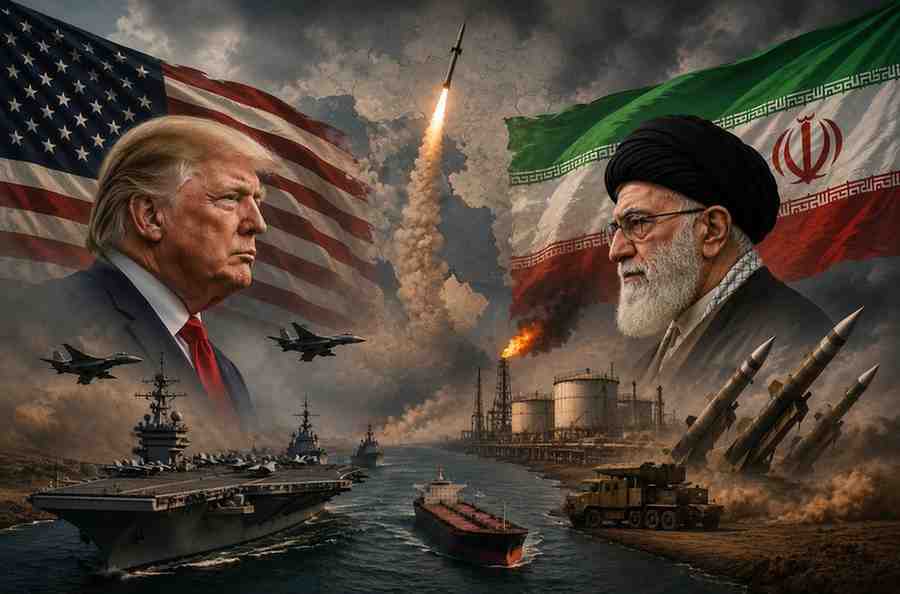
Washington/Tehran: The ongoing conflict between the United States and Iran witnessed fresh escalation on Sunday as Iranian leaders issued strong warnings against American and Israeli interests in the region, while diplomatic efforts to secure a lasting ceasefire continued to face major obstacles. The developments have heightened concerns about regional stability, global energy supplies, and the future of peace negotiations in the Middle East.
Iran’s senior negotiator and Parliament Speaker Mohammad Bagher Ghalibaf accused the United States of failing to honor ceasefire commitments and warned that American military installations across the region could become legitimate targets. His remarks came shortly after Israeli forces carried out airstrikes on Hezbollah-linked locations in Beirut’s southern suburbs, a move that further inflamed tensions.
The latest confrontation follows months of conflict that began earlier this year and has since evolved into a wider regional crisis involving multiple countries. Although indirect talks have been underway to reach a comprehensive settlement, negotiators have yet to agree on key issues, including sanctions relief, Iran’s nuclear activities, and the reopening of the strategically important Strait of Hormuz.
US President Donald Trump defended his administration’s military actions, rejecting criticism that the conflict contradicted his previous opposition to foreign wars. In a recent interview, Trump stated that he had never guaranteed the absence of military conflicts and emphasized that the United States would continue to maintain a strong defense posture. He also indicated that sanctions relief for Iran would only be considered after significant progress in negotiations.
The Strait of Hormuz remains at the center of the dispute. The waterway is one of the world’s most critical energy routes, carrying a substantial share of global oil and gas shipments. Iranian officials have suggested imposing conditions and timelines for reopening the passage, while the United States has maintained military operations aimed at securing maritime traffic. Recent reports indicate that American forces struck Iranian coastal radar installations after intercepting drones allegedly headed toward the strategic shipping corridor.
The conflict has also had a direct impact on neighboring Gulf nations. Bahrain and Kuwait recently reported missile and drone threats linked to the escalating standoff. Although most projectiles were intercepted, the incidents triggered security alerts and raised fears of a broader regional confrontation. Iran has maintained that its actions were responses to what it views as violations of ceasefire arrangements and continued military pressure from Washington and its allies.
Meanwhile, Israel’s operations against Hezbollah in Lebanon have added another layer of complexity to the crisis. Israeli forces have conducted strikes targeting what they describe as militant infrastructure, while Iranian officials and allied groups have vowed retaliation. The renewed violence has increased concerns that the conflict could expand beyond the US-Iran dispute and draw additional regional actors into hostilities.
Efforts to revive diplomatic momentum have involved several regional players. Pakistan has reportedly engaged in mediation efforts and delivered messages between leaders in Tehran and Islamabad as part of broader attempts to reduce tensions. However, major disagreements remain unresolved, particularly regarding sanctions, frozen Iranian assets, and Tehran’s nuclear program.
Economic consequences are also becoming increasingly visible. Investors across Gulf markets reacted negatively to the latest escalation, with stock indices in several countries declining amid fears of prolonged instability. Energy markets remain sensitive to developments around the Strait of Hormuz, while international organizations have warned that a prolonged conflict could worsen global economic pressures and disrupt food and fuel supplies.
As diplomatic channels remain open but fragile, both sides continue to exchange threats while preparing for potential future confrontations. With military operations, regional rivalries, and strategic economic interests all intersecting, the Middle East remains on edge as the world watches for signs of either a breakthrough in negotiations or a further escalation of the crisis.