In the historic city of the Gaekwads, a journey through the courtesy of Indian Railways where history, nature, faith and the new face of development came together
Gujarat, the home state of Prime Minister Narendra Modi, is a land where history, culture, commerce, industry, spirituality and modern development come together in remarkable ways. My recent journey to Vadodara, one of Gujarat’s most historic cities, was therefore much more than a routine visit. It became a journey across time—from a glorious royal past to a rapidly transforming present, and from the present towards a future being shaped by modern infrastructure and the changing face of Indian Railways.
Vadodara’s Royal Legacy and the Gaekwad Era
During a media coverage tour organised through the courtesy of Indian Railways in connection with the Dedicated Freight Corridor and double-decker container transportation, we had the opportunity to experience Vadodara from relatively close quarters. We had travelled with the professional purpose of observing and reporting on the new dimensions of railway development. Yet the city gradually revealed another side of itself—one that cannot be fully understood through statistics, official documents or history books alone.
Vadodara does not merely witness development. It carries its history into the present.
Situated on the banks of the Vishwamitri River, the city has evolved through several historical periods and identities. With the rise of the Maratha Gaekwad rulers, Vadodara emerged as an important political and administrative centre. Under Maharaja Sayajirao Gaekwad III, the city acquired an even more distinctive character. His emphasis on education, art, literature, social reform, libraries, museums and public institutions helped establish Vadodara among the more progressive princely states of India.
The legacy of that era remains visible across the city. The political system has changed, monarchy has disappeared and generations have passed, but the footprints of history remain deeply embedded in Vadodara’s architecture and cultural landscape.
The most imposing expression of this royal legacy is the Laxmi Vilas Palace. Spread across an expansive complex, the palace reflects a fascinating fusion of Indian and European architectural traditions. Its grandeur is not confined to its enormous scale. It can also be seen in its intricate design, artistic detailing and craftsmanship.
Built during the reign of Maharaja Sayajirao Gaekwad III, the palace speaks of an age when architecture, art and public life were closely connected with the vision of governance. Standing before such a magnificent structure, one is naturally led to reflect on the larger legacy of the Gaekwads. Their contribution was not limited to royal buildings or ceremonial grandeur. Education and social reform were equally important elements of their vision.
Maharaja Sayajirao Gaekwad’s contribution to the expansion of education and social development remains an important chapter in the history of Vadodara. His progressive outlook helped shape the foundations of a modern city. In that sense, travelling through Vadodara is not simply a journey through palaces and monuments. It is also a journey through ideas that sought to transform society.
Vishwamitri River and the City’s Natural Heritage
The city’s natural environment added yet another dimension to the experience.
The Vishwamitri River, flowing through the urban landscape, is closely associated with Vadodara’s identity. What particularly caught my attention was the presence of crocodiles in and around the river. It is unusual to encounter such wildlife within a major urban setting. Yet Vadodara presents this remarkable coexistence of city life and nature.
The sight and story of the crocodiles also offered a reminder that development cannot be measured only through roads, buildings and transportation networks. Rivers, lakes, greenery and wildlife are equally important components of a city’s character. The challenge before modern India is not simply to build faster, but to ensure that development and nature can continue to coexist.
Sursagar Lake and Vadodara’s Spiritual Character
As the day’s railway coverage and travel came to an end, Vadodara revealed another face at sunset.
At Sursagar Lake, located in the heart of the city, the atmosphere changed completely. The historic water body, surrounded by the city’s vibrant life, seemed to create a quiet space of its own. Rising majestically from the middle of the lake is the imposing statue of Lord Shiva.
As daylight gradually faded, the city lights began to appear. Their reflections shimmered across the calm waters of the lake, while the towering figure of Lord Shiva stood in the centre, creating a scene that was both majestic and deeply spiritual.
As a journalist, I naturally viewed the scene as a striking visual. But as a traveller, the experience went beyond what the camera could capture. It felt as though the city’s history and its spiritual identity were silently conversing with modern urban life.
The journey also brought us to a magnificent temple complex associated with the Swaminarayan tradition. The evening illumination, architectural beauty and devotional atmosphere created a fitting conclusion to a day that had begun with discussions of freight corridors, rail infrastructure and economic development.
Also Read: UN Praises Iran-UAE BRICS Meeting, Sees India As Key Bridge-Builder
For a few moments, the noise and urgency of modern infrastructure gave way to silence and reflection. It was in that contrast that the deeper meaning of India’s diversity became particularly visible.
From Royal Heritage to Modern Railway Development
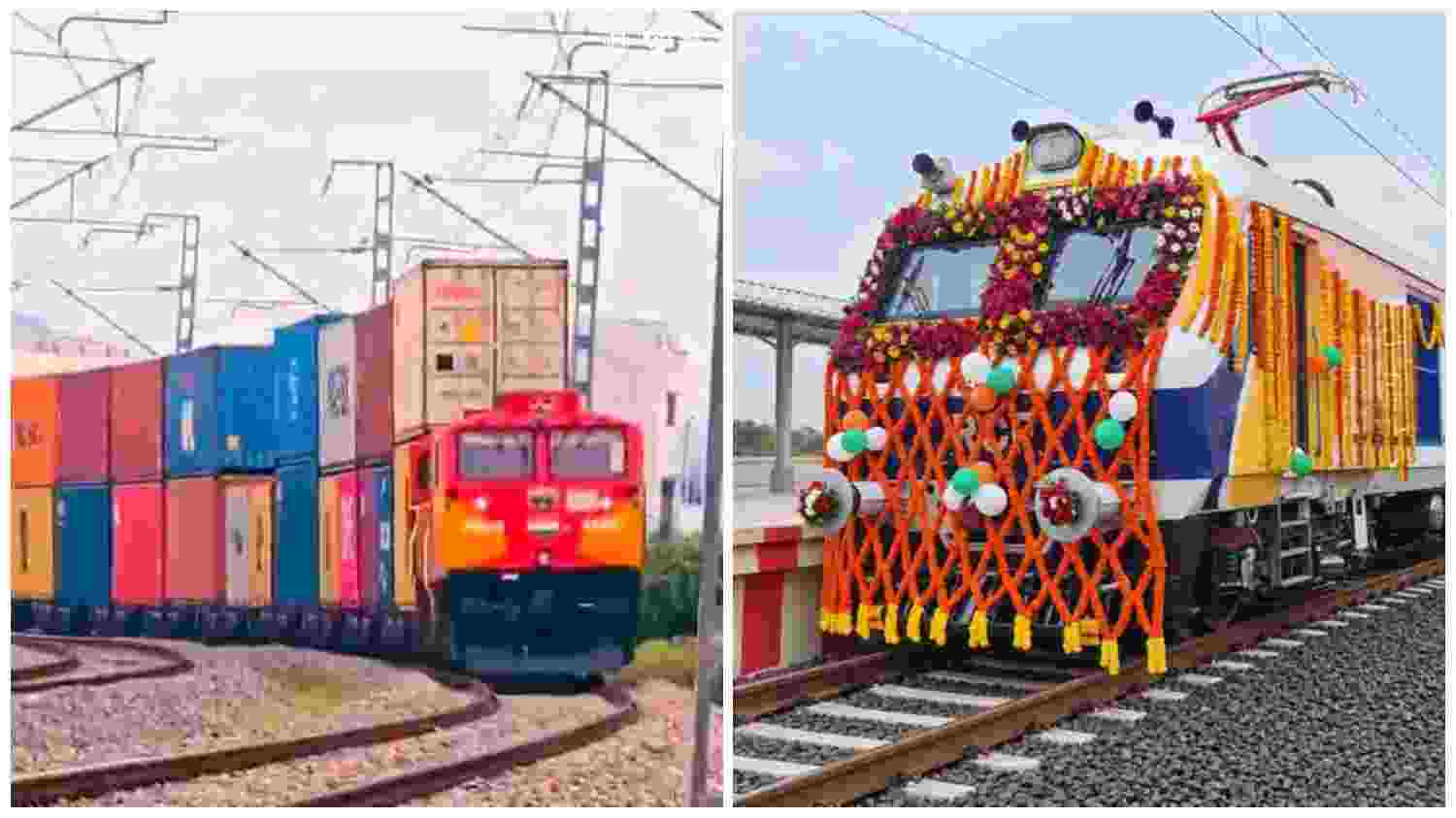
In the course of a single journey, I encountered two very different but equally important images of India. On one side was the Dedicated Freight Corridor, representing speed, efficiency and the transformation of freight transportation. Alongside it was the image of the double-decker container train, symbolising the increasing capacity and modernisation of India’s logistics network.
On the other side stood the heritage of the Gaekwads—the palace, the river, the lake, the temple, the presence of wildlife and the living traditions of faith.
At first glance, these may appear to belong to different worlds. In reality, they form a single picture of contemporary India.
There was a time when goods moved across the country through bullock carts and traditional trade routes. Today, India is building dedicated freight corridors and adopting high-capacity container transportation to move goods faster and more efficiently. This transformation is not merely about railways. It is directly linked with the country’s economic growth, logistics efficiency and emerging infrastructure capabilities.
PM Modi Tells Xi: Border Peace Vital As Differences Must Not Become Disputes
To see these two eras together in Vadodara was perhaps the most memorable part of the journey.
The city’s royal past reminded us of a period when rulers invested in education, culture and institutions. The modern railway reminded us of an India investing in infrastructure, connectivity and economic capacity.
Between the two lies a powerful idea: progress does not necessarily require the past to be erased. India’s strength lies in its continuity.
Here, history does not end when the future begins. The future does not have to destroy the past in order to move forward. Instead, both can travel together.
The palace narrates history. The temple inspires faith. The river and its crocodiles remind us of nature. Sursagar preserves a sense of serenity in the heart of an urban landscape. And the modern railway points towards the future.
A Journey Connecting History, Heritage and a New India
For me, this journey from the royal heritage of the Gaekwads to the double-decker container train became special because it combined two dimensions of my profession and personality—the responsibility of a journalist and the curiosity of a traveller.
The media tour arranged through the courtesy of Indian Railways provided an opportunity to observe railway development from close quarters. At the same time, it offered a chance to understand Vadodara beyond railway tracks and project statistics—to experience its history, culture, spirituality and natural environment.
When the time came to leave the city, several images remained alive in my mind: the grandeur of the palace, the flowing Vishwamitri, the unexpected presence of crocodiles, the tranquil waters of Sursagar, the towering Shiva statue and the evening glow of the Swaminarayan temple. Alongside all these images was another—the double-decker container train moving with purpose on the Dedicated Freight Corridor. Perhaps that is the real beauty of Vadodara.
It is not merely a city of kings and palaces. It is a city where tradition and modernity meet without losing their individual identities. Here, history continues to breathe, nature continues to speak, faith continues to touch the human spirit, and the railway of development continues to move towards the future.
As I returned from Vadodara, one thought stayed with me: to understand India, it is not enough to look only at its metropolitan cities, expressways, industrial corridors and modern infrastructure projects. We must also look at the historic cities where the foundations laid by earlier generations are becoming the platform for a new India. Vadodara is one such city.
Here, the legacy of the Gaekwads and the new momentum of Indian Railways can be seen not as opposing forces, but as two chapters of one continuing story. That is the lasting memory of this journey. That is the distinctive identity of Vadodara.
And perhaps, in its own quiet way, it is also a portrait of a new India—an India that is moving ahead on the new tracks of development while carrying its history, heritage, nature and faith along with it.
Click here to join our WhatsApp Channel for real-time news updates and exclusive coverage.