What began as an economic idea has evolved into one of the most consequential platforms of emerging economies. The term BRIC was coined by economist Jim O’Neill in 2001, when he identified Brazil, Russia, India and China as economies with growing potential to reshape the global economic landscape. The grouping gradually moved from an investment concept to a political and economic forum, holding its first leaders’ summit in Yekaterinburg, Russia, in 2009.
The entry of South Africa in 2011 transformed BRIC into BRICS and broadened its representation. Its agenda also expanded beyond economics to three broad areas: political and security cooperation, economic and financial cooperation, and cultural and people-to-people exchanges. The creation of the New Development Bank (NDB) in 2015 added an important institutional dimension to this cooperation.
BRICS is now considerably larger and more diverse. Its 11 members are Brazil, China, Egypt, Ethiopia, India, Indonesia, Iran, Russia, Saudi Arabia, South Africa and the United Arab Emirates. Together, they account for about 49.5% of the world’s population, 40% of global GDP and 26% of global trade. Their presence across Asia, Africa, the Middle East and Latin America gives the grouping substantial demographic, economic and strategic weight. But greater size has also brought greater complexity.
India’s 2026 Presidency
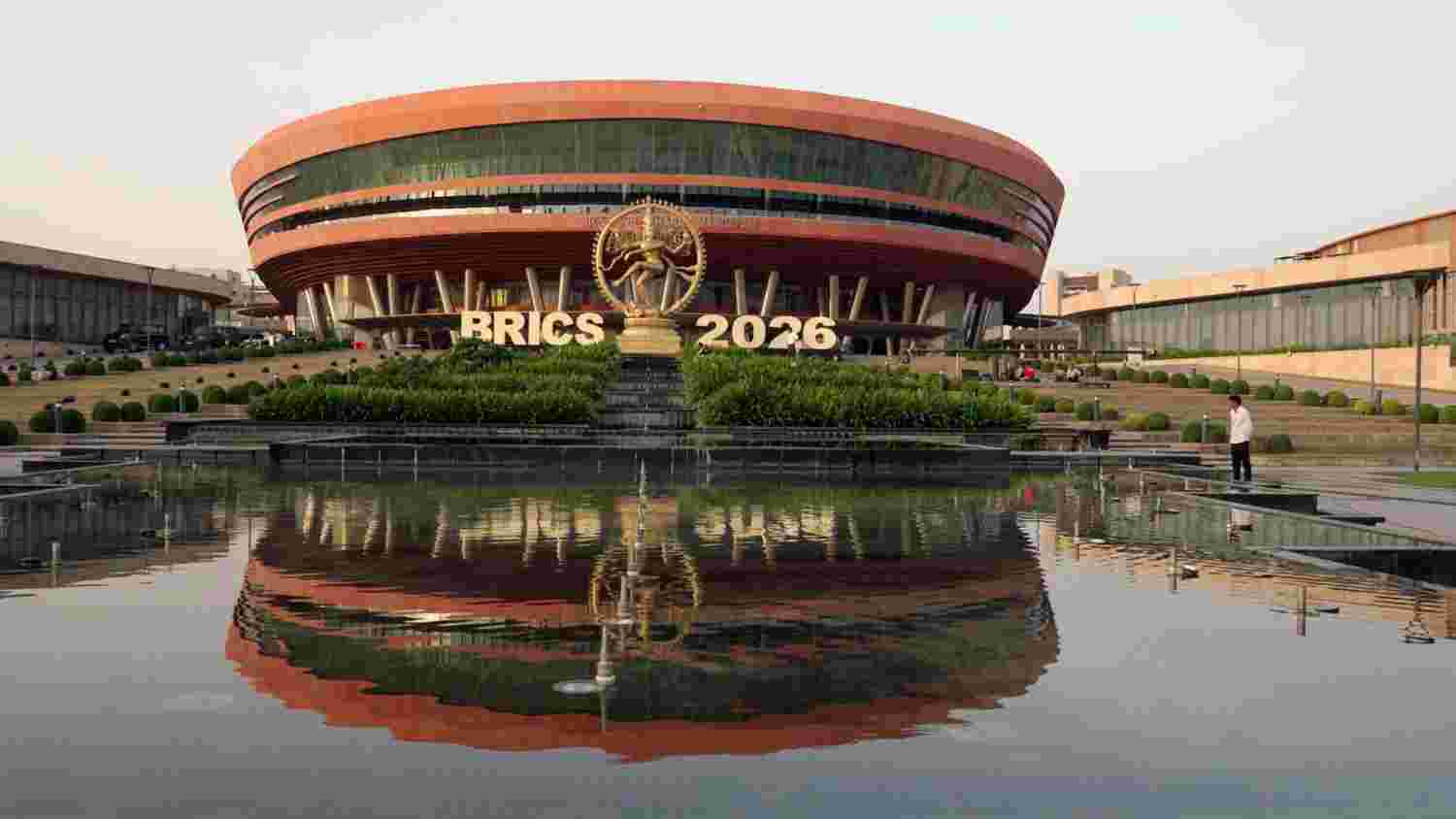
Under its 2026 Presidency, India will host the 18th BRICS Summit in New Delhi on September 12–13. This marks India’s fourth BRICS chairship. New Delhi has chosen the theme “Building for Resilience, Innovation, Cooperation and Sustainability”, reflecting its stated emphasis on institutional effectiveness, development, sustainability and innovation, while seeking to strengthen BRICS as a constructive and solutions-oriented forum.
The timing is significant. As BRICS has expanded, debates over its future direction have become sharper. One question is whether the grouping should evolve into a stronger geopolitical counterweight to Western-led institutions or remain primarily a platform for cooperation among emerging and developing economies. For India, this distinction matters.
New Delhi’s foreign-policy approach is rooted in strategic autonomy and multi-alignment. India maintains important relationships with Western countries while also engaging Russia, China and the wider Global South. From this perspective, turning BRICS into an explicitly anti-Western bloc could narrow India’s diplomatic space and make the grouping less attractive to countries that want greater representation in global governance without joining another geopolitical camp.
Reformed Multilateralism and Financial Cooperation
India therefore has an opportunity to strengthen BRICS around the principle of reformed multilateralism. Rather than seeking to replace existing global institutions, BRICS can push for greater voice and representation for developing countries within bodies such as the United Nations, IMF and WTO. This would align more closely with India’s long-standing call for a fairer and more representative international order.

Financial cooperation illustrates the need for a pragmatic approach. BRICS members have explored ways to increase the use of local currencies and reduce vulnerabilities arising from dependence on existing financial arrangements. For India, however, practical measures such as local-currency settlements, interoperable payment systems and digital financial infrastructure may offer greater value than an ambitious common currency project that could create new asymmetries among members.
DRI Seizes 41 Kg Smuggled Gold Worth ₹62 Crore In Major Crackdown
The larger challenge is cohesion. As membership has expanded, differences in national interests and geopolitical positions have become harder to manage. Regional disputes or disagreements over international conflicts can easily overshadow areas where BRICS members share common interests. The grouping’s credibility will ultimately depend on whether it can manage such differences without allowing them to paralyse cooperation.
Building a More Action-Oriented
India’s 2026 chairship provides an opportunity to focus BRICS on areas with tangible developmental benefits. Food and energy security, climate resilience, disaster management, health, digital public infrastructure, technology and sustainable development can help translate the grouping’s political weight into practical outcomes. Recent BRICS initiatives have already included cooperation in areas such as digital public infrastructure, industrial technology and resilient supply chains, suggesting room for a more action-oriented agenda.
Also Read — Bharat Innovates 2026: India Showcases Deep-Tech Power Ahead Of BRICS Summit
The significance of the New Delhi summit, therefore, lies not simply in the size of BRICS but in the direction it chooses to take. India can demonstrate that the grouping does not have to become another rigid geopolitical bloc. It can remain an independent platform where diverse countries cooperate, defend their strategic autonomy and work collectively for a more representative international system.
BRICS was born from an economic forecast about the rise of emerging economies. Its next chapter will depend on whether those economies can convert their growing collective weight into constructive global influence. For India, the task is to ensure that expansion becomes a source of strength rather than fragmentation-and that BRICS remains a platform for cooperation, development and meaningful reform of global governance.
Click here to join our WhatsApp Channel for real-time news updates and exclusive coverage.