
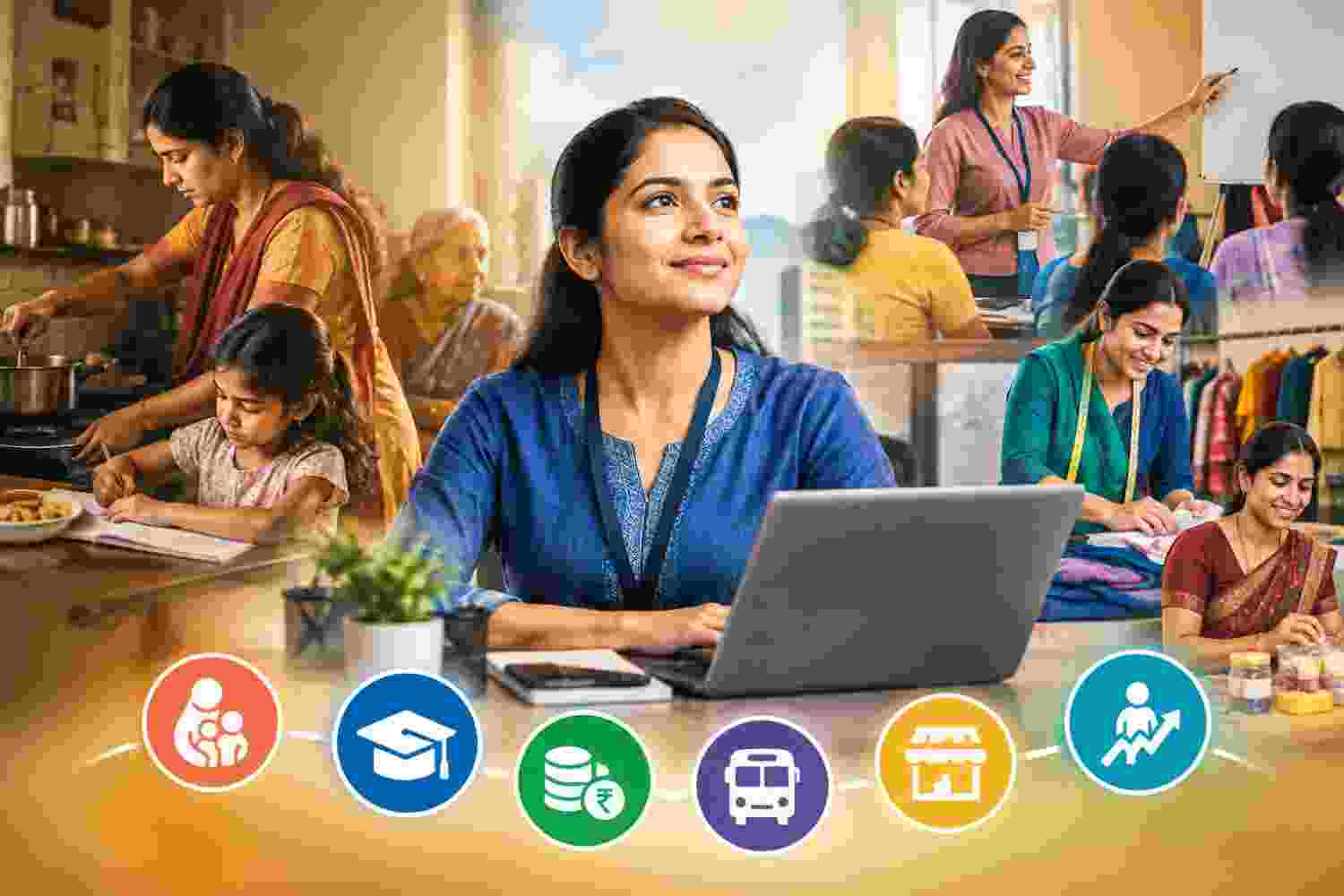
For years, companies doing social work for women have followed the same routine: scholarships, training workshops, self-help groups, small loans. These help — but they miss one big problem: the huge amount of unpaid housework and caregiving women do every day.
In India, 81.5% of women do unpaid housework daily, spending nearly 5 hours (289 minutes) on it, against 27.1% of men who spend just 88 minutes. For caregiving of children or elderly relatives, 34% of women spend 137 minutes a day, versus 17.9% of men at 75 minutes.
The result: only 40% of Indian women are part of the paid workforce, compared to 79.1% of men. Nearly half of the women who aren’t working say it’s because they’re stuck taking care of children or the household.
Why This Should Worry Business Leaders
This isn’t just a sad statistic — it’s a business problem. If companies train and hire women but ignore the unpaid work already weighing on their time, those efforts won’t stick. Women will drop out or never join at all. This matters most in industries like garments, retail, healthcare, and call centres, where a large share of the workforce is female.
The Government Gap — and Why Companies Are Stepping In
The government’s Palna scheme offers daycare for children aged six months to six years, with early learning, nutrition and health support. But by March 2025, only 1,761 of 11,395 approved centres were actually running. This gap is where private companies are stepping in.
Vedanta’s Nand Ghar runs nearly 13,000 childcare centres across 16 states, aiming to eventually reach 7 crore children and 2 crore women. Mobile Creches has reached over a million children through 20,000+ trained workers, 500+ industry partners, and 5,000+ supported centres. Both treat childcare as basic infrastructure — like roads or electricity — not charity.
What’s Actually Working

Mann Deshi Foundation combines loans, business training and market access together. It has supported over a million women, with 9 lakh reached through its business schools. Results: 94% of trained women earned more, average incomes rose 56%, 76% gained asset ownership, and among 1.3 lakh women given financial linkages, average monthly income jumped from ₹4,300 to ₹15,296. Others show the same pattern.
PRADAN reached 3.4 million households across 42,500 villages. Magic Bus reached 2.14 lakh youth in FY2024-25, 60% of them women. EnAble India placed nearly 26,000 people with disabilities into jobs across 1,725+ companies, by tackling training, accessibility and hiring together.
The Big Lesson: Do It All Together
One-off solutions don’t work. A training certificate is useless without childcare. A loan is useless without a way to sell your goods. Real change happens when childcare, skills, credit and market access arrive together.
Also Read: India-Belgium Ties Get Major Boost As PM Modi, De Wever Deepen Strategic Partnership
This applies beyond gender too. A person with a disability isn’t included just by handing them a device. A migrant worker isn’t protected just by registering on a government portal. Real inclusion means removing every barrier — care, mobility, documentation, accessibility, skills, credit, employment — together.
What Companies Should Do Differently
- Stop one-off programmes; combine childcare, training, loans and market access.
- Think beyond gender — apply the same approach to disability and migrant worker inclusion.
- Track real outcomes — income, assets, financial linkages — not just attendance.
- Treat childcare as an investment, not a cost; it pays back through retention and productivity.
Bottom line: Real inclusion isn’t a checkbox. It means building one connected pathway — care, mobility, skills, credit, jobs — not funding scattered programmes. Business schools have a role here too: teaching inclusion as economic design, not compliance, so future managers think this way from the start.
India’s women’s workforce participation cannot rise through training or finance alone. Businesses must address the unpaid care burden and connect childcare, skills, credit, mobility and market access into one ecosystem. Such integrated inclusion can improve incomes, strengthen retention and productivity, and unlock a larger workforce. The real opportunity is to make inclusion a core business strategy, not a social responsibility checkbox.
Click here to join our WhatsApp Channel for real-time news updates and exclusive coverage.