The global economic order is no longer organised around a single table. For decades, the G7 represented the commanding heights of the world economy: rich industrial democracies with disproportionate influence over global finance, technology and international institutions. BRICS began very differently—as a grouping of emerging economies seeking a greater voice in a system largely designed elsewhere. Two decades later, the contrast is harder to dismiss. BRICS countries now account for around half of the world’s population and roughly 40 per cent of global GDP, while BRICS accounts for more than 25% of global trade.
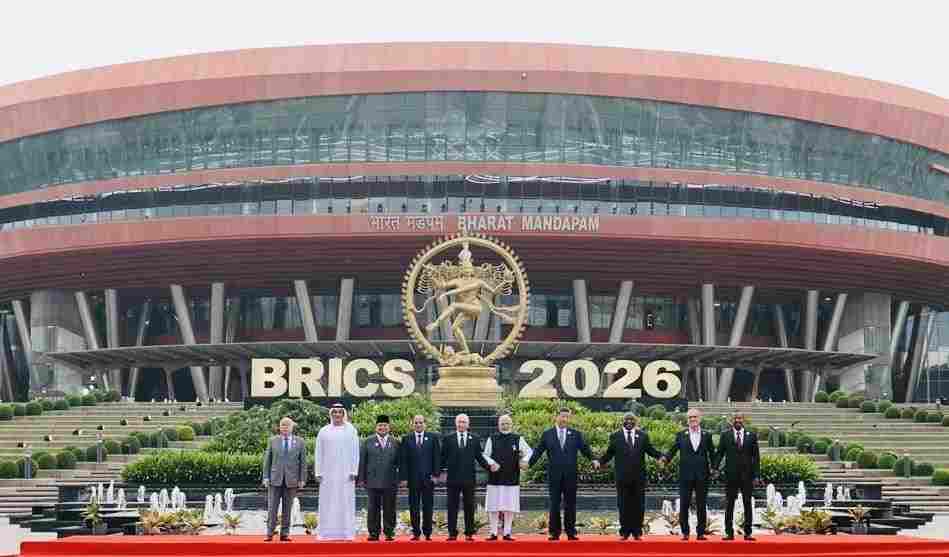
The 18th BRICS Summit in New Delhi on September 12–13, under India’s theme of “Building for Resilience, Innovation, Cooperation and Sustainability,” therefore arrives at an important moment. The question is no longer whether BRICS matters. It is whether an enlarged and heterogeneous BRICS can convert economic weight into institutional influence — and whether it needs to challenge the G7 to do so.
BRICS and G7: Two Different Sources of Power
Comparing BRICS with the G7 purely through GDP produces an incomplete picture. BRICS derives strength from population, resources, manufacturing capacity, energy production, emerging consumer markets and growth potential. The G7 retains enormous advantages in per-capita income, financial-market depth, technological capabilities, reserve currencies and institutional influence.
Their economic architectures are also fundamentally different. The G7 consists of advanced democracies with relatively similar institutional structures and longstanding strategic relationships. BRICS (BRICS+) is deliberately heterogeneous. China and India are economic giants; Russia and Iran are major energy and geopolitical powers; Brazil is a commodity and agricultural heavyweight; the UAE is a global financial and energy hub; while Indonesia, Egypt, Ethiopia and South Africa bring different regional and developmental priorities.
That diversity is both BRICS’ greatest strength and its greatest weakness. Expansion gives it representational legitimacy across the Global South, but every additional member increases the cost of reaching consensus. Current geopolitical tensions have demonstrated this problem: the presence of both Iran and the UAE complicated negotiations over the Middle East, yet the New Delhi Declaration ultimately secured agreement on restraint, diplomacy, and multilateralism.
The G7 can often act more coherently. BRICS can claim to speak for a much broader spectrum of the world economy. The G7 possesses greater institutional cohesion; BRICS possesses greater developmental diversity.
The Economics of a Changing Balance
BRICS is sometimes portrayed as an attempt to replace the Western economic order. That exaggerates both its intentions and its present capabilities.
The more interesting development is institutional diversification. BRICS does not necessarily need to destroy existing institutions to change bargaining power dynamics within them. The New Development Bank, greater local-currency financing, alternative cross-border payment arrangements and demands for IMF and World Bank governance reform create what economists might describe as an expansion of the outside option.
The logic is essentially game theoretic. A country negotiating within a Western-dominated financial architecture has less bargaining power if it has nowhere else to obtain development finance, liquidity or payment connectivity. Credible alternatives change the payoff structure —even when those alternatives never fully replace the incumbent system.
This explains why the debate about “de-dollarisation” is often misleading. New Delhi did not produce a common BRICS currency. Instead, members emphasised greater settlement and investment in national currencies, improved cross-border payment connectivity and expanded local-currency financing through the New Development Bank. This is less a dramatic overthrow of the dollar than risk diversification at the margins.
And margins do matter. Once countries have alternative settlement mechanisms and trading relationships, dependence on any single financial architecture gradually declines.
G7 Versus BRICS — or G7 Plus BRICS?
The temptation is to describe the relationship as a zero-sum contest: if BRICS rises, the G7 must decline. The reality is more complicated.
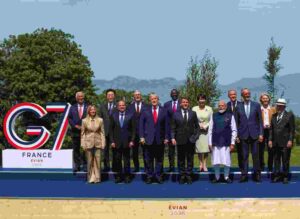
At the 2026 Évian Summit, the G7 itself invited countries including India, Brazil, Kenya, South Korea and Egypt into its discussions. That tells us something important about the changing distribution of global economic power. Advanced economies have increasingly recognised that areas like climate transition, artificial intelligence, supply-chain resilience, critical minerals and development finance cannot be governed exclusively by advanced economies.
Also Read: Gaekwad Legacy Defies Time As Vadodara Enters Powerful New Railway Era
BRICS, meanwhile, needs precisely what many G7 economies possess: capital, advanced technology, sophisticated financial markets, innovation ecosystems and a large consumer base. The economic relationship is therefore characterised by strategic competition alongside deep interdependence.
The future may consequently be less about one bloc defeating another and more about competing institutional platforms forcing each other to become more representative.
India’s Strategic Autonomy Is Being Tested
This is where India becomes particularly interesting. India is a founding member and current chair of BRICS, but it also maintains deep partnerships with the United States, Europe, Japan and Australia and regularly participates in G7 outreach. New Delhi therefore has little interest in allowing BRICS to evolve into an explicitly anti-Western alliance.
For India, strategic autonomy is not neutrality; it is preserving choice. Game theory again provides a very useful interpretation in this regard. India is engaged in a repeated game with multiple major powers. Completely aligning with one coalition may generate immediate benefits but may reduce future strategic options. Maintaining credible relationships across competing platforms increases India’s bargaining space.
This explains the apparently contradictory picture of India working with the United States through the Quad, engaging the G7, purchasing energy from Russia, participating in the Shanghai Cooperation Organisation, hosting Vladimir Putin and Xi Jinping at BRICS, and simultaneously strengthening partnerships with Europe and Japan.
What appears inconsistent through the lens of alliance politics becomes rational through the economics of portfolio diversification. Just as an investor avoids concentrating every asset in one market, India avoids concentrating its geopolitical capital in one bloc.
Building BRICS in New Delhi
The significance of New Delhi 2026 may therefore lie less in dramatic declarations than in practical institution-building. The summit has pushed cooperation in local-currency finance, digital public infrastructure, AI, health, industrial capabilities and development financing, while the New Delhi Declaration calls for a more representative international order.
UN Praises Iran-UAE BRICS Meeting, Sees India As Key Bridge-Builder
Yet BRICS must resist confusing size with effectiveness. A group representing enormous shares of global population and output can still struggle to provide collective goods if national interests diverge. The real test is whether it can turn demographic and economic scale into functioning institutions.
For India, the challenge is even subtler. Building BRICS cannot mean breaking bridges with the G7. New Delhi’s strategic advantage comes precisely from being able to sit comfortably at both tables while being subordinate to neither.
The emerging world economy may not belong exclusively to the G7 or BRICS. It may belong to countries that can navigate both. And few countries are testing that proposition as visibly —or as consequentially — as India is today.
Click here to join our WhatsApp Channel for real-time news updates and exclusive coverage.