
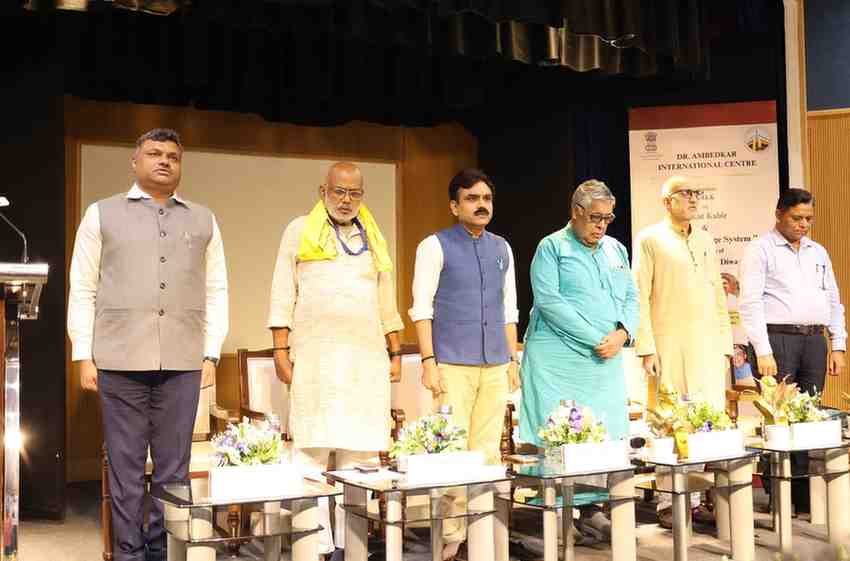
New Delhi: Marking the occasion of Kabir Prakat Diwas, the Dr. Ambedkar International Centre (DAIC), under the Ministry of Social Justice and Empowerment, organised a scholarly lecture titled “Kabir and the Indian Knowledge System” at Samrastha Hall in New Delhi. The event brought together distinguished academicians, thinkers and public intellectuals to reflect on the timeless philosophy of Sant Kabir and its significance in India’s cultural, intellectual and social landscape.
Scholars Examine Kabir’s Contribution to Indian Thought
The programme focused on Sant Kabir’s unique approach to knowledge, spirituality and social transformation. Speakers highlighted how Kabir’s teachings continue to inspire discussions on ethics, rationality, equality and the pursuit of truth. They explored the relevance of his ideas in the context of the Indian Knowledge System (IKS), stressing that his philosophy remains meaningful even in contemporary society.
Experts noted that Kabir’s writings encouraged individuals to question blind faith, embrace personal experience and cultivate inner wisdom. His use of simple vernacular language made profound philosophical ideas accessible to ordinary people, allowing his message to transcend social and linguistic barriers.
Personal Experience and Reason at the Heart of Kabir’s Philosophy
Delivering his address, noted scholar Prof. Purushottam Agrawal explained that Kabir regarded truth as something realised through direct experience rather than accepted solely on the basis of scriptural authority. According to him, Kabir consistently advocated the use of reason and critical thinking alongside spiritual practice.
Prof. Agrawal observed that India’s rich intellectual traditions cannot be fully understood without recognising the importance of regional languages. He underlined Kabir’s emphasis on concepts such as Anubhav (experience), Vivek (discernment), Anabhay (fearlessness), Ram, and Prem (love), describing them as the philosophical pillars of Kabir’s teachings. These ideas, he said, continue to offer valuable guidance in promoting ethical living and intellectual freedom.
Integrating Knowledge, Spirituality and Daily Life
Speaking during the session, Prof. Kuldeep Ratnoo highlighted Kabir’s balanced approach to learning by combining scriptural understanding, practical experience and spiritual discipline. He explained that Kabir encouraged seekers to move beyond ritualistic practices and instead pursue inner transformation through self-realisation.
Prof. Ratnoo discussed Kabir’s emphasis on Naam Jap, devotion to the formless divine or Nirguna tradition, and the importance of spiritual awareness rooted in personal reflection. He also pointed out that Kabir intentionally communicated in simple language so that philosophical knowledge could reach common people instead of remaining confined to scholarly circles.
According to him, Kabir’s teachings challenged rigid social structures and ritualism while promoting compassion, equality and universal human values.
Kabir’s Ideals Linked with Dr. B. R. Ambedkar’s Vision
Addressing the gathering, Shri Kishor Makwana drew connections between the teachings of Sant Kabir and the ideals championed by Dr. B. R. Ambedkar. He referred to Dr. Ambedkar’s emphasis on Knowledge, Self-respect and Character as the foundation for building an equitable and enlightened society.
Makwana stressed that true social progress begins with inner consciousness and respect for human dignity. He observed that Kabir’s message continues to inspire people to reject discrimination, uphold equality and pursue moral integrity. His remarks highlighted the shared commitment of both Kabir and Dr. Ambedkar towards social justice, education and human empowerment.
Renewed Focus on the Indian Knowledge System
The event also reinforced the growing national emphasis on understanding India’s traditional knowledge systems from an academic perspective. Participants noted that thinkers such as Sant Kabir occupy an important place within India’s philosophical heritage because of their ability to bridge spirituality, ethics and social reform.
Discussions emphasised that Kabir’s ideas remain highly relevant in addressing present-day challenges related to social harmony, critical thinking and inclusive education. His teachings encourage dialogue across communities while promoting values of compassion, truth and mutual respect.
Scholars attending the programme agreed that sustained academic engagement with the works of saints and philosophers like Kabir can contribute to a deeper appreciation of India’s intellectual traditions. They called for greater research, documentation and educational initiatives to preserve and disseminate these ideas among younger generations.
Celebrating a Timeless Spiritual Legacy
The scholarly interaction concluded with a shared recognition that Sant Kabir’s philosophy continues to inspire people across religious, linguistic and cultural boundaries. His teachings, rooted in simplicity, reason and universal humanity, remain an integral part of India’s civilisational heritage.
By organising the event on Kabir Prakat Diwas, the Dr. Ambedkar International Centre reaffirmed its commitment to promoting meaningful discussions on India’s intellectual traditions and encouraging greater understanding of the Indian Knowledge System. The programme served as a reminder that Kabir’s vision of truth, equality and compassion continues to offer valuable lessons for contemporary society while strengthening India’s enduring philosophical legacy.