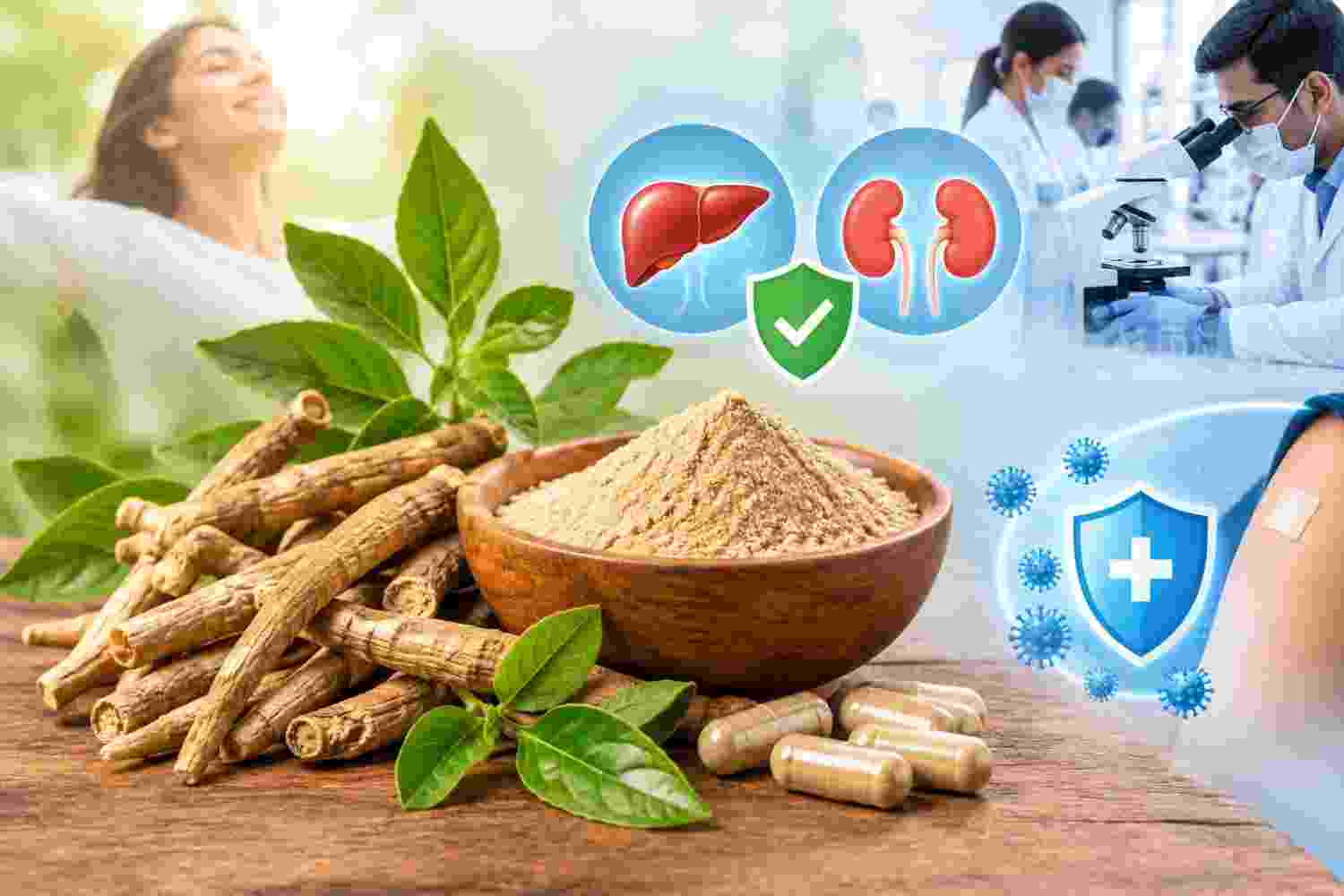
Ashwagandha showed a favourable safety profile in a large multicentre clinical trial published in Frontiers in Medicine. The study found that daily use of a standardised Ashwagandha root extract for 24 weeks was well tolerated, with no evidence of treatment-related liver or kidney injury among participants.
Published on 20 August 2026, the study, titled “Safe prolonged prophylactic use and tolerability of Ashwagandha following COVISHIELD™ vaccination over 24 weeks: a multicentre randomised double-blind placebo-controlled trial,” evaluated the safety and tolerability of a standardised aqueous Ashwagandha root extract in adults who had received a COVISHIELD vaccination.
Large multicentre clinical trial
The research involved 1,200 apparently healthy adults aged 18 to 70 years and was conducted across seven study sites in India. Researchers from nine institutions participated in the trial, bringing together expertise in Ayurveda, clinical medicine, rheumatology, complementary and integrative health and related disciplines.
The multidisciplinary research team included experts associated with organisations such as the Central Council for Research in Ayurvedic Sciences (CCRAS), All India Institute of Ayurveda, National Institute of Ayurveda, Jaipur, Ayush Centre of Excellence, Translational Health Science and Technology Institute, Centre for Complementary and Integrative Health, and Interdisciplinary School of Health Sciences, Savitribai Phule Pune University, among others.
The randomised, double-blind, placebo-controlled study assigned participants to receive either 500 mg of standardised aqueous Ashwagandha root extract daily, equivalent to 4 grams of raw root powder, or a matching placebo.
Participants received the intervention for 24 weeks and were monitored until week 28. Of the 1,200 individuals enrolled, 1,032 participants, or 86%, completed the study.
No treatment-related liver or kidney injury reported
One of the central objectives of the study was to evaluate the safety of prolonged Ashwagandha administration through clinical and laboratory assessments.

According to the researchers, liver and kidney function parameters remained within the reported reference ranges throughout the intervention period. The safety evaluation included measurements such as liver enzymes, bilirubin, creatinine and blood urea.
The findings showed no evidence of treatment-related hepatic or renal injury during the 24-week intervention.
The researchers also reported that no serious adverse events were considered attributable to the study intervention. Importantly, no participant discontinued the trial because of an adverse event associated with the study treatment.
Vaccine-related immune response also assessed
The trial additionally examined whether prolonged administration of the standardised Ashwagandha preparation affected the immune response following COVISHIELD vaccination.
The study reported that virus-neutralising activity remained high in both groups, exceeding 85% among participants receiving Ashwagandha as well as those receiving placebo.
Researchers found no statistically significant difference between the two groups, indicating that, within the conditions and duration studied, the Ashwagandha intervention did not demonstrate an adverse effect on the measured vaccine-induced immune response.
Researchers highlight importance of rigorous evidence
Dr. Arvind Chopra, Ayush Distinguished Scientist Chair and Director and Chief Rheumatologist at the Centre for Rheumatic Diseases in Pune and lead author of the study, said the trial provides important evidence regarding the safety and tolerability of standardised Ashwagandha over 24 weeks.
He highlighted that liver and kidney parameters remained within physiological reference ranges and that no treatment-related injury was observed. He also pointed to the comparable neutralising activity between the Ashwagandha and placebo groups as an important finding from the study.
Prof. Bhushan Patwardhan, National Professor of Ayush and a co-author, emphasised the value of applying contemporary clinical research methods to Ayurveda while maintaining its traditional foundations. He said the favourable safety findings add to the evidence available on standardised Ashwagandha preparations.
Prof. (Vaidya) Rabinarayan Acharya, Director General of CCRAS, similarly stressed the importance of well-designed multicentre clinical studies for strengthening the scientific evidence surrounding Ayurvedic interventions.
Ayush Ministry stresses evidence-based Ayurveda
Vaidya Rajesh Kotecha, Secretary, Ministry of Ayush, said high-quality clinical research can strengthen the evidence base for Ayurveda and improve understanding of its potential role in contemporary healthcare.
He also noted that a growing body of rigorous clinical research can contribute to the responsible use of standardised Ayurvedic interventions in health and wellness settings.
Findings add to Ashwagandha safety evidence
The trial was registered with the Clinical Trials Registry–India (CTRI/2021/06/034496) and incorporated clinical, laboratory and immunological assessments.
Overall, the researchers concluded that the standardised aqueous Ashwagandha root extract demonstrated a favourable safety and tolerability profile during the 24-week intervention under the controlled conditions of the trial.
The findings add to the clinical evidence concerning standardised Ashwagandha preparations, particularly regarding liver and kidney safety during the study period. At the same time, the results apply specifically to the preparation, dosage, participant population and controlled conditions evaluated in this trial, underscoring the importance of continued high-quality research into Ayurvedic interventions.
Click here to join our WhatsApp Channel for real-time news updates and exclusive coverage.