
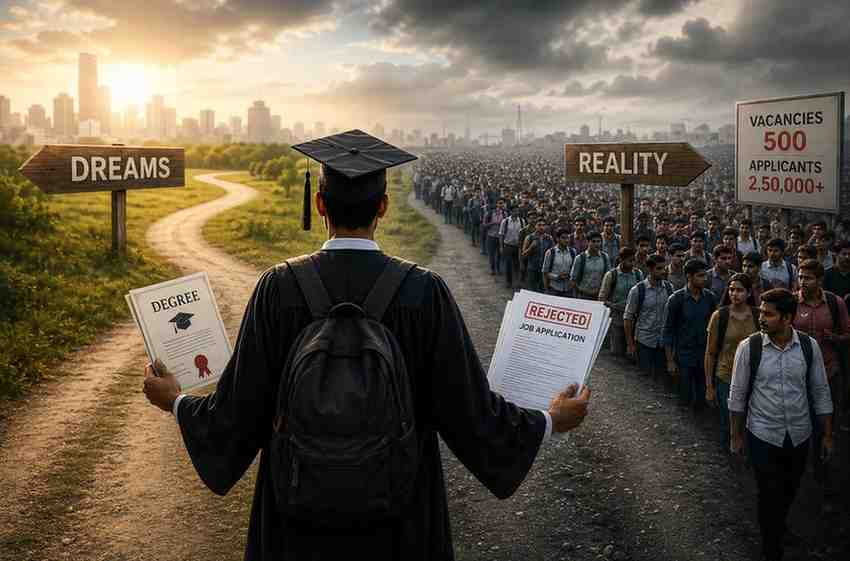
Millions of educated young Indians struggle to find jobs as skill gaps, limited career awareness, intense competition, and changing industry demands create barriers to meaningful employment and economic growth.
India is often described as one of the world’s youngest nations, with a large population of energetic and ambitious youth. This demographic advantage has the potential to drive economic growth and innovation for decades. However, a growing concern continues to overshadow this opportunity: unemployment and underemployment among young people.
Despite earning degrees and completing formal education, many young Indians struggle to secure stable and rewarding employment. Experts believe the issue is not simply a lack of jobs but a combination of educational shortcomings, skill gaps, limited career awareness, and changing economic demands.
Education and Industry Requirements Remain Misaligned
One of the most significant challenges is the gap between what students learn in classrooms and what employers expect in the workplace.
Many schools and colleges continue to focus heavily on examinations, memorization, and theoretical learning. While academic knowledge remains important, employers increasingly seek practical abilities such as communication skills, digital literacy, problem-solving, financial awareness, sales techniques, and technical expertise.
As a result, thousands of graduates enter the job market each year with degrees but without the industry-relevant skills needed to compete effectively.
Academic qualifications alone are often no longer sufficient to secure employment.
Population Growth Intensifies Competition
India’s population has crossed 1.4 billion, with millions of young people entering the workforce annually. While this creates a large talent pool, it also leads to intense competition for available opportunities.
Government recruitment drives frequently illustrate this challenge. A limited number of vacancies can attract hundreds of thousands of applicants. Similarly, entry-level private-sector positions often receive applications from candidates across the country.
Job creation has not consistently kept pace with the growing number of job seekers.
Dependence on Government Jobs
Government employment continues to be one of the most preferred career options among Indian youth. The appeal of job security, social prestige, pensions, and benefits encourages many candidates to spend years preparing for competitive examinations.
However, government jobs account for only a small percentage of total employment opportunities. Consequently, millions of aspirants compete for a limited number of positions, leaving many disappointed after years of preparation.
Excessive dependence on government jobs narrows career exploration and increases competition.
Limited Growth of Manufacturing Sector
Several countries successfully generated large-scale employment through strong manufacturing industries. Although India has witnessed significant growth in information technology and service sectors, manufacturing has not expanded at a pace sufficient to absorb the country’s vast workforce.
A stronger manufacturing ecosystem could create opportunities for workers with diverse educational backgrounds and skill levels.
Industrial expansion remains essential for large-scale job creation.
Skill Development Still Needs Strengthening
Many developed economies offer robust vocational education systems that prepare students for skilled professions without requiring traditional university degrees.
Professions such as electricians, plumbers, welders, machine operators, healthcare technicians, and solar technicians often provide stable incomes and long-term career growth. However, vocational careers continue to receive less attention and social recognition compared to conventional professions.
India needs greater investment and respect for vocational training pathways.
Career Awareness Gap Restricts Opportunities
A major but often overlooked issue is the lack of awareness about diverse career options.
Many students are familiar with only a handful of professions, including engineering, medicine, teaching, banking, government services, police, and defence careers. Beyond these fields, awareness remains limited.
As a result, many graduates complete their education without understanding emerging industries, earning potential, or alternative employment opportunities.
Limited career guidance prevents students from exploring growing sectors.
New-Age Careers Creating Fresh Opportunities
The modern economy offers numerous income-generating opportunities that were largely unavailable a decade ago.
Growing fields include:
- Digital marketing
- Content writing
- Graphic design
- Video editing
- Search Engine Optimization (SEO)
- Social media management
- Web development
- App development
- Artificial Intelligence services
Additionally, freelancing platforms now allow individuals to work with clients worldwide in areas such as programming, design, teaching, writing, and consulting.
The creator economy has also emerged as a significant source of income through YouTube channels, podcasts, online courses, educational content, and blogging.
Many students remain unaware of these rapidly expanding career pathways.
What Schools Rarely Teach
While students study mathematics, history, science, and examination techniques, practical life and financial skills often receive limited attention.
Important subjects frequently missing from formal education include:
- Personal finance
- Investing
- Entrepreneurship
- Communication skill
- Negotiation
- Sales
- Networking
- Career planning
These skills play a crucial role in determining employability and earning potential in the real world.
Solutions for a Stronger Future
Experts suggest several reforms that could help bridge the gap between education and employment:
Education Reforms
- Financial literacy
- Entrepreneurship training
- Communication development
- Digital skills education
- Critical thinking exercise
- Project-based learning
Career Guidance
- Career awareness programs from middle school onward
- Industry interaction sessions
- Internship opportunities
- Apprenticeship programs
Economic Development
- Expansion of manufacturing industries
- Support for startups and small businesses
- Promotion of local entrepreneurship
- Investment in vocational training
Conclusion
India’s young population remains one of its greatest strengths. However, unlocking this potential requires better alignment between education, skills, and employment opportunities.
The challenge is not merely the size of the population but the need to equip young people with relevant skills, broader career awareness, and practical knowledge. If education reforms, entrepreneurship, skill development, and job creation move forward together, India’s youth can become a powerful force for economic transformation and national progress.






Good
Exactly…….