
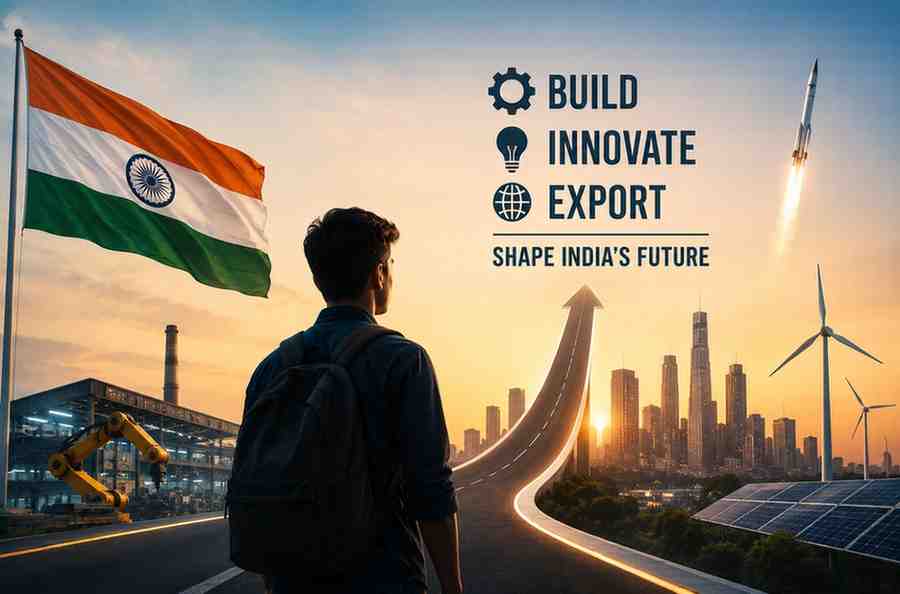
The recent statement by Union Commerce Minister Piyush Goyal that the world should view India not merely as a market but as a global base for manufacturing, innovation, design, and exports deserves more attention than it received. The Commerce Minister urged the world to stop thinking of India as just a place to sell things and start seeing it as a place where things are built, designed, and exported to the rest of the world.
That might sound like a line from a policy speech. But for a 21-year-old engineering student in Pune, a design graduate in Ahmedabad, or a first-generation entrepreneur in Coimbatore, it carries a different meaning.
For a long time, the dominant narrative was this: global companies come to India, sell to its billion-plus consumers, and leave the real value creation elsewhere. That story is changing. Apple manufactures iPhones in Tamil Nadu. Semiconductor investments are arriving in Gujarat. Defence exports have crossed figures that would have been unthinkable a decade ago. This isn’t cheerleading — it’s a reflection of how the world is reorganising its supply chains, and India is finding itself on the right side of that shift.
The IMF projects India’s growth at 6.4–6.6%, making it the fastest-growing major economy. Nearly two-thirds of its 1.46 billion people are of working age. These aren’t just statistics to include in a presentation. They represent the people who will build the next chapter of India’s story — many of whom are probably in college today or just a few years into their careers.
But here’s the reality: opportunity without preparation is just noise.
The jobs that will matter most in this transformation — in electronics, clean energy, biotechnology, AI, and advanced manufacturing — require more than degrees. They require people who can solve problems without textbook answers, adapt when plans fall apart, and build things rather than wait to be assigned tasks. The gap between what classrooms teach and what industry actually needs remains wide enough for many to fall through.
There’s another shift that’s harder to discuss. India needs more job creators. Aspiring to a stable government position or a campus placement is entirely rational — these paths offer security that entrepreneurship often does not. But if India is genuinely going to become a global manufacturing and innovation hub, it needs more young people willing to build companies, file patents, conduct experiments, and occasionally fail in public. That culture is growing, but it needs to grow faster.
The year 2047 — when India aims to become a fully developed nation — is just 21 years away. A student starting college today will be in their early forties when that milestone arrives. The decisions they make over the next five to ten years — the skills they develop, the problems they choose to solve, and whether they create or merely consume — will ultimately shape that future.
India becoming a global base for manufacturing, innovation, and exports is not a guarantee. It is a possibility. And whether that possibility becomes reality depends entirely on whether its youngest generation chooses to rise to the challenge.