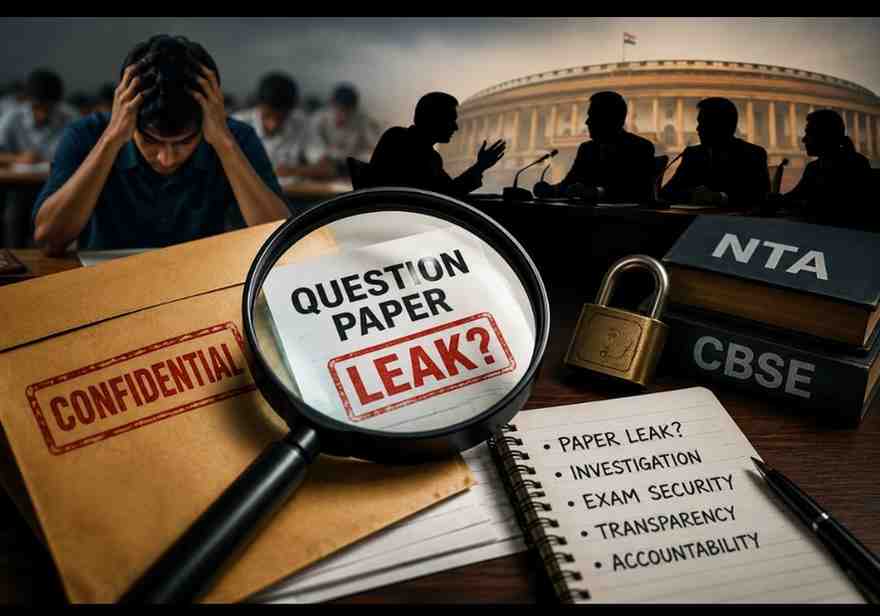
A Parliamentary committee has intensified its scrutiny of India’s examination system by seeking detailed explanations from the National Testing Agency (NTA) and the Central Board of Secondary Education (CBSE) regarding allegations of paper leaks, examination irregularities, and procedural changes in key education-related projects.
The Parliamentary Committee on Education, Women, Children, Youth and Sports has asked the NTA to clearly define what constitutes a “paper leak” and disclose whether any such incidents have occurred in examinations conducted by the agency since 2018. The request comes amid continuing concerns over the integrity of major national-level examinations and follows the controversy surrounding the NEET examination process.
The committee’s inquiry gained significance after senior NTA officials reportedly informed lawmakers that no paper leak had occurred from the agency’s system. According to the agency’s position, questions circulating before examinations were not leaked papers but rather “guess papers” that happened to resemble examination content. The committee has now sought a formal explanation to determine where the line should be drawn between a genuine leak and unofficial predictions or speculative question sets.
The panel, chaired by Congress leader Digvijaya Singh, is conducting a wider examination of issues related to the alleged NEET-UG 2024 paper leak and concerns surrounding CBSE’s On-Screen Marking (OSM) system. Senior officials from both organisations have been called upon to provide detailed responses and supporting documentation.
Among the key questions directed at the NTA is whether the agency conducted any independent investigation into allegations of irregularities connected to NEET-UG 2024 apart from the ongoing inquiries being carried out by the Central Bureau of Investigation (CBI). Lawmakers are seeking clarity on the steps taken by the testing agency to verify claims, identify vulnerabilities, and strengthen examination security.
The committee has also requested extensive information regarding the agency’s internal functioning. This includes details about staff strength over the last three years, recruitment activities since 2022, and annual reports submitted to the Higher Education Department. Members of the panel are examining whether adequate manpower and administrative resources exist to manage large-scale examinations involving millions of students across the country.
Another major area of focus is the implementation of recommendations made by the high-level expert committee headed by former ISRO chief K. Radhakrishnan. Established in June 2024, the committee was tasked with suggesting reforms to improve transparency, efficiency, and security within the NTA’s examination framework. The parliamentary panel has requested a point-by-point status report on all 101 recommendations and details of the actions taken by the agency in response.
The panel’s investigation extends beyond examination security and includes questions regarding the CBSE’s On-Screen Marking system. Lawmakers have sought explanations for several modifications made to tender conditions and Requests for Proposals (RFPs) issued for the project.
Committee members have questioned whether adequate background verification was conducted before awarding contracts related to the OSM system. They have also sought clarification regarding the selection process and the criteria used to evaluate bidders. Particular attention has been paid to reported changes in tender provisions that critics argue may have altered eligibility requirements.
Among the issues under examination are changes to clauses related to bidder performance history and blacklisting provisions. The committee wants to understand why certain restrictions were modified and whether these changes had any impact on the fairness and competitiveness of the bidding process.
Additional questions have been raised regarding technical specifications. Lawmakers have sought explanations for the removal or modification of requirements relating to robotic scanners, scanning resolutions, answer-sheet handling procedures, and data-centre access. The panel is examining whether these changes were justified on technical grounds or if they affected the quality and reliability of the evaluation process.
The committee has further requested details regarding the rationale behind changing project experience requirements. Earlier conditions reportedly required bidders to demonstrate experience handling large-scale projects involving substantial student volumes, while later provisions allowed cumulative experience across multiple assignments. Members are assessing whether such revisions were appropriate and adequately safeguarded the project’s objectives.
Sources indicate that CBSE was asked to provide responses by June 8, while the NTA has been directed to submit written answers by June 10. At the time of reporting, both organisations were yet to furnish their complete responses.
Meanwhile, the NTA has strongly denied recent claims circulating on social media regarding an alleged leak or sale of the NEET-UG 2026 re-examination question paper. The agency described such messages as attempts by organised cheating networks to exploit the anxiety of students and parents.
According to the NTA, the examination process remains secure and multiple safeguards are in place to protect the integrity of the test. The agency stated that it is working with cyber-crime authorities and digital platforms to identify and remove misleading content while taking action against individuals involved in spreading false information.
The agency has urged students and parents not to engage with suspicious messages, avoid making payments to unknown sources promising access to examination papers, and rely only on official communications. As scrutiny intensifies, the parliamentary committee’s findings and the responses from NTA and CBSE are expected to play an important role in shaping future reforms aimed at restoring public confidence in India’s examination system.