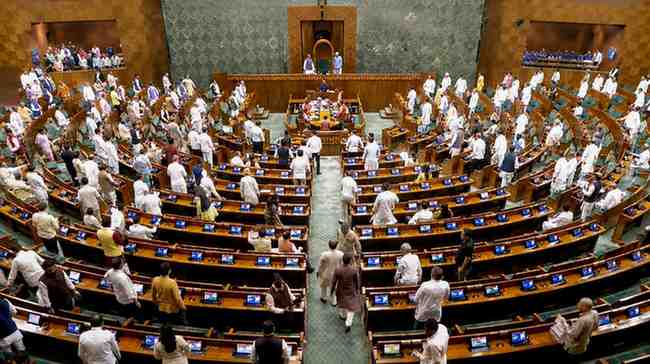
NEW DELHI: The Centre is preparing for an action-packed Monsoon Session of Parliament beginning on July 20, with the government expected to introduce and push seven major bills covering tax reforms, foreign funding, education, MSMEs, judicial capacity and the repeal or amendment of outdated laws. The legislative agenda reflects the government’s focus on modernising India’s legal framework while introducing reforms aimed at improving governance, economic growth and administrative efficiency.
The session, scheduled to continue until August 13, is also expected to witness intense political debates, with the Opposition planning to raise several national issues alongside discussions on the proposed legislation.
Focus on Replacing Outdated Laws
One of the government’s priorities during the session will be to update or replace legacy laws that are considered outdated or no longer suitable for present-day governance. Officials believe that revising these statutes will simplify legal procedures, reduce regulatory hurdles and make laws more relevant to current social and economic conditions.
The move forms part of the Centre’s broader effort to streamline India’s legal system by removing obsolete provisions and introducing legislation aligned with contemporary administrative needs.
Seven Bills Likely to Dominate the Session
According to the government’s legislative agenda, Parliament is expected to deliberate on seven significant bills.
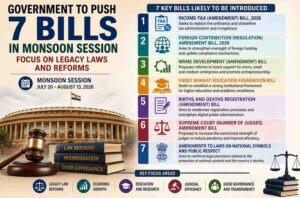
Among the most important is the Income-tax (Amendment) Bill, 2026, which seeks to replace the ordinance currently in force and introduce changes to India’s tax administration. The government says the amendments are aimed at making tax compliance simpler while improving efficiency in revenue collection.
The Foreign Contribution (Regulation) Amendment Bill, 2026 is another major proposal. It is expected to strengthen oversight of foreign funding received by organisations operating in India while introducing updated compliance mechanisms.
The government also plans to introduce amendments to the Micro, Small and Medium Enterprises (MSME) Development Act, with the objective of improving support mechanisms for small businesses, enhancing access to finance and boosting entrepreneurship across the country.
Education and Administrative Reforms
Another important proposal is the Viksit Bharat Education Foundation Bill, which seeks to bring changes to India’s higher education ecosystem. The proposed legislation is expected to create an institutional framework to support educational excellence, innovation and long-term academic reforms.
The Births and Deaths Registration (Amendment) Bill is also on the agenda. The legislation aims to modernise registration procedures, improve record management and strengthen the country’s digital public administration systems.
Judicial and National Symbol Legislation
The Centre is expected to move amendments to increase the sanctioned strength of judges in the Supreme Court through the Supreme Court (Number of Judges) Amendment Bill. The proposal is intended to help reduce the burden of pending cases and improve the efficiency of the country’s highest court.
Also Read: US Expands Iran Offensive, Chabahar Port Hit
In addition, Parliament may consider amendments to laws dealing with the protection of national symbols and public respect for the country’s identity, reinforcing existing legal provisions governing such matters.
Government Eyes Productive Session
The government is expected to seek cooperation from all political parties to ensure smooth functioning of Parliament and timely passage of key legislation. Parliamentary Affairs Minister Kiren Rijiju has repeatedly emphasised the importance of constructive debate and meaningful discussion during the session.
An all-party meeting has also been convened ahead of the session to build consensus on the legislative agenda and minimise disruptions.
Opposition Preparing for Strong Debate
While the government hopes to advance its reform agenda, Opposition parties are expected to aggressively raise issues concerning governance, the economy, national security and other political developments. Several contentious matters are likely to be discussed alongside the proposed bills, making the Monsoon Session one of the most closely watched parliamentary sessions of the year.
Political observers believe that despite expected confrontations, the passage of several reform-oriented bills remains a priority for the government, particularly those aimed at improving taxation, education, judicial administration and regulatory systems.
A Crucial Parliamentary Session
The Monsoon Session is likely to play a significant role in shaping India’s legislative and governance framework for the coming years. If passed, the proposed bills could bring substantial changes across multiple sectors, including taxation, education, business regulation, judicial functioning and public administration.
With the government determined to modernise legacy laws and the Opposition preparing for vigorous debate, Parliament is set for a politically significant and legislatively important session beginning July 20.
Click here to join our WhatsApp Channel for real-time news updates and exclusive coverage.