
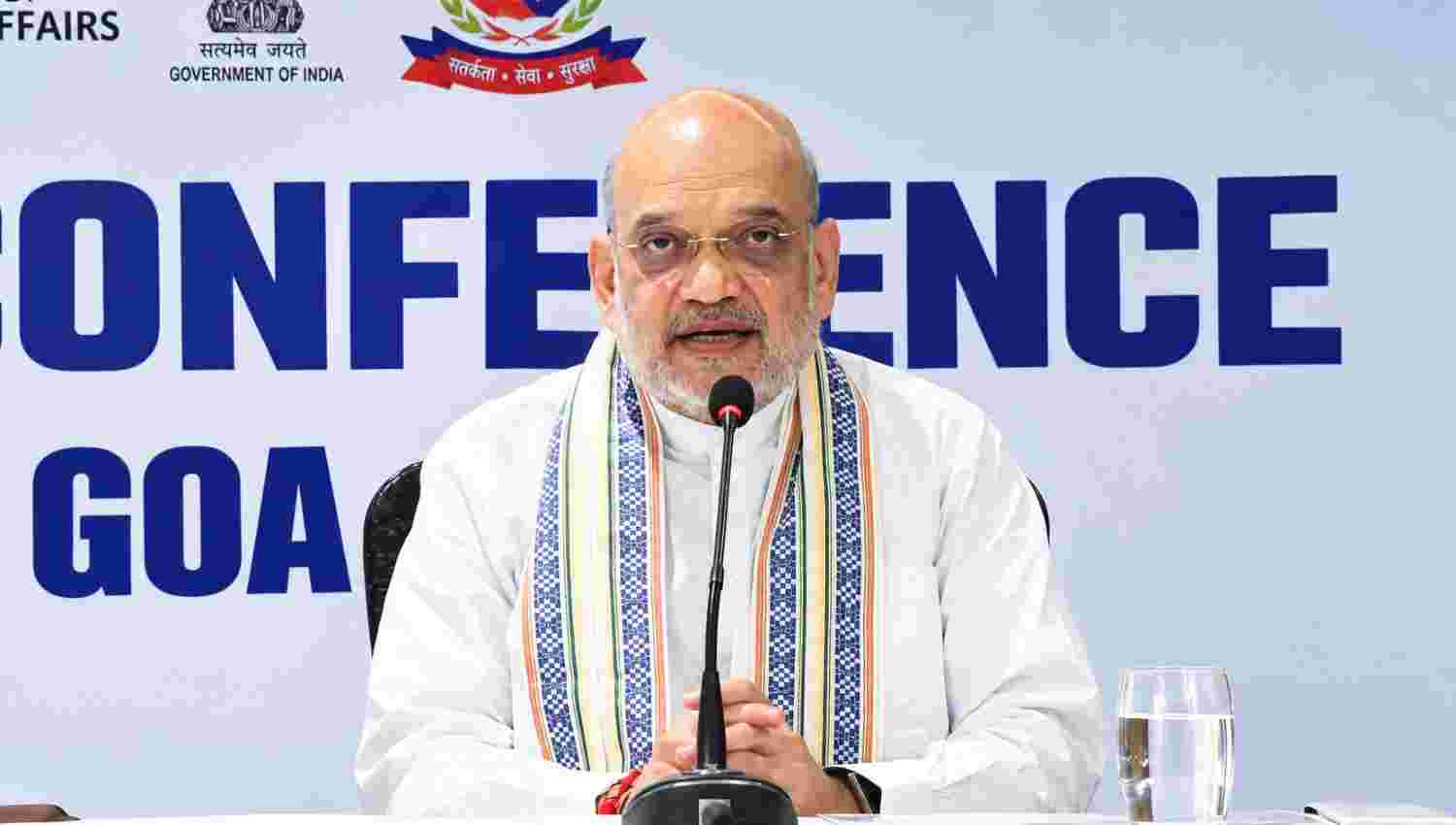
The Union Home Minister Amit Shah has announced an ambitious national roadmap to make India drug-free by 2029, describing the fight against narcotics as a matter of national security. Shah said the Centre intends to tackle the drug menace through a coordinated strategy targeting trafficking networks, financing channels, offenders and demand across the country.
Speaking to the media on Sunday at the Control of Narcotics event in Goa, Shah said the government has moved away from fragmented action against individual drug cases towards a nationwide campaign designed to dismantle the broader narcotics ecosystem. He linked the initiative to Prime Minister Narendra Modi’s vision of empowering drug-free youth as a key force behind India’s development journey towards Viksit Bharat by 2047.
Amit Shah Calls Narcotics a National Security Challenge
Shah said the government’s approach represents a major shift from the way narcotics cases were handled before 2014. According to him, enforcement agencies earlier operated largely in isolation and frequently concentrated on apprehending smaller offenders rather than pursuing the larger networks behind drug trafficking.
The Centre, he said, has now elevated the issue to the level of national security, bringing multiple agencies and state governments into a coordinated framework.
The strategy includes strengthening the National Coordination Committee for Countering Drug Trafficking, or NCORD, as well as state-level Anti-Narcotics Task Forces. The government has also sought closer cooperation between central agencies and state police forces to identify and disrupt major trafficking networks.
New Investigation Model to Target Drug Networks
A key component of the government’s strategy is what Shah described as a reverse investigation model. The approach works in two directions.
Investigators can trace a small drug seizure backwards to identify its original source, while large consignments can be followed forward to determine their intended destination and potential consumers.
The objective is to move beyond individual arrests and expose the complete chain involved in narcotics operations. Shah said the approach is intended to help authorities identify the wider network and take action against those controlling or financing illegal drug activity.
NIDAN Database and Drug Hotspot Mapping
Technology and data-driven enforcement are also central to the government’s anti-narcotics strategy.

Shah highlighted the NIDAN database, which has been developed to maintain information relating to narcotics offenders. Authorities have also created a nationwide map identifying drug hotspots and trafficking patterns.
The government believes that combining databases, intelligence and coordinated investigations can improve the ability of enforcement agencies to detect emerging trafficking routes and identify repeat offenders.
The Narcotics Control Bureau has also been strengthened through organisational changes, additional manpower, greater regional presence and enhanced operational capabilities, according to Shah.
MANAS Helpline and Wider Anti-Drug Strategy
The anti-narcotics campaign is not limited to arrests and seizures. Shah also pointed to the MANAS helpline as part of the broader institutional response to the drug problem.
The Centre’s strategy seeks to combine enforcement with mechanisms aimed at addressing drug-related concerns and protecting young people from substance abuse.
The government has repeatedly emphasised the need for states and Union Territories to work alongside central agencies because narcotics trafficking frequently crosses administrative and state boundaries.
Shah Draws Parallel With Naxalism
Shah compared the government’s planned campaign against narcotics with its efforts to tackle Naxalism and terrorism.
He said Naxalism, which had remained a serious internal-security challenge for decades, had now become a thing of the past. Shah asserted that the government would confront the narcotics menace with a similarly determined approach.
He also referred to developments in the Northeast, saying that more than 10,000 young people in the region had surrendered their weapons and joined the mainstream.
On Jammu and Kashmir, Shah said terrorism had declined and claimed that separatist sentiment had weakened following the abrogation of Article 370.
2029 Deadline Raises Stakes for Anti-Drug Campaign
The 2029 target places a clear deadline before the Centre’s anti-narcotics campaign. Shah’s announcement signals that the government wants the fight against drugs to be treated as a sustained national mission rather than a series of isolated enforcement operations.
The strategy combines intelligence-sharing, state-level task forces, specialised databases, coordinated investigations and stronger central agencies.
The larger objective, according to Shah, is to protect India’s younger population from the destructive effects of narcotics while strengthening internal security. He presented a drug-free youth population as an important foundation for India’s long-term development ambitions.
With the government now targeting 2029, the coming years are expected to see intensified action against trafficking networks and greater coordination between enforcement agencies across the country.
Click here to join our WhatsApp Channel for real-time news updates and exclusive coverage.