
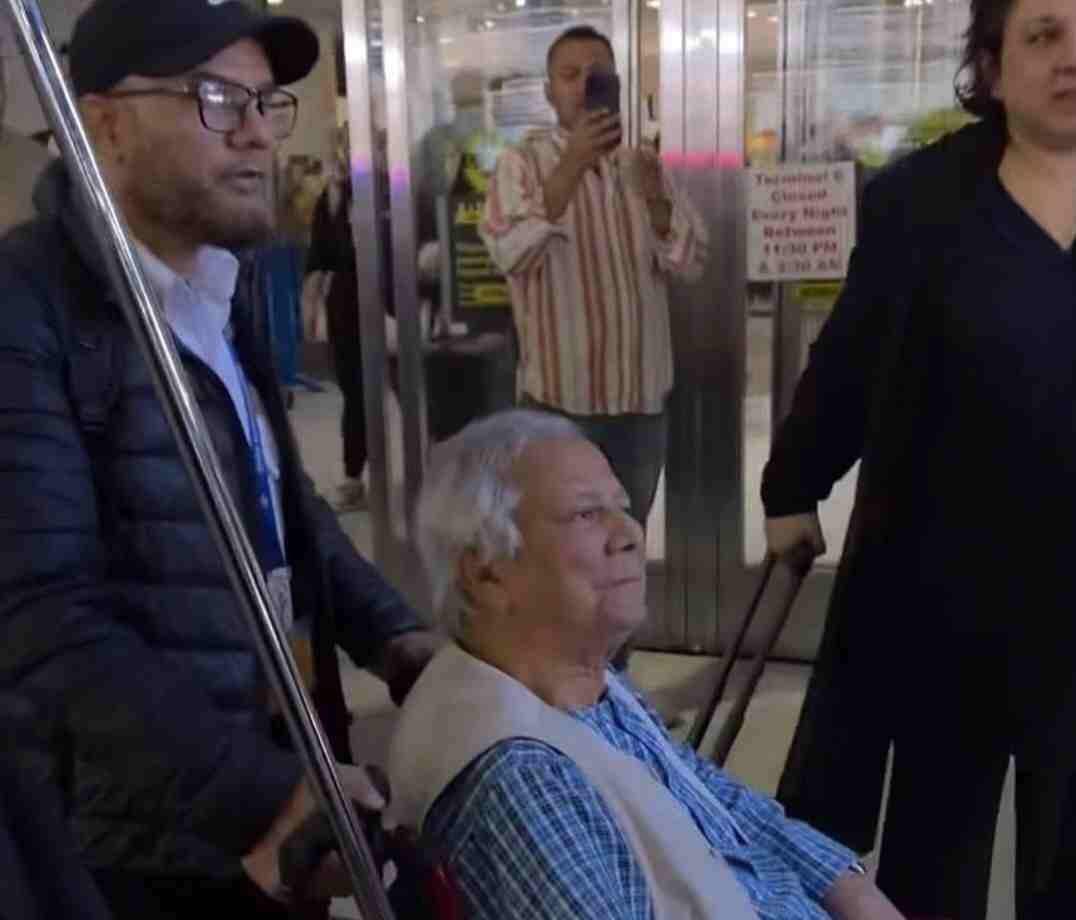
Muhammad Yunus, the Nobel Peace Prize laureate who headed Bangladesh’s interim administration, faced an angry confrontation with a group of Bangladeshi expatriates at New York’s John F. Kennedy International Airport on Monday. The incident has triggered a sharp response from Bangladesh’s government, which has announced plans to pursue legal action over the alleged harassment.
Videos circulating on social media showed several people shouting accusations at Muhammad Yunus as he was being escorted through the airport in a wheelchair. Some protesters called him a “terrorist”, accused him of causing deaths in Bangladesh and questioned his presence in the United States.
The confrontation took place against the backdrop of continuing political divisions in Bangladesh following the removal of former prime minister Sheikh Hasina from power in August 2024 and the subsequent tenure of the Muhammad Yunus-led interim administration.
Muhammad Yunus Faces Angry Protest at New York’s JFK Airport
According to reports, Muhammad Yunus arrived at JFK Airport’s Terminal 8 on a Qatar Airways flight from Doha on October 12. The protesters confronted him as he was being moved through the airport, with security personnel and associates accompanying him.
In footage shared online, one man can be heard shouting accusations and demanding to know why Muhammad Yunus had come to the United States. Other demonstrators reportedly called on the former interim government chief adviser to leave.
The protesters alleged that thousands of people, including police personnel, had died during the turbulent political period and claimed that approximately two lakh people had been arrested in Bangladesh. These allegations were made by the demonstrators and have not been independently verified in connection with the airport incident.
Security personnel subsequently escorted Yunus away from the group. Reports from Bangladesh also indicated that Yunus and his aide, Lamia Morshed, briefly moved back inside the airport during the confrontation.
The identities and affiliations of all the people involved could not be independently established from the circulating footage. Some media reports identified the demonstrators as supporters of the Awami League, the political party led by ousted prime minister Sheikh Hasina.
Bangladesh Government Announces Legal Action
The confrontation prompted a strong reaction from Bangladesh’s government. Zahed Ur Rahman, an adviser on information and communications to the prime minister, said on Tuesday that legal action would be taken over the incident.
The government’s response reflects its position that political disagreements should not be used to justify harassment or intimidation, including when former government officials travel abroad.
Officials have also indicated that the circumstances surrounding the incident and the arrangements made for Yunus may be examined. The episode has therefore raised questions about the treatment of former senior officials overseas and the legal boundaries of political protest.
At the time of reporting, no detailed public response from Yunus or his representatives addressing the protesters’ accusations had been reported.
The allegations shouted at the airport should be distinguished from established findings of investigations or judicial proceedings. The video documents a confrontation, but it does not independently establish the claims made against the former interim government chief adviser.
Why Muhammad Yunus Faced Criticism Over His Tenure
Yunus became the head of Bangladesh’s interim administration on August 8, 2024, after a student-led uprising forced Sheikh Hasina from office. The transition followed weeks of protests, violent clashes and a major political upheaval that drew international attention.
The interim administration inherited a deeply polarised political environment, with demands for accountability for violence, institutional reform and a return to democratic governance.
However, Yunus’s tenure also attracted criticism from political opponents over the handling of law and order, alleged attacks on political supporters and concerns about accountability for abuses. The treatment of minority communities, including Hindus, was another issue raised by critics and rights advocates during the period.
The Awami League and other opponents accused the interim administration of failing to adequately protect political supporters and ensure accountability. These criticisms became part of the wider political dispute surrounding the transition, although individual allegations require assessment against independent evidence and official investigations.
Questions about arrests, custodial deaths and the handling of cases connected to the 2024 uprising also contributed to the controversy. Supporters of the interim administration, meanwhile, framed the transition as an opportunity to address longstanding political and institutional problems.
Also Read | Kerala Tourism Unveils Exciting Holiday Packages To Boost Dussehra–Diwali Tourist Footfall
The airport confrontation illustrates how these unresolved disputes continue to shape reactions to Yunus even after his departure from office.
Strained India-Bangladesh Relations Added to the Political Tensions
Relations between India and Bangladesh also came under pressure during Yunus’s tenure. His remarks during a visit to China in March 2025 about Bangladesh’s geographical position and India’s northeastern region attracted criticism in New Delhi.
The comments were viewed by critics in India as having strategic implications, particularly because the northeastern states are connected to the rest of the country through a narrow land corridor. Disagreements over minority safety, political developments and public statements further complicated bilateral relations.
New Delhi repeatedly expressed concerns about developments in Bangladesh and called for attention to the safety of minorities. The diplomatic strain added another dimension to the criticism surrounding Yunus’s leadership.
The political landscape has since moved beyond the interim administration, but disagreements over its record continue to influence public debate.
Airport Incident Highlights Bangladesh’s Unresolved Political Divide
The confrontation at JFK Airport has brought Bangladesh’s political divisions into international view. The protesters’ accusations reflect the anger of at least some members of the Bangladeshi diaspora, while the government’s promised legal response signals that the incident may have consequences beyond the airport.
The episode also highlights the distinction between peaceful political criticism and conduct that authorities may consider harassment or intimidation.
As Bangladesh continues to navigate its post-Hasina political transition, questions surrounding accountability, public safety, democratic institutions and the legacy of the interim administration remain contentious.
For now, the airport incident has intensified scrutiny of Yunus’s political legacy. Whether the government’s proposed legal action proceeds, and whether investigators establish the identities and conduct of those involved, will determine the next steps in the case.
Click here to join our WhatsApp Channel for real-time news updates and exclusive coverage.