
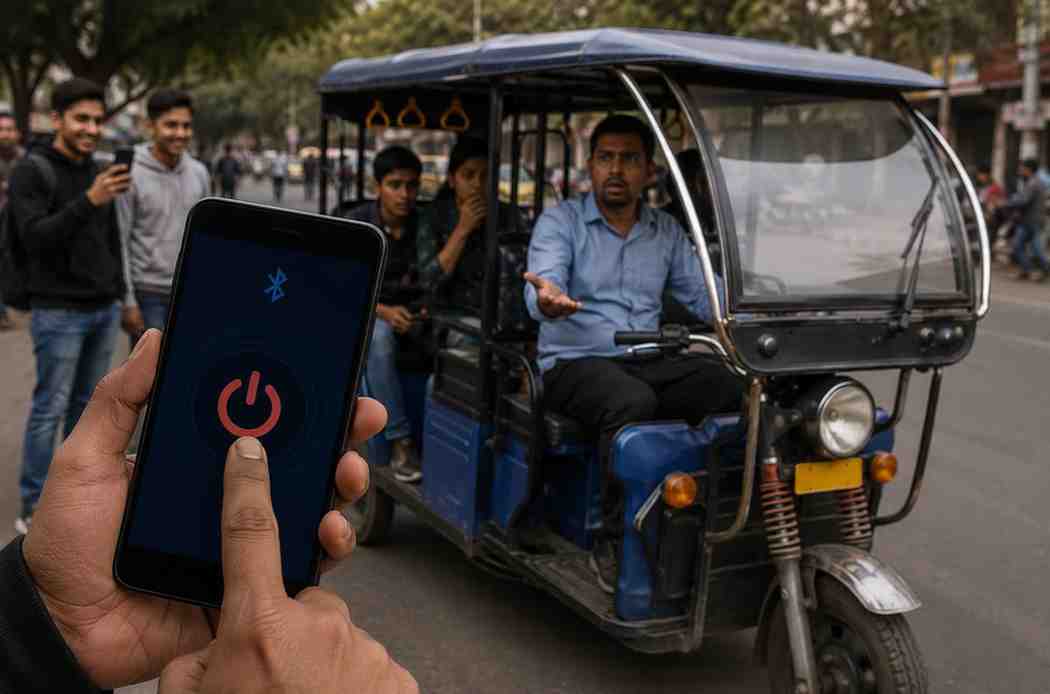
NEW DELHI: A viral social media trend involving a smartphone application allegedly capable of remotely disabling e-rickshaws has sparked serious concerns about public safety, cybersecurity and the security standards of connected electric vehicles in India. Videos circulating across multiple social media platforms show individuals approaching moving or parked e-rickshaws and using an application reportedly named BAT-BMS to switch off the vehicles through Bluetooth connectivity, leaving drivers stranded and, in some cases, placing passengers at potential risk. Government agencies have now begun examining the authenticity of these claims and whether existing electric mobility systems contain exploitable vulnerabilities.
How the App Allegedly Works
The application at the centre of the controversy is said to be a Battery Management System (BMS) monitoring tool designed to communicate with compatible lithium battery packs. Such applications are commonly used by manufacturers and technicians to monitor battery voltage, charging cycles, temperature and overall battery health.
However, reports suggest that some battery systems installed in certain e-rickshaws can be accessed through Bluetooth without adequate authentication. If true, this means an unauthorized user standing nearby may establish a connection and disable the battery’s discharge function, effectively stopping the vehicle from operating. While the feature may have been intended for maintenance purposes, its alleged misuse has triggered widespread concern over product security and user safety.
Viral Videos Turn Dangerous Trend
The issue gained national attention after dozens of videos surfaced online showing content creators disabling e-rickshaws as part of what appeared to be a prank. Drivers, unaware of what had happened, were seen attempting to restart their vehicles while passengers looked on in confusion.
Although many videos portrayed the incidents humorously, online users were quick to point out that disabling a moving vehicle on busy roads could lead to collisions, injuries or even fatalities. Several users questioned how safety-critical systems could be accessed without proper digital protection, calling for immediate intervention by regulators and manufacturers.
Authorities Launch Investigation
Following the rapid spread of the videos, the Delhi government directed the transport department to verify whether the application genuinely possesses the capability to remotely disable compatible e-rickshaws. Officials are examining the app’s functionality, its compatibility with battery systems used in India and the potential cybersecurity implications if the claims are validated.
Reports also indicate that central authorities are reviewing the issue to determine whether further regulatory or technological action is necessary to protect public safety and prevent misuse of connected vehicle technologies.
Bigger Questions About Connected Mobility
Beyond the immediate controversy, the incident highlights a broader challenge facing India’s rapidly expanding electric mobility sector. Modern electric vehicles increasingly rely on software, wireless communication and smart battery management systems to improve efficiency and maintenance. While these technologies provide significant operational benefits, they also introduce new cybersecurity risks if manufacturers fail to implement adequate authentication, encryption and access controls.
Cybersecurity experts have long argued that connected vehicles should follow the same security standards as other internet-enabled devices. Features designed for maintenance or diagnostics must include safeguards that prevent unauthorized users from taking control of essential vehicle functions.
The viral controversy demonstrates that cybersecurity is no longer limited to premium electric cars. Even low-cost electric mobility solutions such as e-rickshaws may require stronger digital protection as they become increasingly connected.
Read Here: US Alerted Iran Over Alleged Israeli Plot To Target Top Negotiators Amid Fragile Peace Efforts
Impact on Drivers and Daily Commuters
For thousands of e-rickshaw drivers across Indian cities, their vehicles are the primary source of income. Any unauthorized shutdown not only disrupts passenger transport but can also result in lost earnings, delays and mechanical inspections that consume both time and money.
Passengers may also face unnecessary inconvenience if vehicles stop unexpectedly in crowded traffic or isolated locations. The incident therefore extends beyond a social media prank, raising concerns about public trust in electric transport systems.
Need for Stronger Regulations
The controversy may encourage regulators to introduce cybersecurity guidelines specifically for electric vehicles and battery management systems. Manufacturers could be required to implement password protection, encrypted Bluetooth communication, firmware updates and secure authentication before allowing access to battery controls.
Industry experts also believe greater public awareness is necessary so that users understand the risks of downloading unauthorized applications or modifying factory settings that could compromise vehicle safety.
Whether the viral demonstrations accurately represent a widespread technical vulnerability or only affect specific battery models remains under investigation. Nevertheless, the episode serves as a reminder that digital security has become inseparable from road safety. As India accelerates its transition towards electric mobility, manufacturers, regulators and software developers will need to ensure that convenience does not come at the cost of passenger safety.
If investigations confirm that remotely disabling vehicles is indeed possible without authorization, the incident could become a defining moment for cybersecurity regulation in India’s electric vehicle ecosystem, prompting stricter standards before connected mobility becomes even more widespread.