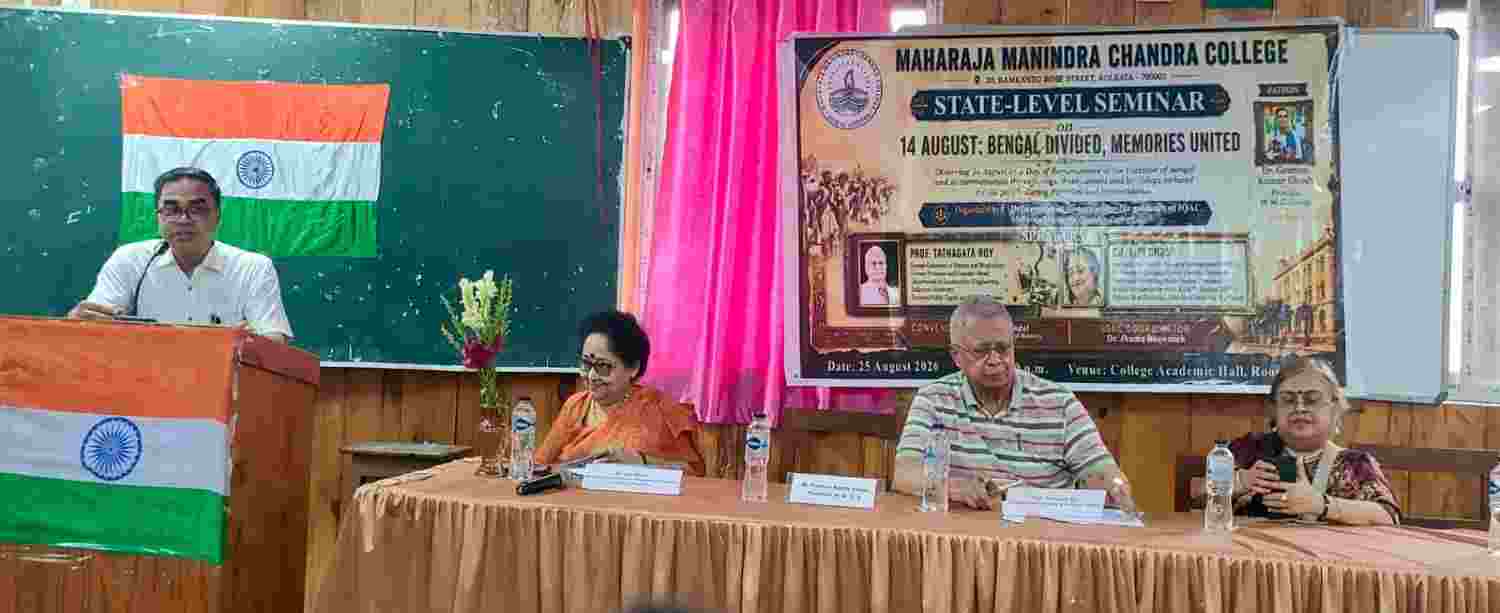
The painful legacy of the 1947 Partition, the suffering of displaced communities and the politics of historical memory took centre stage at a state-level seminar organised by the Department of History at Maharaja Manindra Chandra College. The programme, titled “14 August: Bengal Divided, Memories United,” brought together academics, researchers, teachers, students and public intellectuals to discuss Partition and its continuing impact.
Lipi Ghosh: “We Must Know Our History to Build Unity”
Prof. Lipi Ghosh, while speaking on “Partition Horrors Remembrance Day: History, Significance and Importance,” emphasised that remembering the human cost of Partition is essential for understanding India’s past and strengthening national unity.
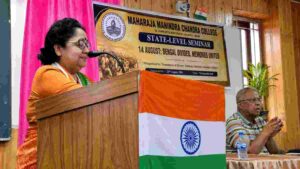
“If we want to bring unity, we must know the history of our country,” Ghosh said, stressing the importance of remembering the millions who suffered during the Partition of 1947.
She underlined that the division of India brought displacement, violence, loss of property and separation of families on an enormous scale. According to her, observing Partition Horrors Remembrance Day is an opportunity to acknowledge those sacrifices and preserve the memories of people who lived through one of the most traumatic episodes in the subcontinent’s history.
Ghosh also stressed that remembering Partition should not be interpreted as an attempt to reopen old wounds. Instead, she advocated a deeper examination of its causes and consequences.
“History must not remain confined to established narratives; previously neglected experiences, memories and voices also need to be brought into historical understanding,” she said in her broader discussion on historical memory.
She further highlighted the responsibility of younger generations to preserve historical memories through research, oral history, technology and documentation of local experiences.
Tathagata Roy: “Why Were Attempts Made to Erase These Memories?”
Former Tripura and Meghalaya Governor Prof. Tathagata Roy delivered the second keynote address on “Post-Partition Memories: Why Were There Attempts to Erase Them?” His presentation examined the political and social dimensions of remembering Partition, particularly the experiences of Bengali refugees.
Roy questioned why the traumatic experiences of many displaced families were not adequately represented in public narratives.
“Those who were killed, tortured, assaulted, raped and driven from their homes—how could their suffering simply be forgotten?” Roy said while highlighting the importance of preserving memories of victims and displaced communities.
He also questioned attempts to minimise or overlook painful chapters of Partition history, arguing that historical memory cannot be meaningful if the experiences of victims are selectively remembered.
“If we want to understand the present, we cannot simply forget what happened in the past,” Roy argued in the context of his presentation on post-Partition memories.
Focus on Bengali Refugees and Historical Memory
Tathagata Roy’s presentation particularly examined the experiences of Bengali refugees, including displacement, insecurity, loss of homes, violence and cultural rupture. He argued that many such memories remained marginal in dominant historical narratives and public discourse.
The former Governor also raised questions about the influence of political priorities, ideological interpretations and changing social circumstances on collective memory. His presentation called for greater recognition of experiences that, according to the seminar’s discussion, have not always received equal space in historical narratives.
“Bengal Divided, Memories United”
Reflecting on the seminar’s theme, “14 August: Bengal Divided, Memories United,” Dr. Saumen Mandal said the Partition of 1947 was not merely a division of Bengal’s geographical territory. It profoundly transformed the lives of millions, affecting their homes, identities, security and collective memories.
He particularly highlighted the experiences of refugees who migrated from East Bengal to West Bengal, stressing that their history should not be viewed solely through the lens of victimhood. Instead, he described it as a story of “resilience, self-respect, reconstruction and agency.”
Dr. Mandal further observed that although political boundaries could divide territories, they could not completely erase Bengal’s shared language, culture, traditions and memories.
He also emphasised the importance of approaching the history of Partition through responsible historical scholarship, recognising the suffering of affected communities while ensuring that remembrance does not become a source of hostility. The broader objective, he suggested, should be to preserve historical memory and encourage a balanced understanding of Bengal’s complex Partition experience.
A Message to the Next Generation
The event concluded with an interactive question-and-answer session involving students and faculty members, followed by concluding remarks and a vote of thanks.
The seminar ultimately presented Partition remembrance as both a historical responsibility and an educational necessity. Prof. Lipi Ghosh emphasised the importance of historical awareness for national unity, while Prof. Tathagata Roy focused on the need to ensure that the experiences of displaced and affected communities are not erased from public memory.
Together, their presentations placed Partition, historical truth, refugee experiences and collective memory at the heart of a wider debate over how future generations should understand one of the defining tragedies of modern South Asian history.
Click here to join our WhatsApp Channel for real-time news updates and exclusive coverage.