
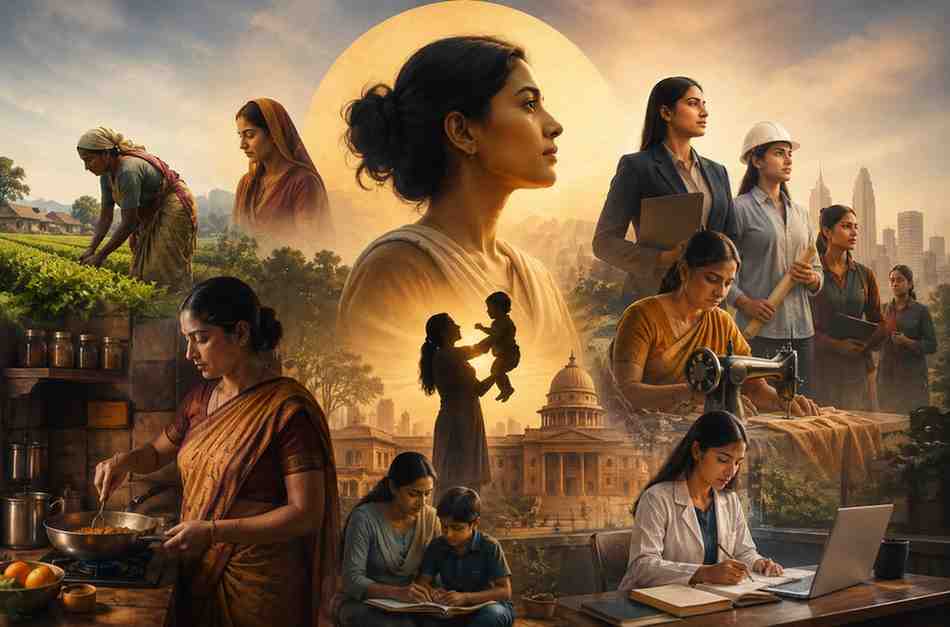
The Society is an umbrella term for multiple diverse aspects living together with different ideals set in mind. Especially when we look into the society of India, we come across realities highlighting the makeup behind the actual foundation on which every single dream aspires.
For long, swinging in the ride of patriarchy, we didn’t even bother to look at the real pedestal on which success lies. Let’s dive into words where we can feel the presence of women, who build the beautiful world around all of us.
The silent creators of society, as the name suggests, best suit the public persona that is often neglected under the polished upper layer of patriarchy. Agreeing to the fact that men contribute their best to society, the real struggle behind making the best possible still remains disguised.
As per the new landmark, the Supreme Court verdict delivered by the bench of Justices Sanjay Karol and N. Kotiswar Singh while hearing an appeal stemming from a motor vehicle accident that occurred in November 2001, housemakers have been declared “nation-builders”. The apex court symbolised the truth behind altering the term from housewives to housemakers, stating that the real strength behind the nation’s growth is the contribution made by housemakers.
The court also ruled that unpaid domestic work must be monetised at a minimum of thirty thousand per month when calculating compensation in motor accident claims, giving recognition to the invisible hard hours and labour that hold profound economic and social value. The court bench highlighted that the loss of domestic care that housemakers provide must be treated as a separate category of damages.
Hidden behind the shackles of society, in the majority of remote areas, women are still not allowed to speak in groups of people. The purdah system is still practised in multiple areas and in various sects of India’s diverse society. The birth of a boy is celebrated with huge pomp and show and, in areas where women are still not properly recognised, the girl child is considered a burden, even though, in today’s era, irrespective of gender, both are contributing equally to the growth of the nation’s GDP.
A woman gives birth to a child and nurtures the child with utmost care and love. That same child, when grown up, marries a woman, and the same cycle repeats itself. Then where does the real accountability for the nation’s growth lie? Definitely with women, who sacrifice even themselves for the children they give birth to. Our government provides numerous schemes, but when it comes to regulation, where do we still lack? It is obvious that we lack in the regulation part.
Coming to the demography of the nation, India’s current Total Fertility Rate is 1.9, whereas the replacement rate is 2.1, highlighting a deficiency in population to maintain long-term stability.
The Andhra Pradesh government announced a new population management policy featuring direct cash incentives to reverse the declining Total Fertility Rate (TFR) and combat the ageing population. Taking this into account, a major question again arises: Are women only meant for contributing to the population aspect of the nation? The ground realities are hard to conquer.
Therefore, this can be improved to a larger extent by, firstly, properly regulating government schemes to include women in the mainstream of society and, secondly, by providing fair and equal opportunities while abiding by the articles mentioned in the Constitution of India.
These amendments are enough to eradicate the dust from the minds of people who think that THE SILENT BUILDERS OF OUR SOCIETY are only meant for working behind the curtains and not representing themselves in the mainstream culture.






Very well written and informative its very important to acknowledge the Hardwork of each and every homemaker heros 💯💯