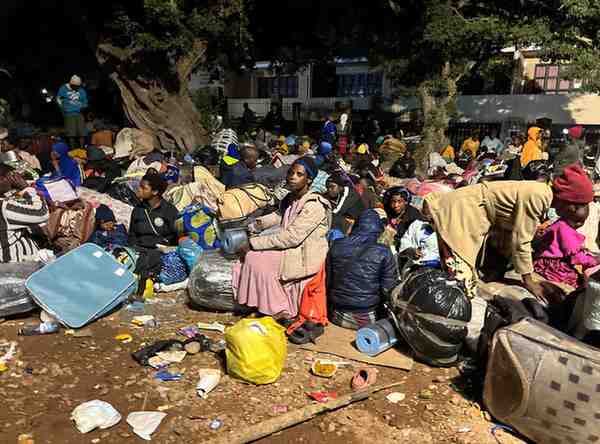
Entering its fourth year, the conflict between the Sudanese Armed Forces (SAF) and the Rapid Support Forces (RSF), which erupted on 15 April 2023, has degraded into one of the gravest displacement crises. Sudan has become the epicentre of the world’s largest internal displacement crisis, shattering millions of family structures and dissolving ancestral communities overnight. Despite far-reaching implications and several diplomatic initiatives, the crisis continues to deepen.
Geography of Exile: Cartographies of Human Dislocation and Displacement
The crisis has torn communities apart and forced almost 13 million people from their homes for more than three years. The conflict has caused profound human suffering, with nearly 8.6 million people displaced from their homes within Sudan and some 3.8 million others seeking refuge in neighbouring countries such as Egypt, Chad and South Sudan. On top of the displacement crisis, the war has worsened an already fragile humanitarian situation. Parts of Darfur are in famine like conditions with millions of people struggling to find food, health care and basic services. Today, nearly half of Sudan’s population relies on humanitarian aid to get through the day and survive. Additionally, increasing rates of gender-based violence, collapsing healthcare facilities, and 19 million war- torn children missing school have deepened the crisis.
The Conflict Multiplier: The Intersection of War, Epidemic, and Climate Emergencies
After getting away from the battlefield, life is still a hard fight for survival. Around 69.3% of people who have been forced to leave their homes do not have access to basic food, clean water, or housing, and 55.9% do not have access to medical services. Also, a susceptible 42.2% are left to deal with chronic illnesses, along with a significant part of the population suffering from mental health conditions.
The Echo Chamber of Inaction: Critiquing Global Geopolitical Apathy
The situation has been further complicated by external actors backing opposing sides. While the United Arab Emirates (UAE) has been linked to support for the Rapid Support Forces (RSF), countries such as Egypt, Saudi Arabia, and Turkey have supported the Sudanese Armed Forces (SAF). This external connection has contributed to the flow of military resources into the conflict, helping to sustain and intensify the violence. Their divergent goals have deteriorated a domestic power struggle into a proxy conflict.
The Berlin conference in April 2026 was an important unifying platform for people working at the frontlines of the world’s worst humanitarian disaster. The summit brought together representatives of 55 states and major regional bodies backed by a powerful coalition of global aid networks. However, these attempts have found no solution.
This year in Berlin, last year in London, and in the year before that in Paris. Even after a unanimous call for action, the crisis still deepens. The conference also received a sharp rebuttal from the Sudanese government, calling it “surprising and unacceptable” interference in its internal affairs, made without consulting Khartoum, undermining state sovereignty. Diplomacy, in this case, has become performative, yielding no substance.
For a peaceful world: Forging solutions
The crisis has worsened a multitude of pre-existing issues that had already undermined Sudan’s social and economic foundations. It demands urgent and legitimate attention, with proportional representation of all stakeholders. The multifold crises demand the serious expansion of humanitarian access corridors. A system of pressure and checks and balances should be developed for external sponsors. Accountability mechanisms should be strengthened by creating a legitimate framework. At last, the framework of peace should be by Africa, for Africa, and to Africa.