
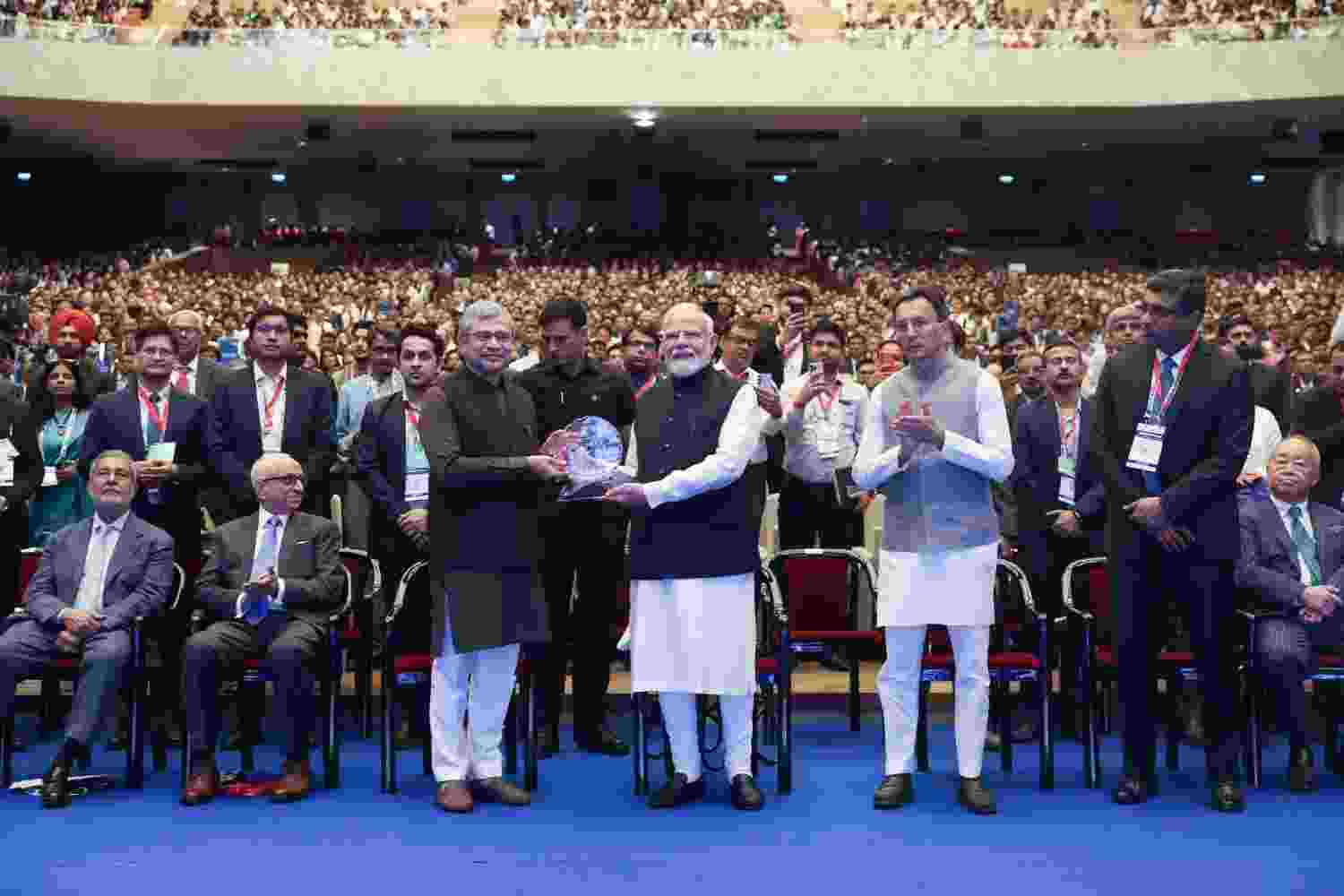
The most important question after SEMICON India 2026 is not what happened inside the exhibition halls of Yashobhoomi. It is what happens outside them.
For three days, New Delhi became a meeting point for the global semiconductor industry, with more than 600 companies and participants from 52 countries gathering around a common theme: “Silicon to Systems: Building the Ecosystem.” The presence of international companies, technology leaders, policymakers, researchers, start-ups and students reflected the growing importance of India in a sector that has become central to the global economy.
But an editorial assessment of SEMICON 2026 must go beyond the excitement of announcements and investment commitments. Semiconductor manufacturing is a long game. It demands enormous capital, scientific expertise, precision engineering, reliable infrastructure and, above all, patience.
Bharat has now made its ambition clear. The challenge is to turn that ambition into an industrial reality.
The significance of this moment goes well beyond India. In a world increasingly dependent on artificial intelligence, electric mobility, advanced telecommunications, defence technology and data centres, semiconductors are no longer simply electronic components. They are strategic infrastructure.
That makes India’s attempt to build a complete semiconductor ecosystem relevant to the world.
India’s Semiconductor Opportunity Is Bigger Than Manufacturing
For many years, Bharat’s global technology reputation was built primarily around software, IT services and engineering. That achievement created a huge reservoir of technical talent, but semiconductor manufacturing demands a different industrial culture.
It requires clean-room manufacturing, advanced equipment, precision materials, sophisticated testing, specialised packaging, process engineering and continuous research. Bharat is now attempting to build those capabilities together.
This is where the theme of SEMICON 2026 becomes particularly important. “Silicon to Systems” suggests a shift from thinking about the semiconductor as an isolated product towards building the complete chain around it. That is the right direction.
A successful semiconductor industry cannot consist of a few factories surrounded by imported machinery and materials. It needs suppliers, designers, research institutions, testing facilities, logistics networks, equipment companies, skilled technicians and customers.
India’s large domestic market provides another important advantage. Chips manufactured or designed in Bharat can potentially find applications in automobiles, telecommunications, consumer electronics, industrial machinery, healthcare, energy systems, defence and artificial intelligence.
The country therefore has something many semiconductor-producing economies do not possess at the same scale: a vast market in which technologies can be developed, tested and commercialised.
For the global industry, India’s emergence could also contribute to greater diversification.
The semiconductor supply chain has become increasingly sensitive to geopolitical tensions, trade restrictions and disruptions. A stronger Indian manufacturing and packaging base would not eliminate those risks, but it could give companies another significant location within an increasingly distributed global network.
Bharat should therefore not approach the semiconductor industry merely as a contest with other countries. Its more useful role could be that of a reliable partner within the global semiconductor system.
From Policy to Production: The Moment Has Changed
The most important change in India’s semiconductor story is that the discussion is gradually moving from policy to production.

Semicon 2.0, approved by the Union Cabinet in July 2026 with an outlay of ₹1,27,500 crore, expands India’s semiconductor strategy across design, equipment and materials, fabs, advanced packaging, applied research and talent.
SEMICON India 2026 provided evidence that the first phase is beginning to produce tangible industrial capacity.
The government said five semiconductor manufacturing plants had commenced commercial production. Commercial production lines were also launched at CDIL Semiconductor in Mohali and Suchi Semicon in Surat, adding to facilities associated with Micron, Kaynes and CG Semi. This distinction is crucial.
A policy announcement can create expectations. An investment proposal can create headlines. A factory under construction can create optimism. But production creates evidence.
India’s semiconductor journey should increasingly be judged by what comes out of these facilities: the products they manufacture, the customers they serve, their quality, their ability to scale and the suppliers that develop around them. There is also an important caution here.
Recent reporting notes that Bharat has not yet begun chip production from a large-scale fabrication facility, while some major projects have faced delays.
That should not diminish the progress already made. It should clarify the next task. India has reached the stage where execution matters more than declarations.
The country will have to demonstrate that large semiconductor projects can be completed on schedule, operate consistently and eventually compete internationally. That is a much harder test.
India’s Real Advantage Will Be Talent, Design and Indigenous Innovation
Factories may attract attention, but people will determine the long-term strength of India’s semiconductor industry.
Also Read | AI Revolution In Ayurveda: Ayush Ministry Expands Smart Digital Ecosystem
India already has a substantial presence in global semiconductor design. Government material says India hosts nearly 20% of the global semiconductor chip-design workforce and around 7% of the world’s semiconductor-domain Global Capability Centres. More than 300 chip designs have been developed by organisations participating in the country’s design ecosystem.
This is potentially one of India’s greatest advantages. But the next step must be to convert employment and engineering capability into intellectual property.
There is a fundamental difference between designing part of a product for a multinational company and building an Indian semiconductor company whose technology is used globally.
India needs more companies that own chip architectures, develop specialised processors, build power-management technologies, create AI accelerators and develop semiconductor solutions for automobiles, telecommunications and industrial applications.
That transition will not happen automatically. It requires research funding, university-industry partnerships, experienced mentors, patient private capital and access to advanced design and fabrication facilities. It also requires accepting failure.
The semiconductor industry is expensive and unforgiving. Not every start-up will succeed. Not every design will reach commercial production. Not every technology will remain competitive.
A mature semiconductor ecosystem must therefore be willing to finance experimentation rather than demand immediate returns.
The goal should be simple but ambitious, India should not remain only a place where the world’s semiconductor industry designs and manufactures. It should increasingly become a place where the next generation of semiconductor ideas originates.
The World Is Watching What India Does Next
The international response to India’s semiconductor push suggests that global industry is taking the opportunity seriously.
Applied Materials announced plans to invest $5 billion in India over the next decade, with its plans covering areas including research, supply-chain development and workforce expansion.
There are also emerging technology partnerships between Indian companies and international semiconductor players. For example, Nexperia and Tata Electronics announced a strategic partnership involving semiconductor production and packaging in India.
Such developments matter because the semiconductor industry is inherently interconnected.
No country can realistically manufacture every machine, material and component required for the most advanced chips. The strength of a semiconductor economy comes from its connections.
India’s objective should therefore be to make itself increasingly valuable to that international network.
That means building the infrastructure that global companies need, but also developing domestic companies capable of becoming global suppliers themselves.
Factories will require engineering services. Equipment manufacturers will require local suppliers. Research centres will need scientists. New industrial clusters will require logistics, housing, education and supporting infrastructure.
The global benefit could be equally significant. More manufacturing capacity, additional packaging capabilities, a larger design workforce and new sources of innovation can contribute to a more diversified semiconductor ecosystem.
India’s rise should consequently be seen not simply as a national industrial project but as one possible contribution to a more resilient global technology supply chain.
The Real Test Begins After SEMICON 2026
This is where the question becomes unavoidable, What will India do after the summit? The answer will determine the real legacy of SEMICON 2026.
India will need to ensure that semiconductor projects move from construction to commercial scale. It will need a deeper ecosystem of domestic suppliers for materials, chemicals, equipment and precision manufacturing. It will need to expand advanced packaging and testing capabilities. It will need to increase semiconductor research. And it will need to ensure that its growing talent pool is connected directly to industry.
Ajit Doval Calls IIT Roorkee Graduates ‘Luckiest Generation’ Amid Technology Boom
Most importantly, India will need to create an environment in which companies can plan for decades rather than quarters. The semiconductor industry rewards consistency.
If policies remain predictable, infrastructure improves, research expands and projects are executed efficiently, international companies may have stronger reasons to place additional parts of their supply chains in India.
The result could be a gradual change in India’s economic profile—from a major services and consumption market into a country with increasingly significant capabilities in strategic manufacturing and technology. But this should be viewed as a possibility, not a guaranteed outcome.
There will be challenges. Global semiconductor cycles will change. Technologies will evolve. Competition will remain intense. Projects can face delays. Capital requirements can rise.
India will have to prove that it can remain committed even when the headlines disappear. That is why SEMICON 2026 should not be treated as the conclusion of India’s semiconductor journey.
The country has established a policy framework, attracted global participation, expanded its design capabilities and begun commercial production in multiple facilities. Government figures also indicate that more than 1 lakh engineers across 500 organisations have gained access to advanced chip-design tools.
The next stage is considerably harder: building companies, technologies and supply chains that can compete globally without permanent dependence on government support.
That is the standard by which the semiconductor mission should ultimately be judged.
The world is looking for resilient technology supply chains. India has an opportunity to become an important part of that future.
SEMICON India 2026 has given India momentum and has demonstrated that the country’s semiconductor ambitions are attracting serious global attention.
Now comes the less glamorous part—the years of construction, experimentation, investment, research and execution.
If India succeeds in connecting silicon with systems, talent with technology, manufacturing with innovation and domestic capability with global partnerships, the consequences could reach far beyond the semiconductor industry.
SEMICON 2026 may then be remembered not simply as another technology summit in New Delhi, but as one of the moments when India’s role in the global technology economy began to change fundamentally.
Click here to join our WhatsApp Channel for real-time news updates and exclusive coverage.