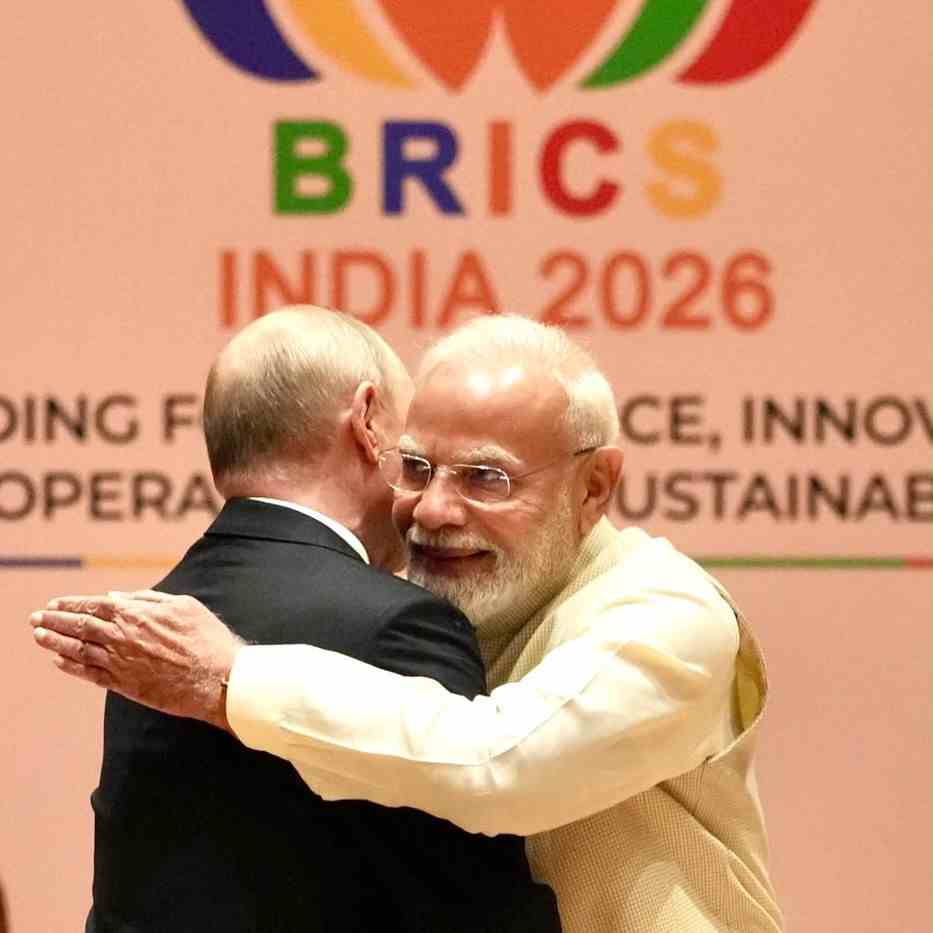
Indian PM Narendra Modi and Russian President Vladimir Putin embrace at the BRICS 2026 gathering in New Delhi offered more than a powerful diplomatic image. It captured the enduring warmth of a relationship that has survived major geopolitical shifts while highlighting India’s distinctive approach to an increasingly fragmented world. As India hosts the expanded BRICS grouping, the meeting between Prime Minister Narendra Modi and Russian President Vladimir Putin carries significance not only for bilateral ties but also for the larger debate over multipolarity, economic resilience and strategic autonomy.
The embrace was instantly symbolic. In an era when diplomatic relationships are frequently viewed through the lens of competing blocs, the Modi-Putin interaction demonstrated that India continues to value political trust with Moscow. Yet India’s engagement with Russia should not be interpreted as a rejection of its relationships with the United States, Europe, Japan or other partners. Instead, it reflects New Delhi’s effort to maintain room for independent decision-making.
Beyond the optics of hug diplomacy
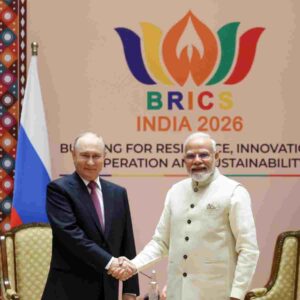
Diplomatic gestures matter, particularly when they occur against a complicated international backdrop. The Modi-Putin embrace conveyed familiarity and continuity, but the real importance of their engagement lies in the discussions behind the public symbolism.
India-Russia relations have historically been anchored in defence cooperation, energy, space, nuclear technology and political coordination. The changing global economy has now created an opportunity to broaden that relationship. Trade, investment, connectivity, manufacturing and technology cooperation are becoming increasingly important components of the partnership.
The challenge for both countries is to translate political confidence into measurable economic outcomes.
For India, maintaining stable energy supplies and diversified strategic partnerships remains essential. For Russia, deeper economic engagement with India provides an important avenue for expanding trade and connectivity amid continuing geopolitical pressures.
BRICS 2026: India sets the tone
The broader setting of New Delhi is crucial. As chair of BRICS in 2026, India has the opportunity to shape the organisation’s priorities at a time when the grouping has expanded and the global economy is undergoing profound changes. The larger BRICS membership brings together countries with different political systems, economic structures and strategic interests.
That diversity can be a challenge, but it can also be BRICS’ greatest strength.
India’s preferred approach is likely to be practical rather than confrontational: strengthening trade, encouraging investment, improving connectivity, supporting innovation and addressing the concerns of developing economies.
This is particularly relevant to Modi’s emphasis on removing trade barriers and expanding opportunities. If BRICS is to become a more influential economic platform, declarations must eventually translate into easier market access, stronger supply chains and more efficient financial and logistical links.
Strategic autonomy at the heart of India’s diplomacy
The Modi-Putin meeting also illustrates what strategic autonomy means in contemporary Indian foreign policy.
Strategic autonomy does not mean maintaining equal distance from every major power. Nor does it mean refusing partnerships. It means retaining the ability to cooperate with different countries according to India’s national interests.
Also Read —“Remove Trade Barriers, Expand Opportunities”: PM Modi’s Strong BRICS Business Push
India can deepen its engagement with Russia while simultaneously expanding cooperation with Western economies and other strategic partners. Such flexibility becomes particularly valuable when geopolitical competition affects energy markets, defence supply chains, technology and international trade.
The Modi-Putin relationship therefore fits into a larger Indian strategy: diversify partnerships without becoming dependent on any single power centre.
From energy dependence to broader economic partnership
One of the most important questions facing India-Russia relations is whether their economic relationship can move beyond its heavy dependence on energy.
Energy cooperation has strategic value, particularly for a rapidly growing economy such as India. But a long-term partnership requires a wider economic foundation.
Manufacturing, pharmaceuticals, agriculture, nuclear energy, transport corridors, digital technology and critical supply chains could provide areas for expansion. Greater investment flows in both directions would also give the relationship greater resilience.
The target of substantially increasing bilateral trade in the coming years is therefore significant, but the composition of that trade will matter as much as its headline value.
BRICS and the changing world order
The significance of Modi’s engagement with Putin ultimately extends beyond India-Russia relations.
Modi Meets Putin: India-Russia Ties Get Major Push With $100 Billion Trade Goal
BRICS is increasingly viewed as an important platform through which emerging economies can seek a greater voice in global governance. But its future will depend on whether its members can cooperate despite their differences.
India has little interest in transforming BRICS into a rigid geopolitical alliance. New Delhi’s larger objective is a multipolar system in which developing and emerging economies have greater representation and strategic choices.
That makes India’s chairship particularly important.
If BRICS can concentrate on economic cooperation, development, technology, connectivity and institutional reform, it can strengthen its relevance without becoming defined by opposition to any particular bloc.
The embrace is symbolic; the strategy is substantive
The photograph of Modi and Putin embracing may dominate headlines, but diplomacy cannot be judged by imagery alone.
The real test will be whether the warmth between the two leaders helps produce stronger economic ties, greater technological cooperation, reliable connectivity and continued political dialogue. Equally, India’s challenge will be to ensure that its relationship with Russia complements rather than constrains its broader international partnerships.
At BRICS 2026 in New Delhi, the Modi-Putin embrace therefore represents a larger diplomatic message. It shows that India is prepared to preserve longstanding partnerships while adapting them to a new global environment.
The embrace represents continuity; strategic autonomy represents the policy behind it.
For India, the objective is not to choose between competing power centres, but to expand its own strategic space. BRICS 2026 provides New Delhi with an opportunity to demonstrate that an emerging power can maintain trusted relationships, pursue economic interests and still retain an independent voice in the evolving global order.
Click here to join our WhatsApp Channel for real-time news updates and exclusive coverage.