West Bengal’s former and defeated Chief Minister Mamata Banerjee once built her political identity on fierce opposition to the Congress. She broke away from the party, accused it of political irrelevance, and positioned the Trinamool Congress as the only credible alternative to both the Left and the BJP. Yet politics often forces leaders to revisit old doors when new challenges emerge. Now she appears to be standing at a crossroads where political survival demands new calculations.
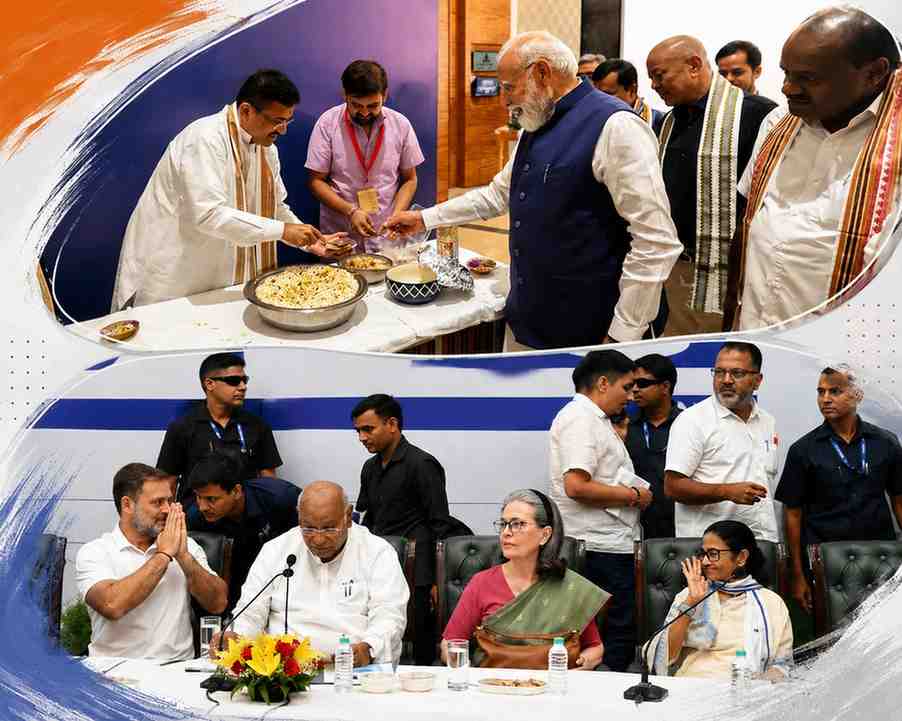
Today, with the BJP expanding its footprint in Bengal and anti-incumbency pressures mounting, Mamata appears increasingly dependent on the very Congress ecosystem she once rejected. The growing prominence of her nephew, Abhishek Banerjee, in national opposition politics reflects this shift. His outreach to Congress leaders and participation in broader anti-BJP platforms signal what many observers view as a pragmatic attempt to secure political survival rather than ideological alignment.
The irony is striking. A leader who spent decades dismantling Congress in Bengal now finds herself seeking strength from the same opposition camp. The Congress, despite its weakened electoral position, still provides a national framework and alliance network that regional parties often need in times of uncertainty.
PM Narendra Modi’s “Jhalmuri” idea, meanwhile, reflects a political philosophy of inclusiveness and collective strength. Just as the popular Bengali snack combines diverse ingredients to create a flavorful whole, Modi has often used the metaphor to emphasize unity among different regions, communities, and ideas in nation-building. The message was simple: diversity is not a weakness but a source of strength.
Politics is often shaped not only by policies and achievements but also by the personal traits of leaders. For over a decade, Mamata Banerjee has remained one of India’s most influential and controversial political figures. Her rise from a street fighter challenging the Left Front to becoming one of the country’s most powerful regional leaders is undeniable.
One of the most common criticisms levelled against Mamata Banerjee is what critics describe as political arrogance. Political success can create a sense of invincibility, but democracy thrives on accountability. When leaders appear unwilling to listen to criticism, they risk becoming disconnected from the changing aspirations of the electorate.
Political opponents frequently accuse Banerjee of making decisions that ultimately harmed her own interests. Critics point to a series of strategic errors that they believe weakened her political standing.
These include confrontational politics with the central government, inconsistent messaging on national issues, and an underestimation of emerging political challenges. In politics, perception matters as much as reality. Decisions that may seem beneficial in the short term can become liabilities when public opinion shifts. Many observers believe that some of her biggest setbacks came not from external enemies but from political miscalculations.
Another criticism often raised is that her government failed to recognize growing concerns regarding corruption allegations, law and order issues, and governance challenges.
The controversies surrounding recruitment scams and allegations involving several leaders within her party created a perception problem. While Banerjee attempted to distance herself from these issues, opponents contend that her responses often appeared defensive rather than corrective.
Ignoring warning signs can be dangerous in politics. Voters may forgive mistakes, but they rarely forgive a leadership that appears unwilling to acknowledge them.
Political survival often appears to take precedence over broader governance concerns. Critics argue that the Trinamool Congress became increasingly centered around protecting its political dominance rather than focusing solely on development and administrative reform.
Whether fair or unfair, the perception emerged among some sections of society that loyalty to the party was often valued more than institutional accountability. Such perceptions can damage a government’s credibility even if they are not universally accepted.
Politics requires balancing personal ambition, party interests, and public welfare. When voters believe that this balance has been lost, dissatisfaction begins to grow. Critics argue that Mamata Banerjee failed to fully understand changing public sentiment in West Bengal and, as a result, lost significant political ground.
Every political leader eventually encounters a moment of self-realization. History is filled with powerful figures who dominated their political landscape only to discover that public support is never permanent.
For Mamata Banerjee, some believe that this moment may involve recognizing that electoral victories alone cannot guarantee lasting legitimacy. Public trust must be continuously renewed through governance, transparency, and responsiveness.
Self-realization does not necessarily mean political defeat. Instead, it can become an opportunity for reflection, reform, and reinvention. Some leaders emerge stronger after acknowledging their mistakes, while others struggle because they refuse to adapt.
Banerjee’s greatest strength has always been her ability to connect with ordinary people and position herself as a fighter against powerful opponents. However, critics argue that this image has weakened over time as she became the establishment she once opposed.
Perhaps the most contentious criticism directed at Mamata Banerjee concerns allegations of Muslim appeasement. Her opponents argue that many of her policies and political statements were designed primarily to consolidate minority votes.
Supporters reject this accusation and maintain that her government merely sought to ensure the welfare and representation of minority communities. They argue that inclusive governance should not be confused with appeasement.
Politics often turns on grand speeches and major policy announcements, but sometimes a simple gesture can carry far greater weight. Prime Minister Narendra Modi’s much-discussed “Jhalmuri moment” in West Bengal appears to be one such example.
At first glance, sharing and appreciating a humble Bengali street snack may have seemed like a light-hearted cultural interaction. However, in politics, symbolism matters. By embracing a food item deeply associated with Bengal’s identity, Modi sent a message that went beyond party lines and electoral calculations. It reflected an attempt to connect with the cultural emotions of ordinary Bengalis rather than engage only through political rhetoric.
The significance of such gestures lies in their ability to soften political barriers. Voters often respond not just to promises and policies but also to signs of respect for their traditions and way of life. The Jhalmuri episode became a talking point because it projected familiarity with Bengal’s culture while helping the BJP strengthen its emotional outreach in the state.
Whether one supports or opposes the BJP, the lesson is clear: in modern politics, small symbolic actions can sometimes prove more influential than headline-grabbing speeches. The “Jhalmuri moment” demonstrated how cultural connection can become a powerful political tool.
In this view, whether Mamata Banerjee’s political future is nearing its conclusion or whether she can reinvent herself once again will depend not on her opponents, but on the people of West Bengal.
One thing remains certain, democracy ultimately belongs to the voters. They alone will decide whether Mamata Banerjee’s political journey is approaching its final chapter or whether another comeback still awaits her.
In my view, I must say is that Mamata Banerjee has to accept her destiny which is “THE END”.