Russia has floated an ambitious proposal to explore a rail connection linking the country with India through an overland corridor, potentially creating a major new route for freight movement between the two strategic partners. The proposal comes at a time when geopolitical tensions are putting pressure on traditional maritime trade routes and forcing countries to search for safer and more reliable alternatives.
Russian Deputy Prime Minister Marat Khusnullin has called for Moscow and New Delhi to examine the feasibility of establishing a railway route that could eventually connect Russia with the Indian Ocean and provide access to India. He described potential connectivity options as viable, indicating that Moscow is willing to consider multiple routes across Central and South Asia.
Russia Eyes Alternative Route To Indian Ocean
According to the proposal, a potential railway corridor could pass through countries including Turkmenistan, Iran, Afghanistan and Pakistan before reaching India. The exact alignment, however, remains at the exploratory stage, and there is no indication yet that construction of such a direct railway has been formally approved.
Khusnullin argued that alternative land routes could become increasingly important because of risks surrounding major maritime chokepoints. He specifically pointed to the Bosphorus Strait and the Strait of Hormuz as areas where geopolitical tensions or disruptions could affect international trade.
The proposal therefore represents more than a conventional infrastructure plan. It reflects Moscow’s broader effort to diversify its transportation network and develop dependable overland connections with major markets.
Strait Of Hormuz Crisis Drives Search For New Corridors
The proposal comes against the backdrop of serious disruptions affecting maritime trade through the Strait of Hormuz. Escalating hostilities involving the United States, Israel and Iran have heightened concerns over the security of one of the world’s most strategically important waterways.
The Strait of Hormuz is a crucial passage for global energy supplies, carrying a significant share of international oil and LNG shipments. Any prolonged disruption can have consequences for energy prices, shipping costs and supply chains across Asia and beyond.
For Russia, developing an alternative route to the Indian Ocean could reduce dependence on vulnerable maritime passages. For India, additional land-based connectivity with Russia could potentially provide another channel for trade, particularly for bulk commodities and industrial goods.
Potential Route Could Cross Four Countries
One of the most challenging aspects of the proposal is the geography involved. A land corridor from Russia to India would have to cross several countries and deal with different railway systems, border procedures, security conditions and infrastructure standards.
Turkmenistan and Iran could provide an important southern passage from the Russian sphere toward South Asia. Afghanistan and Pakistan have also been mentioned as possible parts of the route.
Such a corridor would require extensive coordination among participating countries. Customs procedures, railway gauges, freight handling facilities, border crossings and financing arrangements would all have to be addressed before large-scale construction could begin.
The security environment along portions of the proposed route would also remain a major consideration.
India-Russia Trade Connectivity Could Get Major Boost
If eventually developed, a reliable rail and multimodal corridor could strengthen economic ties between India and Russia by offering an additional option for moving goods.
Faster and more predictable freight movement could benefit sectors such as energy, machinery, metals, agricultural commodities and other industrial products. It could also increase the importance of inland logistics hubs and transport infrastructure across the countries forming the corridor.
The proposal also fits into the wider objective of improving connectivity between Russia, Iran, Central Asia and India. Existing discussions around the International North-South Transport Corridor have already focused on creating multimodal links between these regions.
INSTC Offers Existing Framework For Greater Connectivity
The proposed rail connection would not emerge in isolation. India and Russia have already been associated with the International North-South Transport Corridor, a multimodal network designed to connect India with Russia and other Eurasian markets through a combination of rail, road and maritime routes.
The new proposal could potentially complement such initiatives by expanding the role of rail transportation and creating alternative pathways toward the Indian Ocean.
For New Delhi, greater connectivity with Russia could also support broader efforts to diversify trade routes and strengthen India’s position as a key economic gateway to the wider Eurasian region.
Huge Infrastructure Challenge Ahead
Despite its strategic appeal, building a continuous rail corridor across such a vast and politically complex region would be a formidable undertaking.
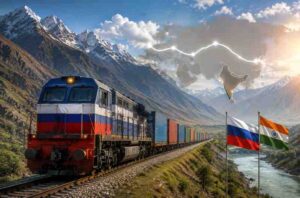
The project would require enormous investment, long-term financing and agreements among several governments. Differences in infrastructure standards and railway systems could create additional technical challenges.
There would also be questions over commercial viability. A new railway would need sufficient freight volumes to justify the investment and operating costs. Political stability and long-term security along the entire route would be equally important.
For now, therefore, the Russian proposal should be viewed as an idea for further exploration rather than an immediate construction project.
Moscow Pushes Broader Infrastructure Expansion
Khusnullin’s remarks also highlighted Moscow’s wider focus on infrastructure and construction capacity. He said Russia’s construction sector could absorb additional investment of around one trillion rubles annually and potentially expand its capacity further if such investment continued over several years.
The comments suggest that Russia is looking beyond individual transport projects and attempting to strengthen the infrastructure base required for large-scale economic development.
A Potential New Eurasian Trade Lifeline
A Russia-India rail connection, if eventually realised, could reshape freight connectivity across Eurasia. It could provide Russia with another route toward the Indian Ocean while giving India additional access to northern Eurasian markets.
However, significant political, financial, technical and security hurdles remain before such an ambitious corridor could become reality.
For now, Moscow’s proposal sends a powerful strategic message: as geopolitical tensions expose the vulnerability of traditional sea lanes, Russia is increasingly looking toward land-based corridors to secure its economic links with India and the wider Asian market.
Click here to join our WhatsApp Channel for real-time news updates and exclusive coverage.