
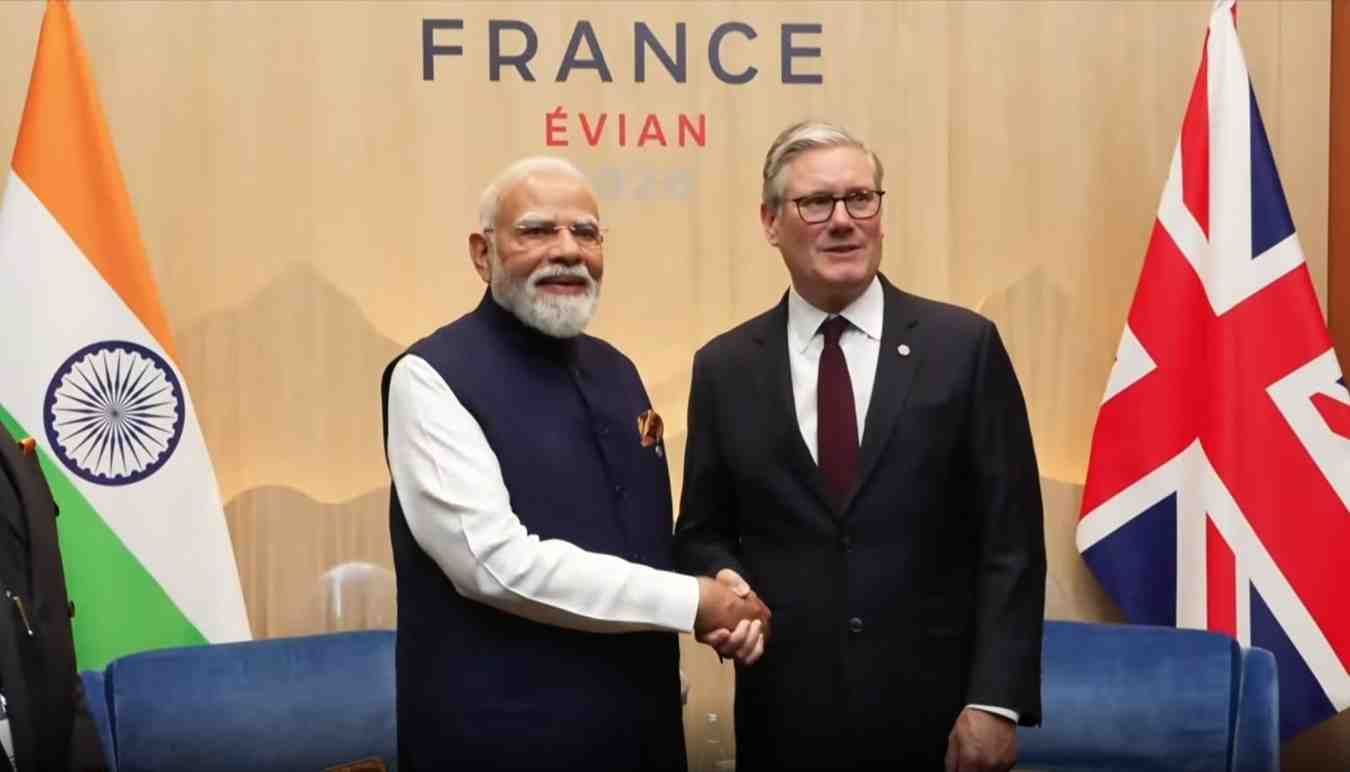
EVIAN, FRANCE: Trade and economic cooperation emerged as the key focus during the bilateral meeting between Prime Minister of India Narendra Modi and UK Prime Minister Keir Starmer on the sidelines of the G7 Summit in Evian, France. The two leaders reaffirmed their commitment to strengthening the India-UK Comprehensive Strategic Partnership and accelerating the implementation of a landmark trade agreement that is expected to unlock new economic opportunities for both nations.
The meeting reflected the growing momentum in India-UK ties, particularly after the reciprocal visits undertaken by both leaders last year. The discussions centred on expanding collaboration across multiple sectors under the ambitious Vision 2035 roadmap, which aims to deepen bilateral relations over the next decade.
A major highlight of the talks was the Comprehensive Economic and Trade Agreement (CETA), which both sides are keen to operationalise at the earliest. The leaders expressed optimism that the agreement would significantly boost bilateral trade, investments, job creation and supply chain integration while opening fresh avenues for businesses in both countries.
The proposed trade agreement is considered one of the most significant economic partnerships for India in recent years. It is expected to reduce trade barriers, improve market access for industries and strengthen cooperation in critical sectors such as manufacturing, services, technology and innovation.
Beyond trade, Prime Minister Modi and Prime Minister Starmer reviewed progress across all pillars of Vision 2035. These include trade and economic growth, defence and security, climate action, green energy, technological collaboration, education and stronger people-to-people exchanges.
Education emerged as another major area of progress during the meeting. Both leaders welcomed the expanding academic partnership between India and the United Kingdom, which has witnessed notable developments in recent months.
They highlighted the decision of the University of Liverpool to establish its campus in Bengaluru, a move expected to provide Indian students with access to globally recognised educational opportunities without having to travel abroad. Additionally, the University of York and the University of Bristol are also moving ahead with plans to establish campuses in Mumbai.
The expansion of leading British universities into India is expected to enhance academic exchanges, research collaborations and skill development programmes while strengthening educational ties between the two countries.
Technology cooperation also featured prominently in the discussions. Prime Minister Modi thanked the United Kingdom for its strong participation at the AI Impact Summit held in New Delhi earlier this year. The summit had brought together governments, researchers and industry leaders to discuss the safe and responsible deployment of artificial intelligence globally.
The two leaders welcomed the steady progress being made under the India-UK Technology Security Initiative, a framework designed to promote collaboration in emerging and strategic technologies.
They also noted the recent launch of the India-UK Critical Minerals Global Supply Chain Observatory. The initiative is aimed at improving resilience in critical mineral supply chains, which are essential for advanced technologies, renewable energy systems, electric vehicles and modern industrial manufacturing.
Defence and security cooperation also remained a priority area during the discussions. Both countries reiterated their commitment to strengthening strategic collaboration to address evolving global challenges and promote regional stability.
The leaders exchanged views on several international developments, including the ongoing situation in West Asia and the conflict in Ukraine. They stressed the importance of dialogue, diplomacy and international cooperation in addressing global crises.
India and the United Kingdom have increasingly aligned their strategic interests over recent years, with cooperation expanding beyond traditional sectors into areas such as cybersecurity, clean energy, advanced manufacturing and emerging technologies.
The meeting concluded with both leaders reaffirming their shared commitment to further deepen the India-UK Comprehensive Strategic Partnership and translate existing agreements into tangible outcomes that directly benefit citizens, businesses and institutions in both countries.
As both nations move towards implementing the Comprehensive Economic and Trade Agreement, the partnership is expected to enter a new phase marked by stronger economic integration, enhanced technological cooperation and deeper people-to-people connections, further cementing India and the United Kingdom as important strategic partners in a rapidly changing global landscape.