
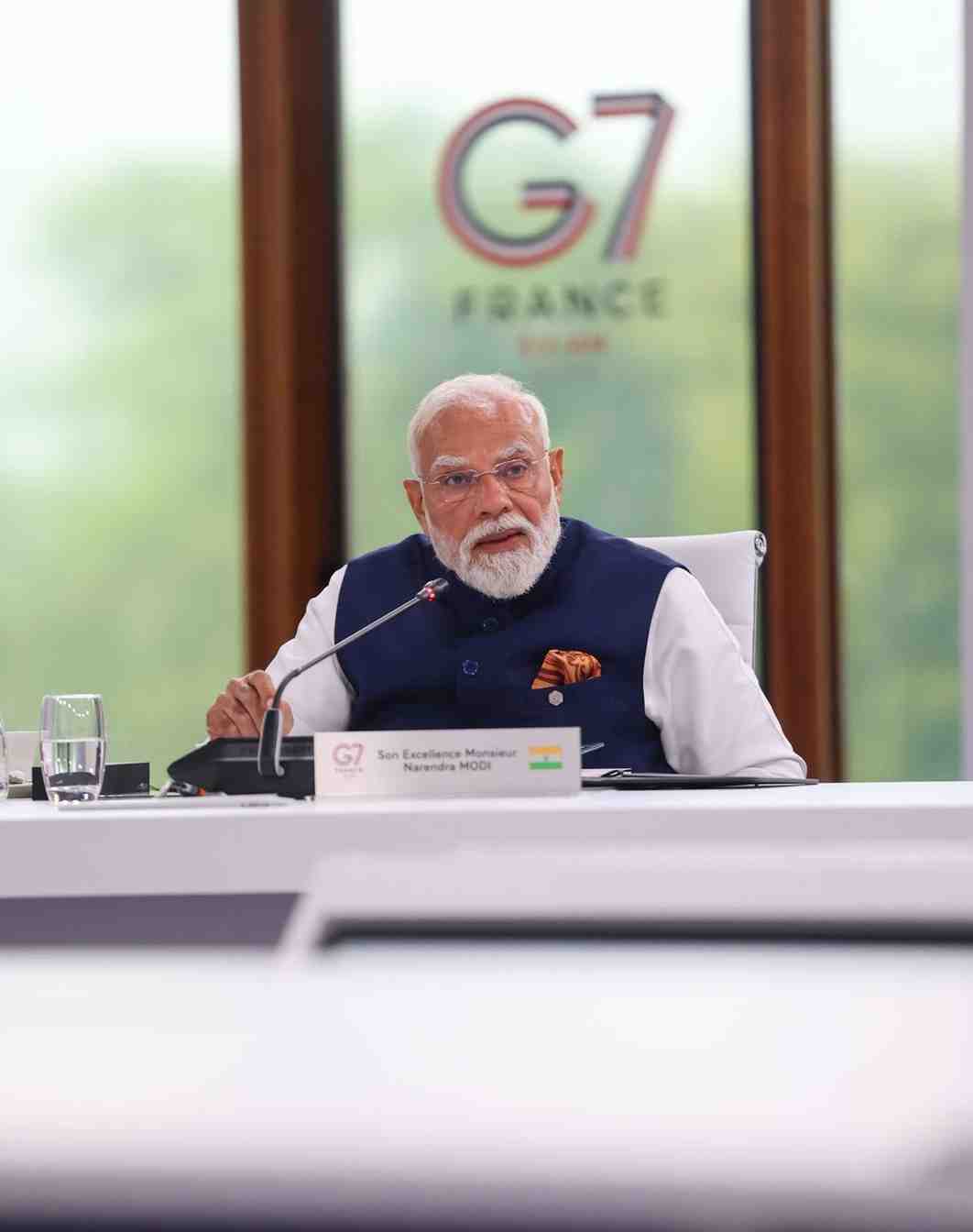
Prime Minister of India Shri Narendra Modi delivered a strong message on the future of global cooperation during the Outreach Session of the G7 Summit in Évian, France, calling for a new era of partnerships founded on trust, dignity and equality rather than dependency.
Speaking at the session titled “Forging New Partnerships and Rebuilding International Solidarity,” PM Narendra Modi highlighted the growing interconnectedness of the modern world and stressed that genuine collaboration between nations can only thrive when built upon mutual trust.
“In a world that is getting more interconnected and interdependent than ever before, this subject becomes all the more vital. But partnerships can succeed only when they are founded on trust. Mutual trust is the most important strategic asset today,” Modi said.
The Prime Minister observed that despite the world possessing abundant resources and technological capabilities, a deficit of trust has emerged as one of the greatest global challenges.
“But, sadly, today, the world does not suffer from a shortage of resources…it suffers from a shortage of trust. And the future of our partnerships depends on rebuilding this trust,” he stated.
India’s Vision: The World as One Family
Reiterating India’s long-standing philosophy of ‘Vasudhaiva Kutumbakam’ (The World Is One Family), PM Modi said New Delhi’s approach to international engagement has always been centred around people and their aspirations.
He underlined that sustainable development becomes meaningful only when it directly benefits ordinary citizens and empowers communities from within.
“We, in India, view the world as one family. Our experience shows that development is most effective when it is connected to the aspirations of people,” he said. According to PM Modi, this people-centric principle forms the foundation of several global initiatives spearheaded by India over the years.
He cited initiatives such as the , , , and the ‘Ek Ped Maa Ke Naam’ campaign as examples of India’s efforts to create collective solutions to global challenges.
These initiatives, he explained, are designed not only to address climate change and sustainable development but also to encourage active participation from countries across different regions.
Moving Beyond the Donor-Recipient Model
One of the central themes of PM Modi’s address was his call to transform traditional international aid structures.
He argued that the world must move away from outdated donor-recipient relationships and instead establish equal partnerships that promote self-reliance and local capacity building.
“India believes that the true test of partnership is not what we build for others, but what we enable others to build for themselves,” PM Modi said. He emphasised that India’s own development partnerships are rooted in this philosophy.
“Our efforts have focused on capacity building and skill development in partner countries,” he added.
The Prime Minister said that empowering nations to develop their own capabilities creates lasting progress and stronger international relationships compared to dependency-based assistance models.
He further stressed that global cooperation should be based on mutual respect and shared responsibilities.
“The Global South has immense expectations from the world. More than support, it seeks partnership. We must move beyond the donor-recipient mindset and work as equal partners. We must walk together and not merely alongside one another,” Modi said.
Delivering perhaps the strongest line of his speech, he declared, “Partnerships must be linked to dignity, not dependency.”
Focus on Africa and the Global South
Modi also highlighted India’s growing engagement with African nations, describing the continent as a key partner in shaping future global growth.
He pointed to India’s initiatives in training, skill development, water resource management, agriculture and energy cooperation across Africa.
According to him, these efforts are helping African countries strengthen their domestic capacities while simultaneously contributing solutions to wider global challenges, including food security, energy access and climate resilience.
The Prime Minister said that developing countries are no longer seeking charity from wealthier nations but are demanding equitable participation in global decision-making processes.
His remarks reflected India’s broader diplomatic push to amplify the voice of the Global South and advocate for reforms in international governance systems.
A Message for an Uncertain World
At a time when geopolitical tensions, economic uncertainty and climate challenges continue to reshape international relations, Modi’s speech positioned trust as the cornerstone of future diplomacy.
His address underscored India’s ambition to act as a bridge between developed economies and emerging nations, while promoting a model of cooperation based on shared growth and mutual empowerment.
By placing trust, dignity and equality at the centre of global partnerships, Modi presented a vision that seeks to redefine international solidarity for a rapidly changing world.
As nations grapple with increasingly complex challenges, his message was clear: the future will not be built through dependency, but through genuine partnerships that empower every nation to grow on its own terms.