
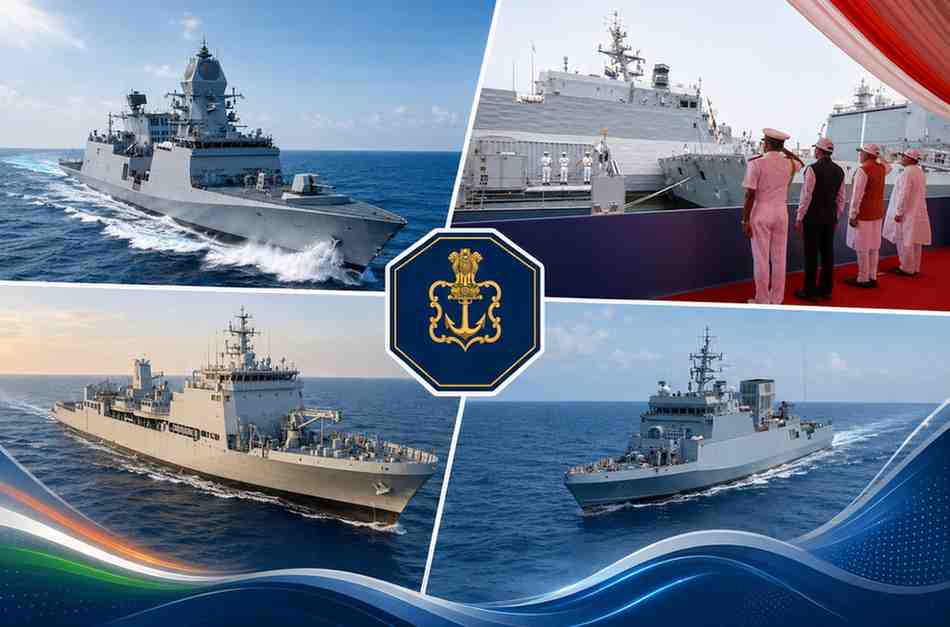
KOLKATA: Prime Minister Narendra Modi on Sunday commissioned three indigenously built Indian Navy platforms in Kolkata, marking a significant milestone in India’s journey towards defence self-reliance and strengthening maritime security. The induction ceremony brought INS Dunagiri, INS Sanshodhak and INS Agray into active naval service, reflecting the country’s increasing ability to design, build and deploy sophisticated naval assets domestically.
The commissioning ceremony was held in Kolkata, a city with a rich shipbuilding legacy and strategic importance in eastern India’s maritime ecosystem. The event showcased the progress made under the government’s vision of promoting indigenous defence manufacturing and reducing dependence on foreign suppliers.
Addressing the gathering, Prime Minister Modi underlined the growing significance of maritime strength in shaping a nation’s economic and strategic future. He emphasised that development, security and prosperity are closely connected to the seas and that India is steadily transforming from a defence importer into a major defence producer.
Three Platforms, Three Strategic Roles
Each of the newly commissioned platforms has a specialised operational role, collectively enhancing India’s naval preparedness.
INS Dunagiri
INS Dunagiri is an advanced stealth frigate designed for multi-dimensional warfare. Equipped with modern technologies and stealth capabilities, the vessel can undertake air defence, anti-surface and anti-submarine operations. The frigate represents a significant advancement in indigenous warship construction and is expected to strengthen India’s blue-water naval capabilities.
INS Sanshodhak
INS Sanshodhak is a sophisticated survey vessel that will enhance hydrographic operations and maritime domain awareness. It will support seabed mapping, underwater navigation, coastal studies and operational planning. Such capabilities are essential for both defence missions and civilian maritime development initiatives.
INS Agray
INS Agray is designed primarily for anti-submarine warfare operations in coastal regions. The vessel will help detect, track and neutralise underwater threats, thereby strengthening India’s coastal defence architecture amid evolving regional security challenges.
Boost to Atmanirbhar Bharat
The induction of all three naval platforms reinforces the government’s Atmanirbhar Bharat initiative, which seeks to create a robust domestic defence ecosystem. Over the past decade, India has accelerated investments in indigenous research, manufacturing and technological innovation in the defence sector.
Prime Minister Modi said India should no longer remain only a buyer in the global defence market. Instead, the country aims to emerge as a manufacturing hub capable of producing advanced military equipment not only for domestic use but also for exports.
The development also provides a boost to domestic shipyards, private industries, micro, small and medium enterprises, and thousands of skilled workers involved in the naval supply chain. Indigenous defence production generates employment opportunities while reducing external dependencies.
Strategic Importance in a Changing Region
The commissioning comes at a time when geopolitical competition in the Indian Ocean Region is intensifying. Maritime routes carry a significant portion of global trade, making naval preparedness a strategic necessity for India.
Defence experts believe the combination of a stealth frigate, a survey vessel and an anti-submarine warfare craft creates a comprehensive operational ecosystem. Together, these platforms improve surveillance, underwater threat detection, mission planning and coordinated naval responses.
India’s expanding naval capabilities are also expected to strengthen partnerships with friendly countries and support regional security initiatives in the Indo-Pacific region.
Kolkata’s Shipbuilding Legacy Highlighted
The choice of Kolkata as the venue also underscored eastern India’s historic contribution to shipbuilding and maritime industries. The city has long served as an important hub for naval construction and engineering excellence.
The commissioning ceremony symbolises a larger transformation underway in India’s defence sector — one that prioritises indigenous innovation, strategic autonomy and long-term national security objectives.
As India continues to modernise its armed forces, the addition of INS Dunagiri, INS Sanshodhak and INS Agray marks another important step toward building a technologically advanced and self-reliant navy capable of protecting the nation’s interests across vast maritime domains.