
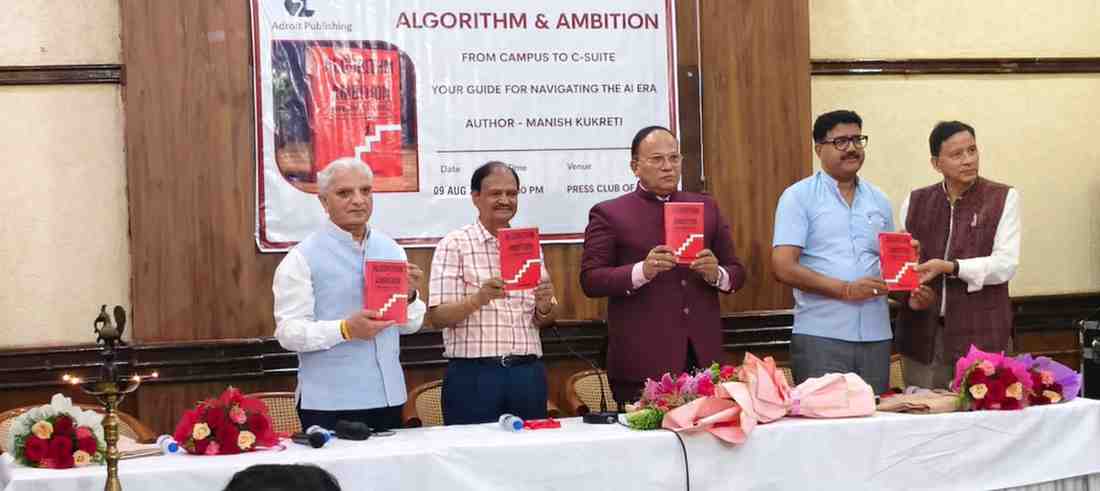
“No Humans in Sewers” was the key message at the launch of “Algorithm and Ambition: From Campus to C-Suite” at the Press Club of India, where Senior Supreme Court Advocate Dr. Bharat Nagar called for AI-powered robots and advanced technology to replace hazardous manual sewer cleaning and protect sanitation workers from deadly risks. The event brought together policymakers, academics, industry experts and other stakeholders to discuss the growing role of artificial intelligence in public safety, governance and the future of work.
Dr. Bharat Nagar Calls for End to Manual Sewer Entry
Dr. Nagar said human beings should not be exposed to life-threatening conditions while carrying out sewer cleaning or hazardous waste-related operations. He argued that modern AI-powered tools and robotic systems can increasingly perform tasks that traditionally required workers to enter dangerous environments.
According to Dr. Nagar, AI-based technologies can detect hazardous waste remotely in underground locations, inside buildings and in open areas. Once identified, robotic systems can potentially assist in removing and managing such material while keeping workers away from contaminated or otherwise dangerous environments.
His remarks underline the growing debate over the use of technology to address occupational safety concerns in sanitation and waste-management operations.
Legal Prohibition on Hazardous Manual Cleaning
Dr. Nagar referred to the legal framework introduced in 2013 and subsequent directions of the Supreme Court concerning manual cleaning of sewers and manholes. He stressed that despite legal restrictions, unsafe practices continue in some places, putting sanitation workers at serious risk.

He also pointed to weaknesses in contractual arrangements and implementation mechanisms as factors that can contribute to continued hazardous practices.
Calling for stronger enforcement, Dr. Nagar urged municipal authorities to move towards technology-driven sanitation systems. He said AI-enabled machinery and robotic equipment should be prioritised wherever hazardous environments are involved.
AI Technology for Hazardous Waste Management
The senior advocate also proposed a dedicated campaign for better identification, handling, treatment and disposal of hazardous waste.
Hazardous waste can occur in several forms, including solid, liquid and gaseous materials. Improper handling of such waste can pose serious risks to human health and the environment. Identifying dangerous material before workers come into direct contact with it could therefore play an important role in improving workplace safety.
Dr. Nagar highlighted the ability of emerging AI systems to assist in detecting hazardous material across different environments. Combined with robotics and remote-operated machinery, such technologies could reduce the need for direct human exposure during inspection, collection and disposal operations.
Uttar Pradesh and Gujarat Emerging as Technology Examples
Dr. Nagar also stated that companies in Uttar Pradesh and Gujarat have already started working on AI-based solutions for hazardous waste management.
According to him, these initiatives could provide useful models for other municipalities and institutions looking to modernise waste-management systems. Wider adoption of such technologies, he suggested, could help create safer working conditions while improving the efficiency of hazardous waste operations.
The push comes at a time when governments and industries are increasingly exploring automation, robotics and AI to address complex operational challenges.
AI’s Growing Influence Across Education and Industry
The book launch also featured discussions on the expanding influence of artificial intelligence beyond industrial applications. Speakers examined its impact on education, governance, leadership, institutional decision-making and professional careers.
Participants highlighted the need for institutions and professionals to understand the opportunities as well as challenges emerging from rapid technological advancement. AI is increasingly influencing how organisations analyse information, make decisions, develop skills and prepare their workforce for future requirements.
The discussion suggested that adapting to AI will require not only technological investment but also changes in education, organisational culture and professional training.
‘Algorithm and Ambition’ Examines the AI-Driven Future
“Algorithm and Ambition: From Campus to C-Suite” explores the changing relationship between artificial intelligence, careers, leadership and institutional decision-making.
The book examines how AI is reshaping professional pathways from education and early careers to senior management and leadership positions. It also seeks to provide readers with insights into remaining relevant as workplaces increasingly integrate intelligent technologies.
The event ultimately highlighted a broader message: AI is no longer confined to laboratories or technology companies. From hazardous waste management and public safety to education and corporate leadership, artificial intelligence is increasingly becoming part of critical decision-making and operational systems.
Dr. Nagar’s call for AI-driven sanitation and robotic sewer operations further reinforced the argument that technological innovation can play a crucial role in protecting human lives when applied responsibly and supported by effective legal and institutional safeguards.
Click here to join our WhatsApp Channel for real-time news updates and exclusive coverage.