
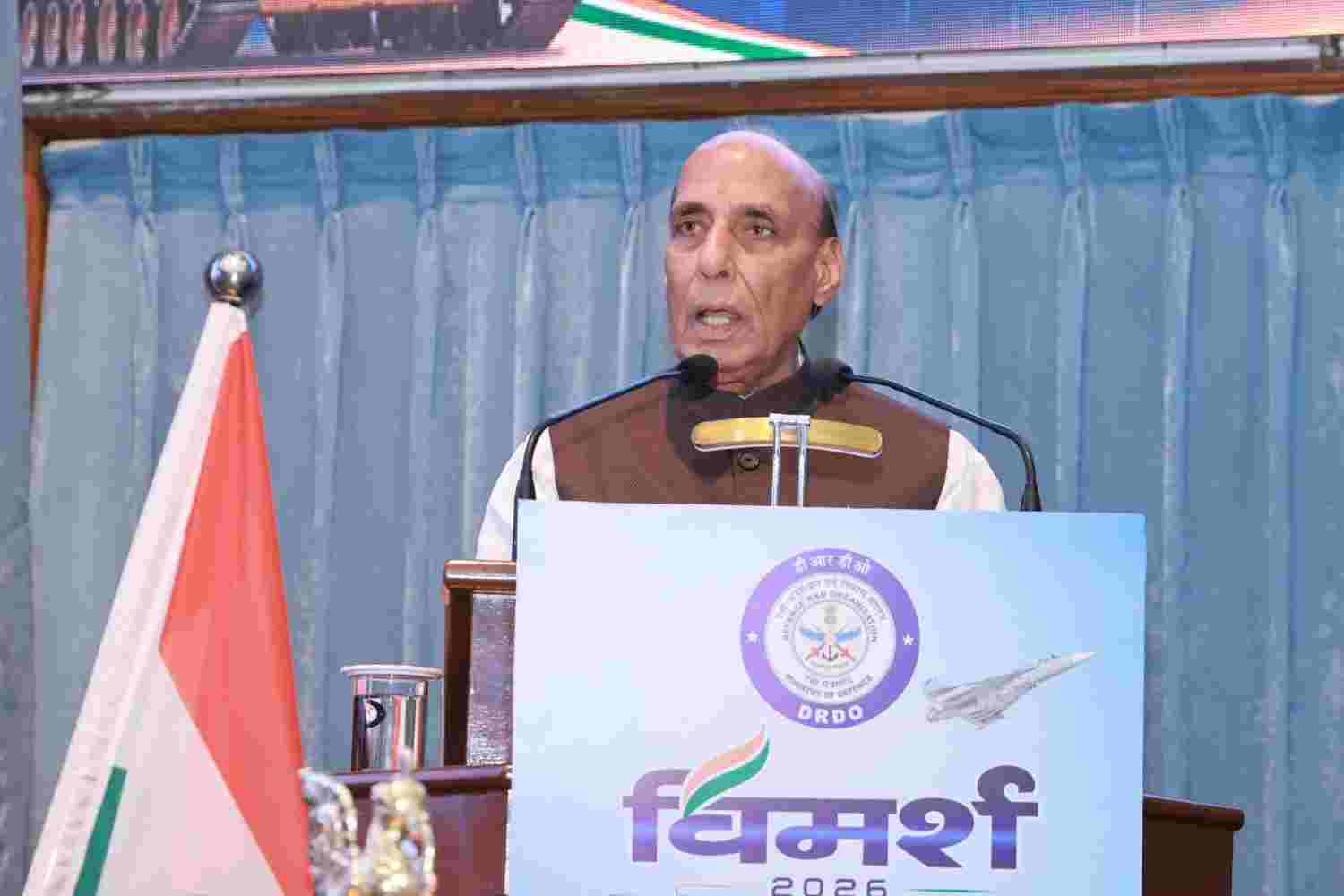
Defence Minister Rajnath Singh on Tuesday unveiled a series of significant policy initiatives to deepen collaboration between the Defence Research and Development Organisation (DRDO) and the Indian defence industry, with a particular focus on MSMEs, deep-tech start-ups and indigenous technology development.
The initiatives were announced at VIMARSH 2026, a DRDO-Industry Synergy Meet held in New Delhi under the theme ‘Varta se Vikas’. The measures are aimed at lowering barriers for smaller enterprises, accelerating technology transfer and strengthening India’s journey towards Aatmanirbharta in defence.
New Support Framework for MSMEs and Deep-Tech Start-Ups
A comprehensive framework has been introduced to reduce technical and financial barriers faced by MSMEs and deep-tech start-ups seeking to enter the defence technology ecosystem.
The framework provides for direct financial support, incubation assistance and dedicated access to DRDO testing facilities. The initiative is designed to encourage more private-sector participation in defence R&D and help promising technologies progress towards commercial and operational applications.
DRDO also launched a standardised and secure mechanism for sharing software source codes developed by the organisation with licensed industries. The framework is expected to support the growth of software-defined defence systems while helping industry address technology obsolescence.
Nine Technology Transfer Agreements Handed Over
Nine Licensing Agreements for Transfer of Technology (LAToTs) were handed over to 13 manufacturing partners in the presence of Rajnath Singh.
The agreements will enable the commercial production of advanced defence systems and are expected to expand domestic manufacturing capacity while creating opportunities for additional companies to participate in the defence supply chain.
Strategic MoUs were also formally exchanged with the Society of Indian Defence Manufacturers (SIDM) and Laghu Udyog Bharati (LUB). The agreements are aimed at expanding industry outreach and encouraging greater participation from enterprises across the manufacturing ecosystem.
DRDO further signed a contract with the Quality Council of India (QCI) for System for Advance Manufacturing Assessment and Rating (SAMAR) 2.0, which will provide a framework to assess and benchmark the manufacturing maturity of Indian defence enterprises.
Rajnath Singh Calls for Wider DRDO-Industry Partnership
Addressing the gathering, Rajnath Singh said cooperation between DRDO and industry must move beyond conventional production arrangements and cover the entire technology value chain.

He called for stronger collaboration in research, design, testing, certification and manufacturing, with the objective of establishing India as a global centre for defence manufacturing.
Rajnath Singh highlighted the complementary strengths of different stakeholders in the ecosystem. He said DRDO brings technological knowledge, industry contributes manufacturing scale, start-ups provide innovation and agility, while the youth represent the aspirations of a new India.
He emphasised that bringing these capabilities together would create the foundation for achieving ambitious national defence goals.
Focus on Viksit Bharat and Defence Aatmanirbharta
The Defence Minister said the vision of Viksit Bharat is not restricted to economic growth. According to him, India must simultaneously become technologically self-reliant, socially inclusive, environmentally sustainable and strategically secure.
He set out the long-term objective of achieving self-reliance in critical technologies by 2047, increasing indigenous content, expanding defence exports and strengthening India’s role in global supply chains.
Rajnath Singh also highlighted major defence-sector reforms introduced in recent years, including Positive Indigenisation Lists, Make in India, iDEX and ADITI.
He pointed to the decision to allocate 25% of the defence R&D budget to the private sector as another important step towards reducing dependence on imports and strengthening domestic technological capabilities.
MSMEs and Start-Ups to Drive Defence Innovation
Rajnath Singh described MSMEs and start-ups as important contributors to India’s innovation ecosystem and said they have a critical role in achieving Aatmanirbharta in defence.
Smaller enterprises are increasingly contributing components and subsystems for major defence platforms while also developing advanced technologies of their own. The Defence Minister called for their deeper integration into defence supply chains alongside established large companies.
Also Read: 9/11 Tribute Takes Strong Turn As FIA-Chicago Calls For Action Against Terrorism
The latest initiatives, he said, are intended to open new avenues for these enterprises and strengthen their ability to participate in national defence programmes.
The government’s approach also places emphasis on industry-led R&D, mentorship and financial support for emerging companies, greater academia-industry cooperation and investment in futuristic technologies.
These areas include artificial intelligence, quantum computing, hypersonics and directed-energy technologies.
India’s Shift Towards Defence Exports
Rajnath Singh said India is undergoing a major transition from being primarily a defence importer to becoming an increasingly important defence exporter.
He identified drones, artificial intelligence and cybersecurity as areas where MSMEs and start-ups could make a substantial contribution to innovation and strengthen India’s technological and strategic capabilities.
He urged MSMEs to maintain high standards of quality, timely delivery and innovation while aligning their operations with global standards and expanding partnerships with larger companies.
The Defence Minister stressed that technological leadership will become increasingly important in future conflicts and that companies investing in emerging technologies today could emerge as major players in the future defence ecosystem.
More Than 2,300 Technology Transfers Completed
Defence Secretary, Secretary of the Department of Defence R&D and DRDO Chairman Rajesh Kumar Singh said VIMARSH 2026 has been designed to connect commercial innovation with national defence preparedness.
UK-India Strike Powerful New Pact To Combat Digital Fraud With AI And Telecoms
He said the objective is to develop a collaborative technology ecosystem rather than maintain a traditional buyer-seller relationship between the government and private industry.
Rajesh Kumar Singh highlighted the progress made in technology transfer under India’s defence self-reliance efforts. According to him, more than 2,300 Technology Transfers (ToTs) have been handed over to more than 1,100 industries so far.
He also said technologies related to approximately 50 DRDO-developed missiles have been made available to industry to encourage wider participation in the defence manufacturing ecosystem.
DRDO Presents Technology Roadmaps
Technical sessions at VIMARSH 2026 featured presentations from DRDO’s technological clusters covering aeronautical systems, missiles, armaments, microelectronics and naval systems.
DRDO headquarters also outlined measures intended to simplify procedural requirements, speed up access to testing and other facilities, and reduce the time required for licensing.
A high-level panel involving representatives from DRDO, the Department of Defence Production and the Armed Forces discussed mechanisms to accelerate technology absorption and improve the Development-cum-Production Partner model.
The discussions also focused on enabling faster induction of indigenous technologies into operational service.
New Defence Publication and HR Guidelines Released
A book titled ‘Defence Systems for Resilient Bharat – Advancing Aatmanirbharta in Defence’ was released during the event.
The publication documents significant defence systems developed by DRDO’s technology clusters between 2014 and 2026, highlighting the organisation’s contribution to strengthening indigenous defence capabilities.
Guidelines for Human Resource Outsourcing Service Contracts in DRDO were also released. The guidelines cover the formulation of service requirements, selection of service providers, contract management, performance monitoring and compliance with contractual and statutory obligations.
Over 250 Industry Leaders Attend VIMARSH 2026
More than 250 defence industry leaders, representatives of industry chambers, senior civil and military officials and DRDO scientists participated in VIMARSH 2026. The Secretary of the Department for Promotion of Industry and Internal Trade (DPIIT) also attended the event.
With its focus on technology transfer, private-sector participation and emerging deep-tech capabilities, VIMARSH 2026 provided a platform for closer integration between DRDO’s research ecosystem, start-ups, MSMEs and established manufacturers.
The initiatives announced at the meet are aimed at building a more responsive and collaborative defence-industrial ecosystem and supporting India’s broader objective of achieving technological self-reliance and a stronger position in the global defence manufacturing landscape.
Click here to join our WhatsApp Channel for real-time news updates and exclusive coverage.