Prime Minister Narendra Modi has challenged what he described as an unfair attribution of global carbon-emission responsibility to developing countries, highlighting India’s comparatively low per-capita emissions and its efforts to expand renewable energy and strengthen environmental protection.
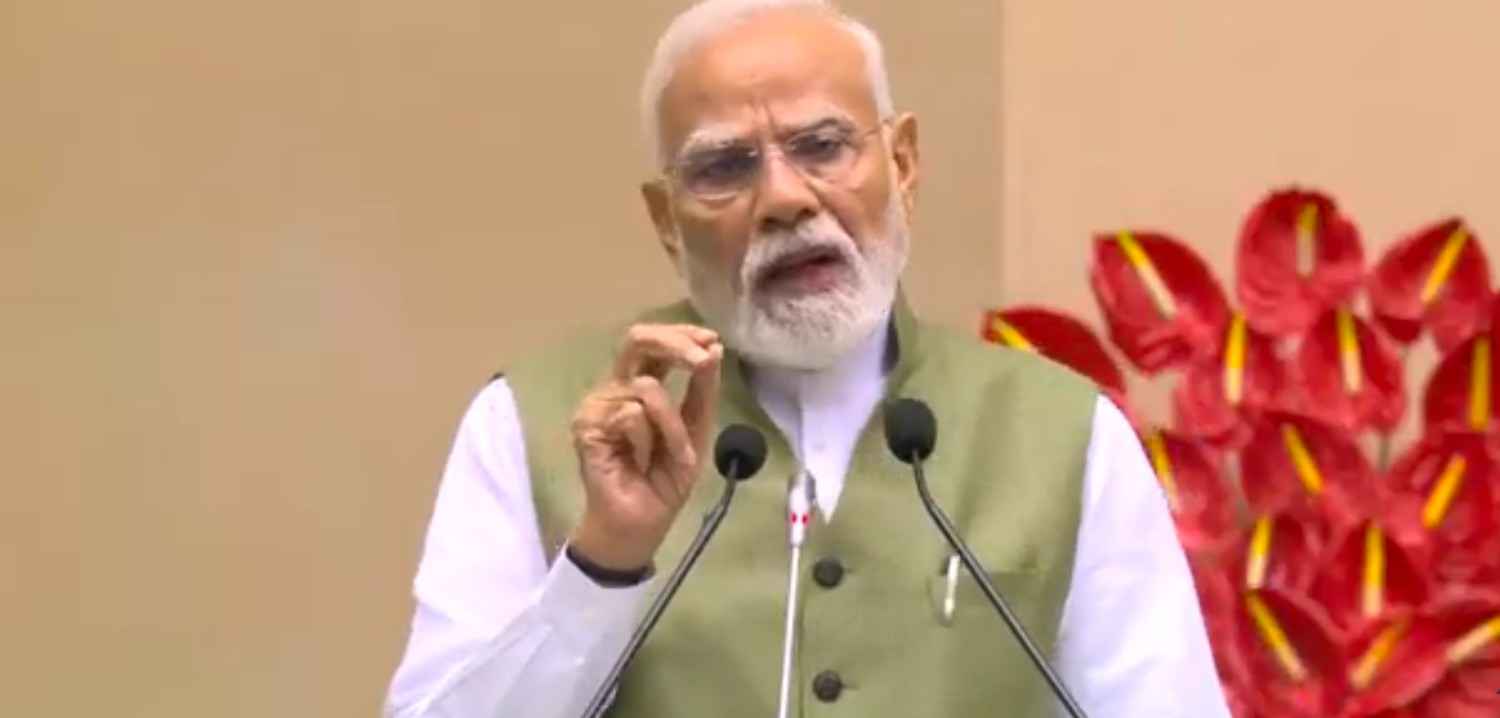
Addressing the International Conference on “The Future of Environment and Climate Dynamics” at Vigyan Bhawan in New Delhi on Saturday, September 19, 2026, Modi said climate responsibility needs to be viewed in the context of per-capita emissions and historical circumstances. The two-day conference has been organised by the National Green Tribunal and brings together judges, environmental experts, government officials and representatives from several countries.
PM Modi Highlights India’s Low Per-Capita Carbon Emissions
The Prime Minister said that the burden of responsibility for carbon emissions has frequently been placed on developing nations despite significant differences in per-capita emissions.
According to Modi, India’s per-capita carbon emissions remain below half the global average. He also contrasted India’s figure with emissions from developed economies, saying developed nations have substantially higher per-capita emissions.
The issue of per-capita emissions has been a recurring element of India’s position in international climate discussions, particularly in debates concerning equity, development needs and the distribution of climate responsibilities.
Modi said India has consistently raised these concerns at international forums while simultaneously pursuing measures intended to reduce emissions and increase the share of cleaner energy in its development pathway.
India’s Renewable Energy Push Takes Centre Stage
The Prime Minister pointed to renewable energy as a major component of India’s environmental strategy over the past 12 years.
He highlighted the expansion of solar power, electric mobility, hydrogen-related initiatives and other clean-energy technologies. Modi also referred to the PM Surya Ghar Muft Bijli Yojana, under which households are being encouraged to participate directly in solar power generation.
According to figures cited by the Prime Minister, solar panels have been installed in around 50 lakh households, while solar energy is helping India avoid a substantial volume of carbon emissions. He said renewable-energy capacity had also expanded considerably during the period.
The government has increasingly positioned household solar generation as part of India’s broader clean-energy transition, linking renewable power expansion with energy access and environmental objectives.
Climate Action Linked With Sustainable Development
Modi also referred to changes in India’s transportation infrastructure, particularly the rapid expansion of metro rail networks.
He said India’s metro network had expanded from a relatively limited presence in a few cities to more than 1,000 kilometres, presenting the expansion as an example of how infrastructure development can be linked with cleaner urban mobility.
Water conservation and waste management were also among the environmental issues highlighted during his address. The Prime Minister referred to efforts to conserve water and discussed measures aimed at reducing plastic waste.
He also spoke about India’s efforts to develop a “waste-to-wealth” approach, under which waste is treated as a potential economic resource rather than solely as an environmental burden.
India Highlights Paris Agreement Progress
Another key element of Modi’s address was India’s record on international climate commitments.
The Prime Minister said India had achieved the commitments it made under the Paris Agreement ahead of schedule and described the country as the only G20 member to have fulfilled all its Paris COP21 commitments before the deadlines.
India’s climate strategy has increasingly combined renewable-energy expansion with initiatives involving alternative fuels, conservation and sustainable infrastructure.
Modi also cited India’s participation in international initiatives such as the Global Biofuel Alliance and Big Cat Alliance, presenting them as examples of the country’s engagement in international environmental cooperation.
Global Climate Debate Focuses on Equity and Responsibility
The Prime Minister’s remarks come as developing countries continue to emphasise the importance of equity in global climate action.
India has maintained that climate policies should account for differences in historical emissions, development requirements and per-capita emissions. At the same time, the country has expanded renewable-energy infrastructure and introduced programmes aimed at reducing the environmental impact of economic growth.
Also Read | Semiconductor Boom in India: 5 Chip Plants Start Production as ISM 2.0 Tackles Major Gaps
The New Delhi conference is providing a wider platform for these discussions. Organised by the National Green Tribunal on September 19 and 20, the event includes participation from judicial representatives from 17 countries as well as Indian judges, environmental specialists, senior officials and other stakeholders.
The conference is focused on climate resilience, biodiversity, sustainable energy, environmental governance and challenges related to policy implementation and enforcement.
Against this backdrop, Modi’s intervention places India’s climate record within the broader global debate over who should bear responsibility for emissions and how developing economies can pursue growth while responding to climate change.
The Prime Minister’s message was that climate protection and economic development need not be treated as opposing goals, with India seeking to demonstrate that renewable energy, sustainable mobility, conservation and technological innovation can advance alongside economic progress.
Click here to join our WhatsApp Channel for real-time news updates and exclusive coverage.