
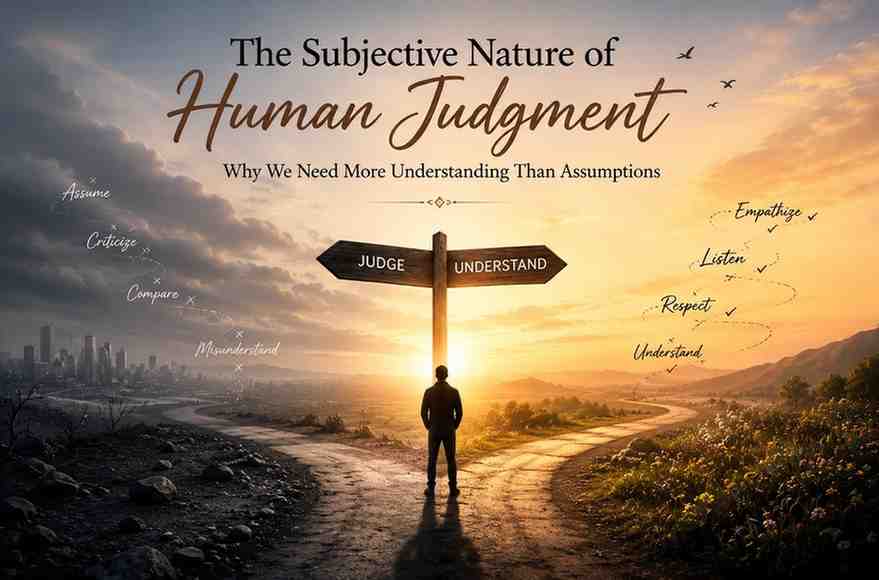
Human beings naturally try to make sense of the world by categorizing people and situations as “right” or “wrong.” This mental shortcut helps us make quick decisions, but it also creates misunderstandings. Most aspects of human life are not purely objective; they are shaped by personal experiences, values, emotions, culture, upbringing, and circumstances. This is what makes many human decisions subjective.
Every day, we judge people without realizing how little we actually know about them. We label someone as successful because they earn a high salary. We call another person lazy because they quit a prestigious job. We criticize someone for staying in a relationship, while praising another for leaving one. The surprising truth is that these judgments often reveal more about our own beliefs than about the people we judge.
Success Means Different Things to Different People
Consider success. Society often associates success with wealth, luxury, or social status. Yet, for someone who grew up in poverty, financial security may be the ultimate goal. For another person, success may mean spending time with family, working in a peaceful environment, or pursuing art despite earning less money. Neither definition is universally correct. They simply reflect different priorities.
Relationships and Healing Are Personal Journeys

The same applies to relationships. Imagine two people after a breakup. One starts dating again within a few months, while the other remains single for years. Some may call the first person insensitive and the second emotionally weak. However, psychology tells us that people process emotional pain differently. Attachment styles, childhood experiences, emotional resilience, and personality traits all influence how individuals cope with loss. There is no universal timeline for healing.
Career Choices Reflect Personal Values
Another common example is career choice. A student may reject a high-paying corporate job to become a teacher or a social worker. Family members may consider it a poor decision because they value financial stability. Yet the student may value purpose, creativity, or work-life balance more than money. Both perspectives are based on different value systems rather than objective truth.
Why We Judge Others: The Psychology Behind It
Our tendency to judge others is deeply connected to psychology. One important concept is the Fundamental Attribution Error, which explains that people often attribute others’ actions to their personality while explaining their own actions through circumstances. For example, if someone arrives late, we might immediately think they are irresponsible. But when we arrive late, we blame traffic, bad weather, or an emergency. This double standard makes our judgments unfair.
Also Read: Vietnam Detains Speedboat Captain After Capsize Kills 15 Indian Lives
Another psychological concept is confirmation bias. Once we form an opinion about someone, our brain naturally looks for information that supports our existing belief while ignoring evidence that contradicts it. If we think someone is arrogant, we notice every confident statement they make but overlook moments when they are kind or humble. In this way, our minds often create stories that feel true without being completely accurate.
Social Comparison and Personal Beliefs
Social comparison also shapes our judgments. According to psychologist Leon Festinger’s Social Comparison Theory, people evaluate themselves by comparing themselves with others. These comparisons can lead to envy, pride, insecurity, or criticism. Sometimes we judge others simply because their choices challenge our own beliefs or make us question our decisions.
Cultural Differences Shape Our Perspective
Culture further influences what people consider “normal.” In some societies, living with parents into adulthood is considered respectful and responsible. In others, independence at an early age is admired. Neither practice is inherently right or wrong; each reflects different cultural values. Judging one culture by the standards of another often leads to misunderstanding rather than wisdom.
How History Changed Our Judgments
History provides countless examples of how subjective judgments change over time. Left-handed children were once forced to write with their right hand because left-handedness was considered wrong. Women who pursued higher education were once criticized for challenging traditional gender roles. Mental health conditions were misunderstood and heavily stigmatized. Many beliefs that society once accepted as absolute truths are now recognized as misconceptions. This reminds us that certainty should always be accompanied by humility.
Subjectivity Has Moral Limits
However, acknowledging subjectivity does not mean believing that everything is acceptable. Actions that intentionally harm others, violate human rights, exploit people, or involve violence cannot simply be dismissed as “different opinions.” Respecting diverse perspectives should never come at the cost of ignoring justice, empathy, or basic human dignity.
The Importance of Empathy
Practicing empathy is one of the most effective ways to reduce unnecessary judgment. Empathy requires us to ask questions before reaching conclusions. Instead of assuming why someone made a particular choice, we can try to understand the circumstances behind it. This does not require us to agree with every decision, but it encourages fairness and compassion.
Social Media and Instant Judgment
In today’s world, social media has made instant judgment easier than ever. A few photographs, a short video, or a single comment often become enough for people to define an entire personality. Yet a person’s online presence represents only a tiny fraction of their real life. Behind every decision lies a story that outsiders rarely see.
Understanding the Bigger Picture
Ultimately, the world is not divided into simple categories of right and wrong. Human life is shaped by countless variables that make every individual unique. Our experiences, upbringing, emotions, opportunities, fears, and aspirations create different perspectives on what it means to live a meaningful life.
The next time we feel tempted to judge someone, we should pause and remember that we are seeing only one chapter of a story, not the entire book. Understanding another person’s perspective may not always change our opinion, but it can make us kinder, wiser, and more humane.
Conclusion
Judgment is easy because it requires very little information. Understanding is difficult because it demands curiosity, patience, and empathy. While some moral principles remain essential for a just society, many everyday choices are deeply subjective. Recognizing this reality allows us to replace assumptions with understanding and criticism with compassion. In a world where everyone is fighting battles we cannot see, empathy is not weakness—it is wisdom.
Click here to join our WhatsApp Channel for real-time news updates and exclusive coverage.