
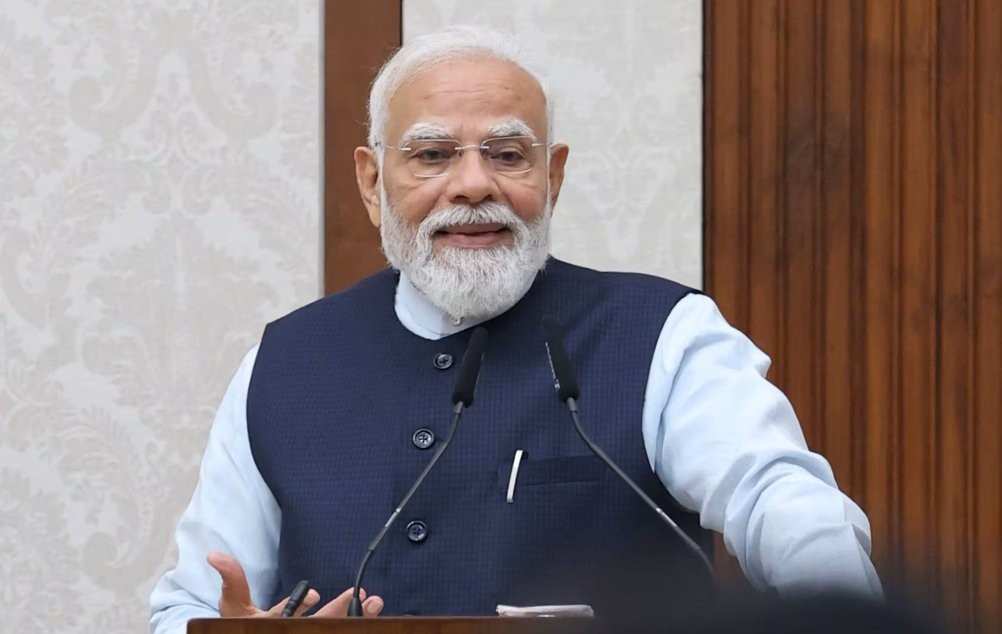
NEW DELHI: Prime Minister Narendra Modi on Tuesday called upon India’s young civil servants to place citizens at the centre of governance, embrace technology and work collectively to achieve the vision of a developed ,India by 2047. He made these remarks while interacting with 183 IAS officer trainees of the 2024 batch currently serving as Assistant Secretaries in various ministries and departments in New Delhi.
The interaction took place at Seva Teerth, where the Prime Minister shared his vision for a more responsive, technology-driven and citizen-centric administrative system. He encouraged the officers to adopt the principle of “Nagrik Devo Bhava”, stressing that public service should always remain the foundation of governance.
Citizen First Must Remain The Core Of Administration
Addressing the young officers, Prime Minister Modi said governance is not merely about implementing schemes but about understanding the aspirations and expectations of ordinary citizens. He urged the officers to maintain direct engagement with people and ensure that government policies create a tangible impact at the grassroots level.
He emphasised that every administrative decision should be guided by the welfare of citizens and not be restricted by departmental boundaries or procedural limitations. According to him, officers should continuously ask themselves whether their work is making life easier for the common people.
PM Calls For A Whole-Of-Government Approach
The Prime Minister also highlighted the need to break bureaucratic silos and promote inter-ministerial collaboration.
He said modern governance challenges, including urbanisation, climate concerns, infrastructure development and social welfare, cannot be addressed in isolation. Instead, ministries and departments must work together under a unified framework.
He encouraged officers to adopt a Whole-of-Government Approach, where coordination and collective action become standard administrative practices rather than exceptions. Such collaboration, he said, would accelerate decision-making and improve policy outcomes across sectors.
Technology And Artificial Intelligence To Shape Future Governance
Prime Minister Modi underlined the growing importance of technology in public administration and described Artificial Intelligence, digital platforms and data-driven governance as key pillars of future policymaking.
He urged the officers to remain adaptable and continuously upgrade their skills in emerging technologies. According to him, digital innovation can significantly enhance efficiency, transparency and service delivery while helping governments anticipate challenges before they arise.
The Prime Minister also said India’s rapid digital transformation offers administrators an opportunity to create governance models that are efficient, accessible and globally competitive.
Young Officers Asked To Become Leaders Of Change
During the interaction, the Prime Minister encouraged the trainees to view themselves not merely as administrators but as leaders of transformation.
He said India is currently undergoing a major developmental transition and today’s young officers will play a decisive role in shaping the country’s future.
The officers were urged to remain sensitive, innovative and solution-oriented while dealing with emerging challenges. He advised them to remain connected to field realities and understand regional diversity while implementing national policies.
According to the Prime Minister, every officer has an opportunity to leave a lasting impact through dedicated service and people-centric governance.
Focus On Viksit Bharat 2047
Prime Minister Modi reiterated the government’s long-term vision of building a developed India by the year 2047, when the nation will celebrate 100 years of independence.
He said achieving this goal will require strong institutions, efficient governance and committed public servants capable of translating policy into measurable outcomes.
The Prime Minister emphasised that young civil servants would be instrumental in driving reforms, strengthening delivery mechanisms and ensuring inclusive growth across all sections of society.
He also highlighted that India’s demographic advantage, digital progress and expanding global stature create a historic opportunity that administrators must utilise responsibly.
Interaction Provides Practical Exposure To Future Administrators
The IAS officer trainees are currently attached as Assistant Secretaries in different ministries and departments under a structured programme designed to expose them to policymaking and governance at the national level.
The interaction with the Prime Minister forms an important part of this learning process, allowing young officers to gain insights into leadership, governance priorities and national development objectives.
The Prime Minister’s message ultimately centred on one key principle: governance should remain people-centric, collaborative and future-ready.
As India advances towards becoming a developed nation, he said, civil servants must combine empathy with innovation and administrative excellence with public service to fulfil the aspirations of more than 1.4 billion citizens.