
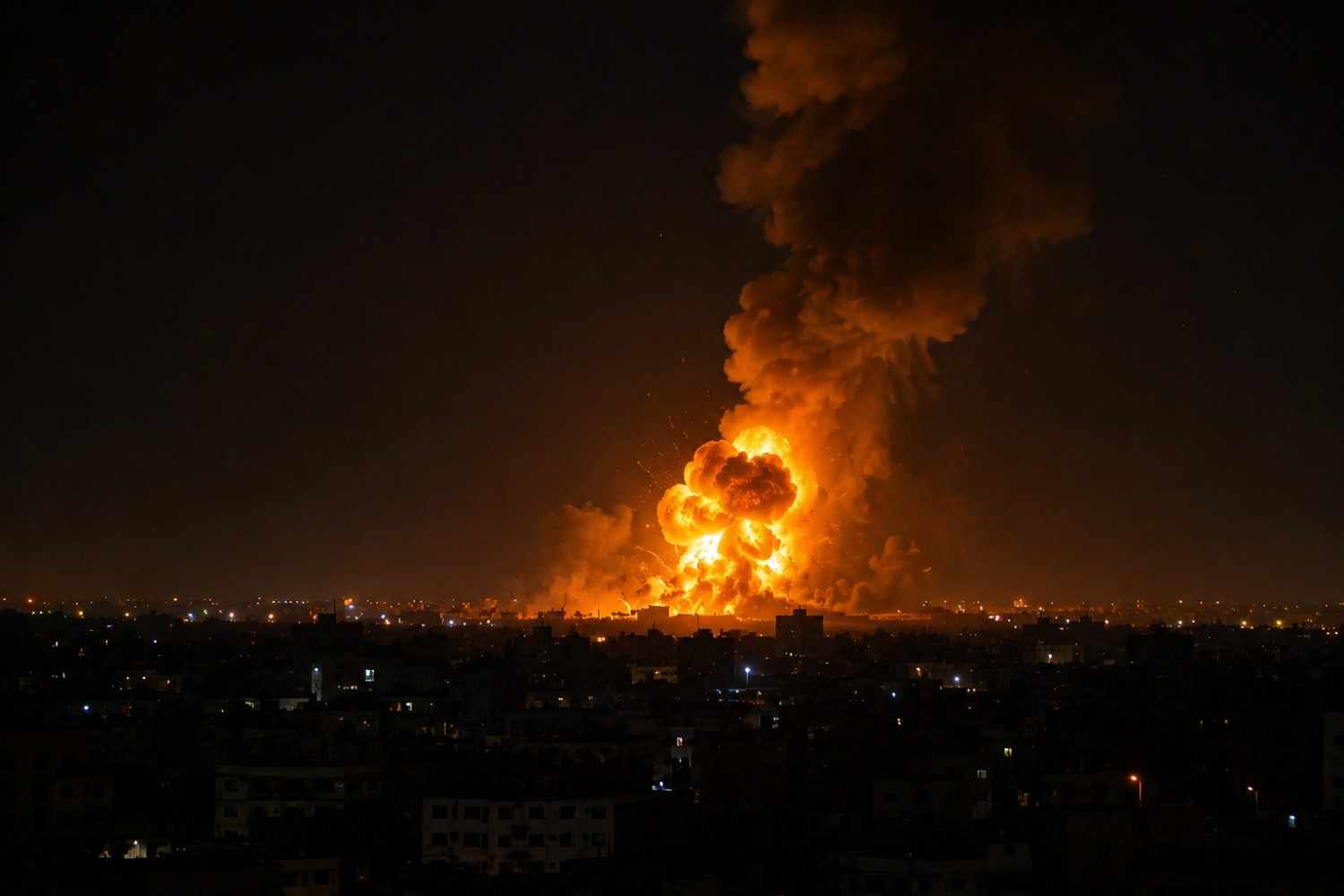
The Middle East remained on edge on Monday after Iran announced the suspension of its military operations against Israel following a fresh round of missile exchanges and airstrikes that intensified fears of a broader regional conflict.
The announcement came hours after US President Donald Trump stated that an “immediate” ceasefire between Tehran and Tel Aviv was underway. However, developments on the ground suggested that tensions remained high as Israeli forces launched new strikes targeting military sites in central and western Iran.
According to reports, Iranian state television confirmed that explosions were heard in several cities, including Isfahan, Karaj, Tabriz and the capital Tehran. Witnesses in Tehran reported hearing at least one major blast west of the city. In response to the security situation, Iranian authorities temporarily closed the airspace around Imam Khomeini International Airport, the country’s primary international gateway.
Israeli military officials confirmed that the air force had conducted strikes against what it described as military targets linked to the Iranian government. In a brief statement issued at dawn, the Israeli military said its aircraft had targeted facilities belonging to the “Iranian terror regime” in western and central Iran. No further details regarding the nature of the targets were immediately released.
Iranian authorities also provided limited information about the attacks. Officials did not disclose the extent of damage or possible casualties. However, Iran’s Revolutionary Guard claimed that Israel used air-launched ballistic missiles during the operation, though it did not provide additional evidence or operational details.
The latest escalation followed a night of missile exchanges between the two regional rivals. The conflict has heightened concerns that instability could spread further across the Middle East, a region already grappling with multiple security crises.
In a significant development, Iran’s Khatam al-Anbiya Central Headquarters announced the cessation of military operations against Israel. The military command said the decision came after what it described as a “painful response” to Israeli actions in southern Lebanon and Beirut’s Dahieh district, areas that have witnessed repeated military activity in recent months.
The headquarters said Iranian missile strikes carried out overnight against Israeli military installations in occupied territories should serve as a warning to Israel and its allies. According to the statement, the operation was conducted in response to what Tehran characterized as aggression and atrocities committed by Israel with support from the United States.
“On this basis, the cessation of operations by the armed forces is announced,” the statement said.
Despite the announcement, Iranian military leaders warned that any future Israeli military action would provoke a much stronger response. The statement emphasized that if attacks continue, Iran would adopt measures far more severe than those seen during the latest confrontation.
Iranian officials also continued to accuse Washington of playing a direct role in Israeli military actions. One senior Iranian figure stated that it was impossible for Israel to carry out attacks on Iranian territory without coordination from the United States. The allegation reflects Tehran’s longstanding position that US support enables Israeli military operations throughout the region.
The White House did not immediately comment on the Israeli strikes or clarify whether there had been any coordination between Washington and Tel Aviv. The absence of an official response added to uncertainty surrounding the status of the reported ceasefire efforts.
The renewed hostilities have complicated diplomatic attempts to reduce tensions. Negotiations between Iran and the United States had already faced significant obstacles amid ongoing violence involving Israel and Hezbollah. Analysts warn that continued clashes could derail fragile diplomatic channels and increase the risk of a wider conflict involving multiple regional actors.
Israel’s military presence in southern Lebanon has been a particular source of concern. The country has expanded operations into areas it had not controlled for decades, prompting fears that military activities could extend beyond current flashpoints and draw additional parties into the conflict.
Regional governments and international observers are closely monitoring the situation. While Iran’s declaration of a halt in military operations may offer a temporary opportunity for de-escalation, the exchange of threats from both sides indicates that the situation remains volatile.
As diplomatic efforts continue, the latest confrontation underscores the fragile security environment across West Asia. With multiple conflicts overlapping and major powers involved, even a limited military exchange carries the potential to trigger a broader regional crisis. The coming days are expected to be critical in determining whether the reported ceasefire can hold or whether the region will witness another dangerous escalation.