
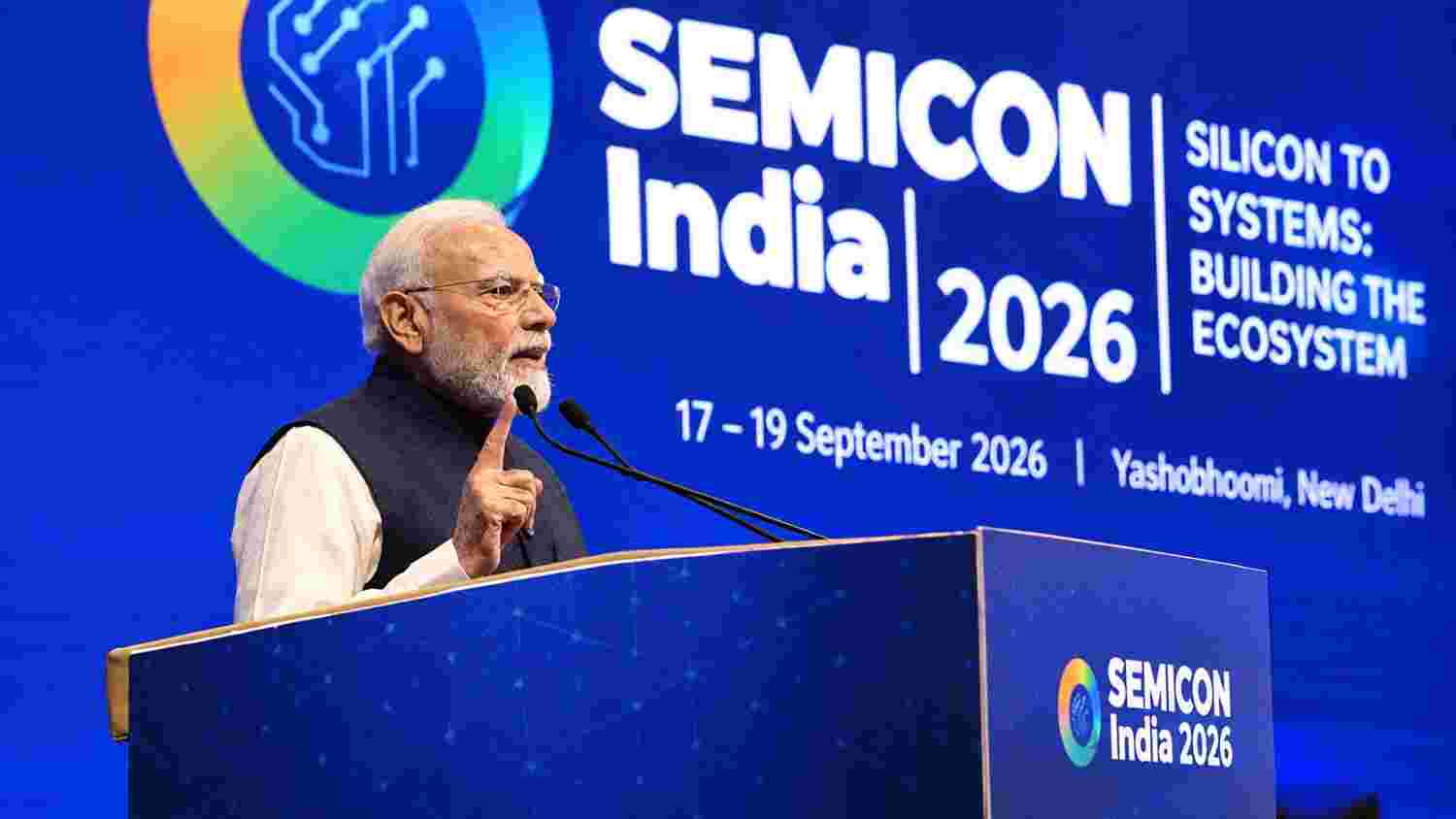
Prime Minister Narendra Modi inaugurated the fifth edition of SEMICON India 2026 at Yashobhoomi in New Delhi on September 17, marking another major step in India’s semiconductor ambitions. The three-day event, themed “Silicon to Systems: Building the Ecosystem,” brings together global semiconductor companies, policymakers, investors, researchers, startups, academia and students.
Addressing the gathering, Modi welcomed international participants and underlined the significance of hosting the semiconductor industry’s global stakeholders in India. He drew a connection between SEMICON India and Vishwakarma Diwas, describing the convergence of India’s traditional culture of creation and craftsmanship with advanced 21st-century technology.
He said this combination reflects the broader ambition of building a self-reliant India and advancing the vision of a Viksit Bharat.
Economic Growth and Rising Global Confidence
The Prime Minister also highlighted several developments that, according to him, demonstrate India’s expanding economic strength and international credibility.
He pointed to recent discussions on inclusive finance at the Global Fintech Fest, the operationalisation of a 3,000-kilometre Dedicated Freight Corridor and quarterly GDP growth of 7.8 percent. He also referred to a recent sovereign rating upgrade by a Japanese credit rating agency.
Modi said these developments indicated simultaneous growth in India’s economy and international confidence in the country.
He also cited the recently concluded BRICS Summit hosted by India and the unanimous adoption of the New Delhi Declaration as another indication of international consensus and engagement with India.
From Semiconductor Policy to Commercial Production
Recalling the evolution of the India Semiconductor Mission, Modi said India’s semiconductor journey had progressed from policy formulation and project planning to pilot lines and commercial production.
The government has approved 12 semiconductor projects under the first phase of its programme, while Semicon 2.0 has subsequently been approved with a total outlay of ₹1,27,500 crore to further develop India’s semiconductor design and manufacturing ecosystem.
Modi said chips manufactured in India have begun reaching customers domestically and internationally. He also highlighted commercial production developments in semiconductor facilities, describing them as evidence of the sector’s movement from planning towards execution.
$13.5 Billion Semiconductor Mission Expansion
The Prime Minister announced the next major phase of India’s semiconductor push, referring to a $13.5 billion second phase of the Semiconductor Mission.
He emphasised that semiconductor manufacturing requires an integrated ecosystem covering chip design, equipment, testing, materials, chemicals and other specialised capabilities.
According to the government, Semicon 2.0 is designed around six major pillars, including chip design, machines and materials, additional fabrication facilities, packaging, research and development, and workforce development.
Modi also highlighted regulatory measures intended to facilitate collaboration between international companies, Indian startups and semiconductor design firms.
Focus on Fabless Companies and Silicon Photonics
The Prime Minister stressed the need to strengthen India’s domestic semiconductor supply chain by encouraging fabless semiconductor companies, developing intellectual property and expanding advanced technologies such as silicon photonics.
He called upon companies working in equipment, chemicals, gases and materials to participate in the emerging ecosystem.
The government has also been supporting semiconductor research and design by providing advanced design tools to academic institutions and startups. PIB said facilities have been extended to more than 332 academic institutes and 105 startups, while 24 startups have been approved under the Design Linked Incentive scheme.
India’s Engineering Talent as a Strategic Asset
Modi placed particular emphasis on India’s large engineering talent pool and specialised skilling programmes.
He said the government aims to train one lakh engineering students in chip design, with around 70,000 already trained. He encouraged semiconductor companies to engage with India’s young researchers and engineers and expand domestic research and development.
The Prime Minister also urged industry leaders to create greater opportunities for young Indian innovators to work on advanced technologies from within the country.
AI Is Reshaping Semiconductor Manufacturing
Addressing the rapidly changing semiconductor market, Modi said the rise of artificial intelligence is transforming the requirements of chip technology.
He pointed out that future semiconductor innovation will involve more than reducing transistor sizes, with system-level considerations such as memory architecture, integration and heat management becoming increasingly important.
SEMICON India 2026 reflects this wider ecosystem approach, with the event covering manufacturing, AI and digital transformation, supply chains, chemicals and materials, sustainability, product design, startups, innovation and talent development.
Power Infrastructure Key to AI and Semiconductor Growth
Modi also highlighted energy security as a crucial requirement for semiconductor manufacturing and AI infrastructure.
He noted the enormous electricity requirements of AI data centres and the need for uninterrupted power supplies for semiconductor plants. He pointed to India’s expanding renewable-energy capacity, including solar power, along with developments in nuclear energy and small modular reactors.
The Prime Minister said continued investment in power infrastructure would strengthen the conditions required for advanced manufacturing and high-performance computing.
India Positions Itself in the Global Chip Supply Chain
SEMICON India 2026 is being held from September 17 to 19 at Yashobhoomi, New Delhi. The event is expected to feature more than 600 exhibitors, around 300 international companies and delegations from over 40 countries.
Concluding his address, Modi linked India’s technological ambitions with the country’s democratic and constitutional traditions. He invited global semiconductor companies, investors and technology leaders to participate in India’s expanding opportunities.
The government’s semiconductor strategy is increasingly focused on building an integrated ecosystem spanning design, manufacturing, packaging, equipment, materials, talent and research, with the stated objective of strengthening India’s role in global semiconductor supply chains.
Click here to join our WhatsApp Channel for real-time news updates and exclusive coverage.