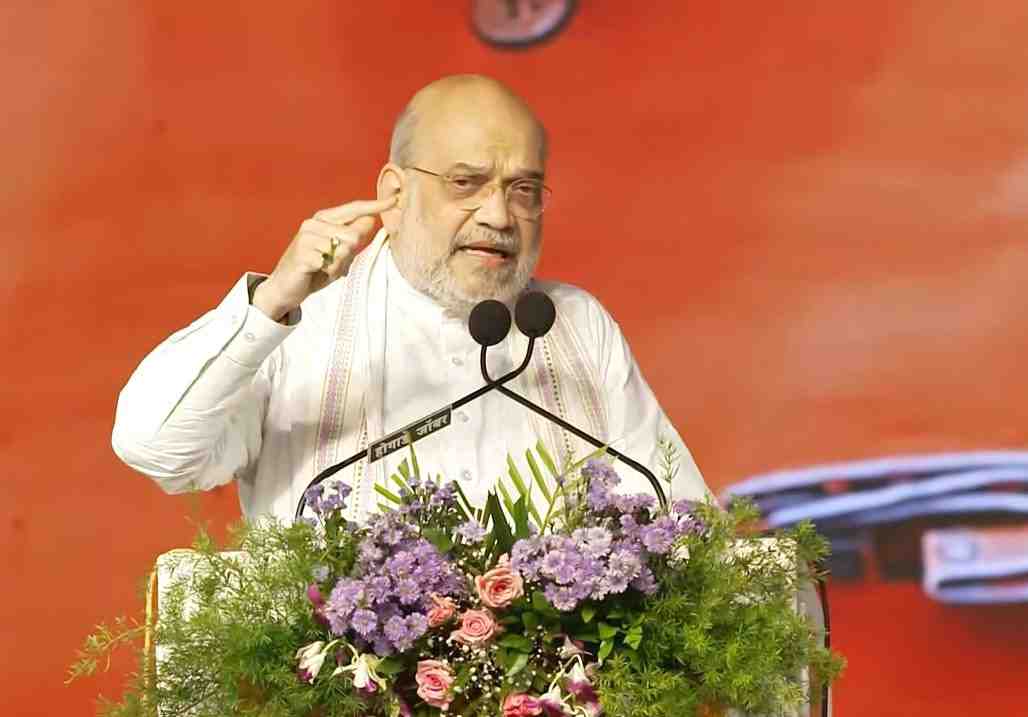
MUMBAI: Union Home Minister Amit Shah delivered a strong message on illegal immigration, declaring, “India is not a dharamshala” and asserting that every infiltrator living illegally in the country would be identified and deported individually. He made the remarks while addressing a public gathering in Kolhapur, Maharashtra.
Strong Warning On Illegal Infiltration
Addressing the “Dhanyawad Sabha” in Kolhapur, Amit Shah said the Narendra Modi government would not tolerate illegal infiltration under any circumstances. Emphasising the importance of national security, he said that people entering India illegally would be identified through legal mechanisms and removed from the country.
His statement, “This country is not a dharamshala, infiltrators will be identified and deported one by one,” was one of the strongest assertions made recently by the Union government on the issue of illegal immigration.
The Home Minister said border security and demographic stability remain major priorities for the central government and added that protecting India’s sovereignty is non-negotiable.
Illegal Immigration:
Over the past few years, illegal immigration has remained a key political issue for the Bharatiya Janata Party, especially in states bordering neighbouring countries.
Amit Shah has repeatedly argued that illegal infiltration impacts national security, economic resources and social balance. The government has maintained that stricter action is necessary to protect citizens and prevent misuse of welfare systems.
The Home Minister also accused previous governments, particularly the Congress party, of ignoring the issue for decades and allowing illegal immigration to become entrenched in several parts of the country.
Focus On Border Management
The Centre has consistently highlighted improvements in border surveillance, fencing and technological monitoring systems under the current administration.
According to government statements, stronger coordination among security agencies, enhanced digital tracking systems and increased vigilance at vulnerable borders are being implemented to curb illegal entry.
The government has also been linking demographic changes in certain regions to illegal immigration and has initiated institutional mechanisms to study the issue more closely.
High-Level Committee On Demographic Change
Earlier this year, the government constituted a High-Level Committee on Demographic Change to study the impact of illegal immigration and other abnormal demographic shifts across the country.
The committee is headed by retired Justice Prakash Prabhakar Navlekar and includes experts from administrative, security and economic backgrounds. The panel has been tasked with assessing demographic changes and their implications for national security, law and order and social structures. The government has described illegal infiltration as a long-term challenge with implications extending beyond border security.
Opposition Criticism And Political Debate
The issue remains politically sensitive and has frequently triggered intense debates between the ruling party and opposition leaders.
Opposition parties have often accused the BJP of politicising immigration and using the issue to polarise voters. They have argued that every action must remain within constitutional and humanitarian frameworks.
On the other hand, the BJP has defended its position by saying that protecting national borders and identifying illegal residents is a sovereign responsibility of every nation.
Continuing A Long-Standing Position
Amit Shah’s Kolhapur remarks are not isolated statements but part of a broader policy narrative that he has reiterated in multiple states, including Assam and West Bengal, where illegal immigration has been a major political issue.
In several speeches this year, Shah has repeatedly stressed that infiltrators would be identified, removed from official systems and eventually deported through legal procedures.
National Security Remains The Core Message
With the statement from Kolhapur, the Union government has once again signalled that tackling illegal infiltration will remain a priority agenda.
The issue is expected to continue dominating political discourse in the coming months as debates over border management, demographic changes and internal security intensify across the country.