NEW DELHI: India and Nepal have taken another significant step toward deepening their longstanding partnership, with External Affairs Minister Dr. S. Jaishankar and Nepal’s Foreign Minister Shisir Khanal unveiling a series of initiatives spanning healthcare, cultural heritage, digital payments and language technology. The announcements came after high-level discussions in New Delhi focused on expanding cooperation in development, connectivity, energy, education and digital innovation.
Following what Dr. Jaishankar described as a productive meeting with his Nepali counterpart, India virtually handed over 72 health facilities and 12 cultural heritage projects completed under the post-2015 earthquake reconstruction programme. These projects form part of India’s continued assistance to Nepal in rebuilding critical infrastructure damaged by the devastating earthquake that struck the Himalayan nation more than a decade ago.
The reconstructed health facilities are expected to strengthen healthcare access and service delivery in various parts of Nepal, while the cultural heritage projects aim to preserve and restore historically significant sites affected by the earthquake. The handover reflects India’s long-term commitment to supporting Nepal’s recovery and development efforts through grant-based assistance and infrastructure cooperation.
One of the most notable outcomes of the meeting was the launch of a cross-border digital payment linkage between India’s Unified Payments Interface (UPI) and Nepal’s National Payments Interface (NPI). The initiative is designed to facilitate personal remittances between the two countries, making cross-border financial transactions faster, more convenient and more accessible for citizens.
The digital payments connection is expected to benefit thousands of people who regularly send money across the India-Nepal border. Experts believe that integrating payment systems can reduce transaction costs and promote greater financial inclusion while strengthening economic ties between the neighbouring countries. The move also highlights the growing role of digital public infrastructure in regional cooperation.
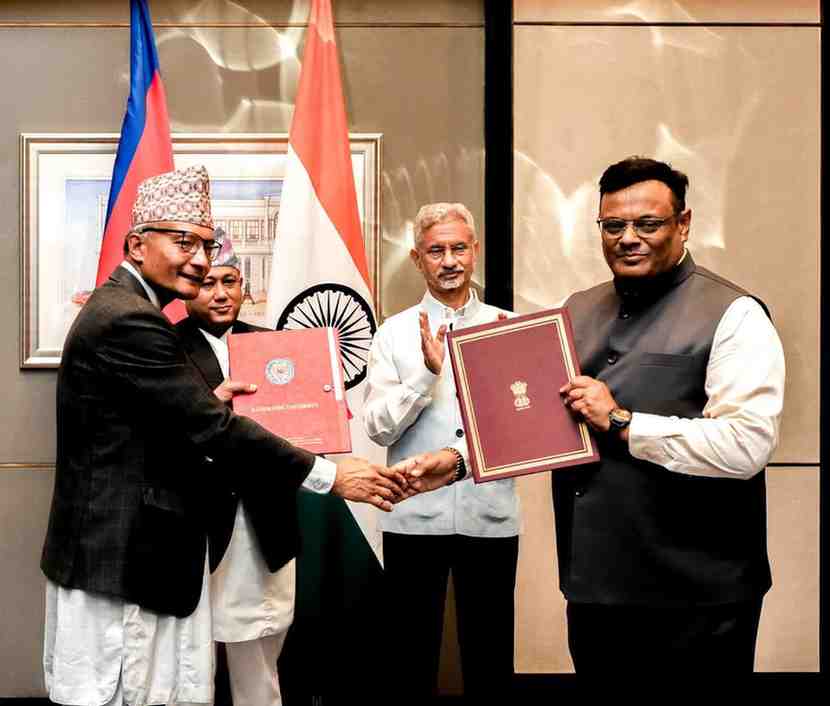
Another important development witnessed by the two ministers was the exchange of a Memorandum of Understanding between Digital India Bhashini and Kathmandu University. The agreement seeks to jointly develop a National Digital Infrastructure for a “Voice First” language translation platform tailored to Nepal’s linguistic needs.
The proposed platform aims to leverage language technology and artificial intelligence to improve communication and digital accessibility. By focusing on voice-based translation capabilities, the project is expected to help bridge language barriers and expand access to digital services for diverse linguistic communities across Nepal. The collaboration also highlights growing cooperation between India and Nepal in emerging technology sectors.
During their discussions, Dr. Jaishankar and Shisir Khanal reviewed a broad spectrum of bilateral issues and ongoing cooperation programmes. According to statements released after the meeting, the talks covered development partnerships, connectivity projects, energy cooperation, hydropower development, education, healthcare, capacity building, digital initiatives, cultural exchanges and sports cooperation.
Dr. Jaishankar reaffirmed India’s commitment to working closely with Nepal for the mutual progress, prosperity and well-being of people in both countries. He emphasised the unique nature of the India-Nepal relationship and the importance of continued collaboration in both traditional and emerging sectors.
The meeting comes at a time when both nations are seeking to further strengthen economic and people-to-people ties. Nepal has repeatedly described India as one of its most important partners, while New Delhi has continued to support infrastructure, connectivity and development projects across the Himalayan country.
Observers note that the latest announcements combine humanitarian assistance, cultural preservation and technological advancement, reflecting the evolving nature of India-Nepal relations. The handover of reconstruction projects underscores India’s role in Nepal’s post-earthquake recovery, while the launch of digital payment connectivity and language technology cooperation points toward a future-oriented partnership driven by innovation and regional integration.
With healthcare infrastructure, heritage conservation, digital finance and language technology now forming key pillars of bilateral engagement, the initiatives announced during the Jaishankar-Khanal meeting are expected to further deepen cooperation and bring tangible benefits to citizens on both sides of the border in the years ahead.