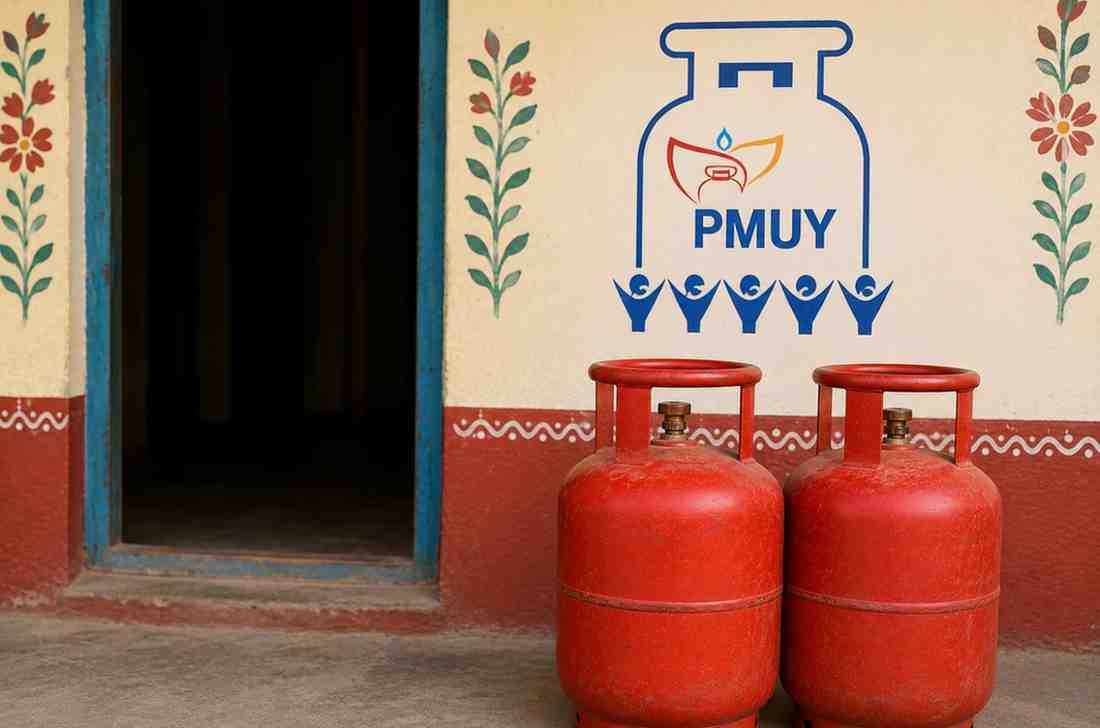
NEW DELHI: The Government of India has reduced the number of subsidised LPG cylinders available annually under the Pradhan Mantri Ujjwala Yojana (PMUY) from nine to four, marking a significant change in one of India’s largest welfare schemes for low-income households. The decision comes amid rising global energy costs and increasing subsidy burdens on public sector oil marketing companies.
The revised policy means that PMUY beneficiaries will continue to receive a subsidy of ₹300 per 14.2-kg LPG cylinder, but only on the first four refills in a financial year. Earlier, eligible households could claim the same subsidy on up to nine cylinders annually.
The change was revealed shortly after the government announced a ₹29 increase in the price of domestic LPG cylinders. Officials from the Ministry of Petroleum and Natural Gas stated that the subsidy limit has been aligned with the average annual consumption pattern of Ujjwala households, which is estimated to be around four to five cylinders per year.
According to government officials, despite the reduction in subsidised refills, LPG users continue to receive substantial support because domestic cooking gas prices remain significantly below international market rates. The government argues that oil marketing companies are still absorbing heavy losses on each LPG cylinder supplied to consumers.
Officials said the actual cost of supplying a 14.2-kg LPG cylinder has crossed ₹1,600 due to elevated international prices and supply uncertainties. However, general consumers in Delhi currently pay around ₹942 per cylinder, while PMUY beneficiaries pay approximately ₹642 after accounting for the ₹300 subsidy.
The Pradhan Mantri Ujjwala Yojana scheme, launched in 2016, was designed to provide clean cooking fuel to economically weaker households, particularly women. The programme initially offered support for up to 12 subsidised LPG refills annually. During the COVID-19 pandemic, beneficiaries also received free cylinders under relief measures introduced by the government.
In May 2022, the Centre introduced a targeted subsidy of ₹200 per cylinder for Pradhan Mantri Ujjwala Yojana beneficiaries, covering up to 12 refills per year. The subsidy amount was increased to ₹300 per cylinder in October 2023. Subsequently, in August 2025, the annual subsidised refill limit was reduced from 12 to nine cylinders while retaining the ₹300 subsidy. The latest decision further lowers the annual entitlement to four subsidised cylinders.
Government representatives have defended the move by pointing to the growing financial burden created by rising LPG import costs. India imports a significant portion of its LPG requirements, making domestic prices sensitive to fluctuations in global energy markets. Recent geopolitical tensions in West Asia have added pressure to international fuel prices, increasing subsidy costs for the government and oil companies.
Data cited by officials indicates that average LPG consumption among Pradhan Mantri Ujjwala Yojana households has gradually increased over the years. Consumption rose from around three refills annually in 2019-20 to more than four refills in recent years, a factor the government says influenced the revised subsidy framework.
The decision is expected to affect more than 105 million PMUY beneficiary households across the country. While the government maintains that the revised cap reflects actual consumption trends, critics are likely to argue that the reduction could increase cooking fuel expenses for families that use more than four cylinders annually.
The Centre has not yet announced any further changes to the subsidy amount itself, which remains fixed at ₹300 per cylinder. However, the reduction in eligible subsidised refills effectively lowers the maximum annual subsidy benefit available to each PMUY household. Under the new structure, beneficiaries can receive a subsidy of up to ₹1,200 per year compared to a much higher benefit under previous limits.
As global energy markets remain volatile, the government is expected to continue reviewing fuel pricing and subsidy mechanisms to balance consumer relief with fiscal sustainability.