
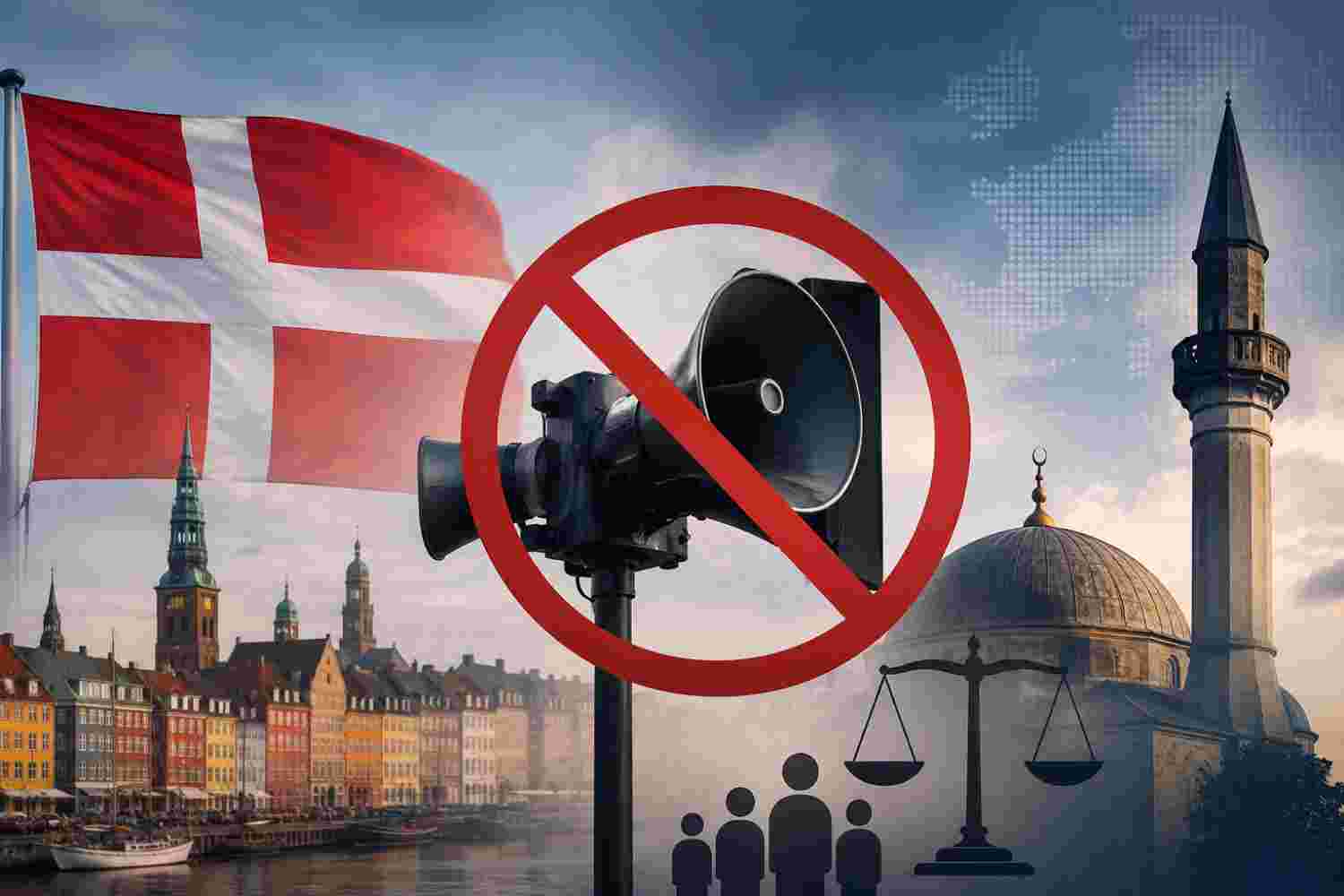
Denmark is considering a nationwide ban on the public broadcast of the Islamic call to prayer (Azan) through mosque loudspeakers, a proposal that has reignited discussions on immigration, national identity, and religious freedom. The move comes after the country’s immigration authorities announced a legal review to determine whether such a restriction would comply with Danish law and constitutional protections.
Government Orders Legal Examination
Danish Immigration and Integration Minister Morten Bodskov said the government wants to examine whether public loudspeaker broadcasts of the Azan can be prohibited across the country. According to the minister, the Islamic call to prayer should not become part of Denmark’s public soundscape.
His remarks, including a comparison suggesting parts of Denmark should not resemble “a suburb of Islamabad,” have attracted widespread international attention and sparked political as well as public debate.
Proposal Targets Loudspeaker Broadcasts
The proposal specifically concerns the amplified broadcast of the Azan through mosque loudspeakers. It does not seek to prevent Muslims from practising their faith, attending mosques, or offering prayers. Religious worship inside mosques would continue without restriction if the proposal eventually becomes law.
Third Attempt to Address the Issue
This is not the first time Denmark has explored restrictions on public calls to prayer. Similar legal examinations were initiated in 2020 and again in 2025, but neither resulted in nationwide legislation. The latest initiative marks another attempt by the government to determine whether a legal framework for such a ban can be established.
Constitutional Questions Remain
Any nationwide ban is expected to face legal scrutiny because Denmark’s constitution guarantees freedom of religion and the right to public worship. Government lawyers are expected to assess whether restricting only the Islamic call to prayer would comply with constitutional safeguards or whether it could be viewed as discriminatory against a particular religious community.
Legal experts believe authorities will have to balance religious freedoms with public interest considerations such as noise regulations and equal treatment of different faiths before introducing any legislation.
Supporters and Critics Divided
Supporters of the proposed ban argue that amplified religious broadcasts do not belong in Denmark’s public spaces and view the measure as part of broader efforts to preserve Danish cultural identity. They believe public soundscapes should remain free from loudspeaker announcements associated with religious institutions.
Critics, however, argue that targeting the Azan could undermine religious freedom and send a negative message to Denmark’s Muslim community. They warn that any restriction focused solely on one religion could face legal and human rights challenges.
Existing Local Restrictions
Some Danish municipalities already regulate outdoor loudspeaker use through local noise-control rules. In certain areas, including parts of Copenhagen, mosque loudspeaker broadcasts are either restricted or effectively prevented under municipal regulations. The proposed legislation would extend such restrictions across the country if approved.
No Final Decision Yet
At present, Denmark has not introduced a formal bill in Parliament, and no nationwide ban has taken effect. The government is still conducting its legal assessment before deciding whether to move forward with legislation. Officials have also not announced a timeline for completing the review.
The outcome of the legal examination is expected to shape future discussions on immigration policy, religious expression, and constitutional rights in Denmark, while drawing attention from governments and human rights organisations across Europe.
Denmark’s proposal to ban the public broadcast of the Azan through loudspeakers reflects the country’s continuing debate over immigration, cultural identity, and religious expression. Supporters argue that amplified religious calls should not become part of Denmark’s public soundscape and view the measure as a step toward preserving national traditions.
Critics, however, contend that singling out the Islamic call to prayer could raise concerns about equal treatment and religious freedom, potentially inviting legal challenges under constitutional and human rights protections. As the government conducts its legal review, the outcome could influence future policies on balancing secular public spaces with the rights of religious communities.