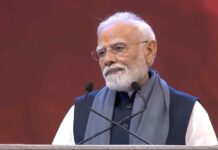
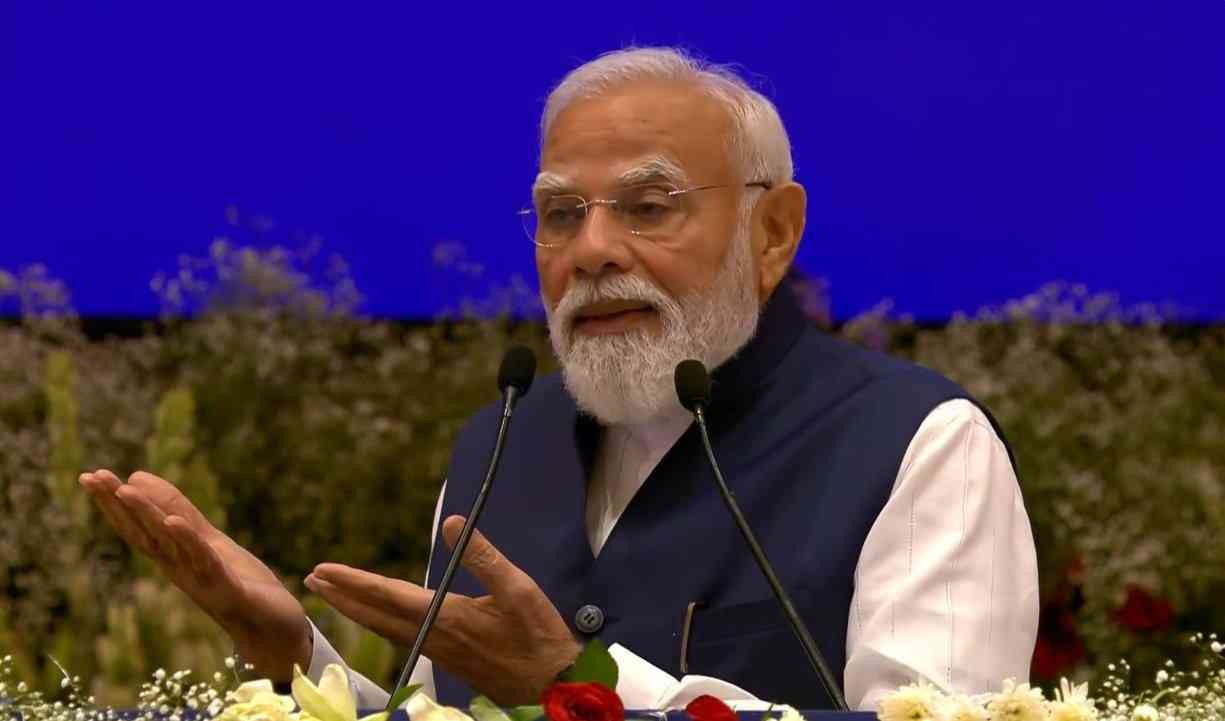
NEW DELHI: Prime Minister Narendra Modi on Wednesday launched a sharp attack on the Congress while addressing the NDA Conclave at Bharat Mandapam, where alliance partners felicitated him for becoming India’s longest-serving elected Prime Minister. Modi used the occasion not only to express gratitude to NDA leaders and BJP workers but also to draw a stark contrast between the governance records of the BJP-led NDA and previous Congress governments.
“Under Congress Rule, The Nation Was Pushed Into Despair And An Inferiority Complex. The Country Has Now Broken Free From That Vicious Cycle And Is Moving Forward With Confidence And New Aspirations,” PM Modi Said At The NDA Conclave.
Speaking before NDA constituents, Modi said the recognition he received was not a personal achievement but a collective accomplishment of the NDA family and BJP karyakartas. He dedicated the honour to all alliance partners, emphasizing that the coalition’s success was built on teamwork and a shared commitment to national development.
The Prime Minister accused Congress of creating an era of pessimism and slow growth, claiming that the country had been trapped in a cycle of underperformance for decades. Referring to the term “Hindu Growth Rate,” often used by economists to describe India’s modest growth in earlier decades, Modi argued that the phrase unfairly blamed Hindu society for what he described as Congress’ failures in governance.
According to PM Modi, the period should instead be remembered as the “Congress Growth Rate,” marked by weak governance, policy paralysis, lack of accountability and delayed decision-making. He said previous governments conditioned citizens to accept slow progress, whereas the NDA government had focused on delivering results quickly and at scale.
The Prime Minister asserted that the period between 2014 and 2026 represented a transformation in India’s development trajectory. He highlighted India’s economic growth, noting that despite global economic challenges, the country recorded a growth rate of 7.7 per cent in 2025-26 and 7.8 per cent in the final quarter of the fiscal year. He said India had moved from being counted among the world’s “Fragile Five” economies to becoming one of the fastest-growing major economies.
Modi also outlined several policy initiatives aimed at the middle class, including tax relief measures that make annual income up to ₹12 lakh tax-free. He said simplified taxation, improved infrastructure and expanded opportunities for young people had strengthened the aspirations of middle-class families.
On national security and governance, the Prime Minister Modi defended several landmark decisions taken by his government. He cited the abrogation of Article 370, efforts to bring peace to the Northeast and India’s military responses to terrorism, including surgical strikes, air strikes and the recent Operation Sindoor. He argued that such decisions reflected the NDA government’s willingness to take difficult steps in the national interest.
Addressing energy security, Modi highlighted the government’s push toward self-reliance in oil, gas and nuclear power. He referred to recent developments in hydrocarbon exploration and called for accelerated efforts to achieve India’s target of 500 GW renewable energy capacity. He also pointed to advances in fast breeder reactor technology as evidence of India’s growing capabilities in nuclear energy.
The Prime Minister’s speech began on a personal note, as he thanked NDA leaders for honouring him after he crossed 4,399 days in office as an elected Prime Minister. He described public service as a form of national devotion and credited the people of India, whom he called the embodiment of the divine, for giving him the opportunity to serve for such a long period.
Beyond the celebration of Modi’s tenure, the speech carried a clear political message. By repeatedly contrasting NDA governance with the Congress era, the Prime Minister sought to frame the upcoming political battle as a choice between what the BJP describes as decisive leadership and what it portrays as Congress-era stagnation.
His remarks on the “Congress Growth Rate,” Article 370 and national security were aimed at reinforcing the BJP’s long-standing narrative that major reforms became possible only after 2014.
For Congress, Modi’s attack signals that economic performance, governance and national security will remain central themes in the BJP’s political strategy. As the opposition attempts to challenge the NDA on issues such as unemployment, inflation and social concerns, the BJP appears determined to keep the focus on its governance record and compare it directly with previous Congress administrations.
The speech, therefore, was not merely a celebration of a political milestone; it was also an early indication of the ideological and electoral contest that continues to define Indian politics between the BJP and Congress.