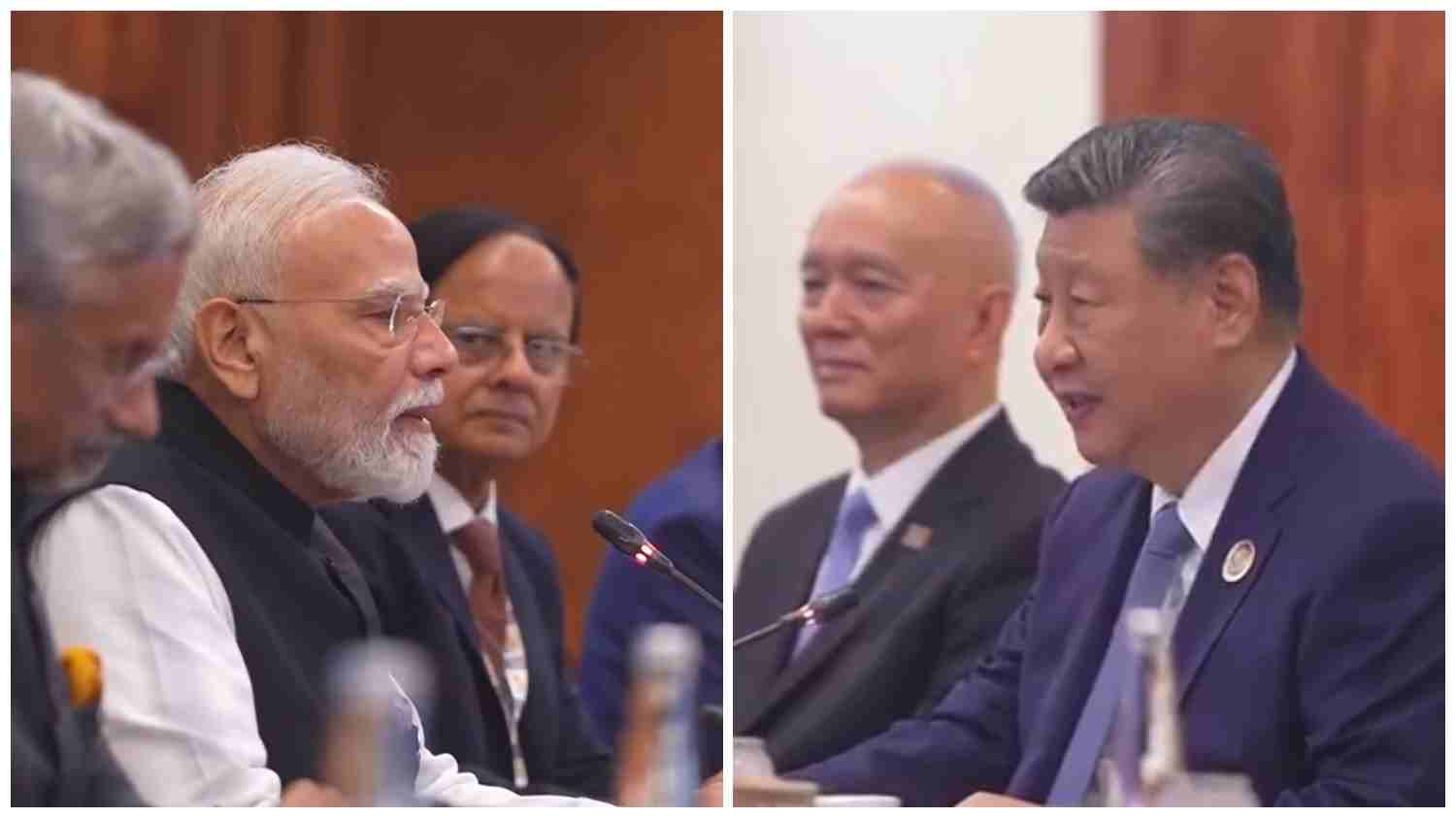
Indian Prime Minister Narendra Modi and Chinese President Xi Jinping began a closely watched bilateral meeting in New Delhi on Saturday, marking a significant moment in India-China relations after years of military tensions and diplomatic strain. The talks took place on the sidelines of the 18th BRICS Summit, with both sides seeking to build on recent efforts to stabilise ties.
The meeting carries particular significance as it is the first time Xi Jinping has travelled to India since the deadly 2020 Galwan Valley clash. His visit to New Delhi, after nearly seven years, comes at a time when the two Asian powers are cautiously attempting to restore dialogue while continuing to manage unresolved strategic and border-related differences.
Modi welcomes Xi Jinping to India
Prime Minister Modi warmly welcomed the Chinese president at the beginning of their bilateral engagement. The meeting follows Xi’s arrival in New Delhi earlier on Saturday to participate in the BRICS leaders’ summit hosted by India.
Xi was received at the airport by Union Minister of State for Commerce and Industry Jitin Prasada, while cultural performances were organised as part of the welcome ceremony. His delegation includes senior Chinese officials, including Communist Party leader Cai Qi and Foreign Minister Wang Yi.
The bilateral meeting has been closely watched because direct engagement between the Indian and Chinese leadership has remained limited since relations deteriorated following the 2020 military confrontation along the Line of Actual Control in eastern Ladakh.
First India visit since the Galwan crisis
Xi’s return to India represents an important diplomatic milestone. His previous visit was in October 2019, when he travelled to Mamallapuram for an informal summit with Modi.
Relations subsequently suffered a severe setback following the Galwan Valley clash in June 2020, in which soldiers from both countries were killed. The confrontation triggered a prolonged military standoff and significantly affected political, economic and people-to-people ties between the two countries.
India and China have since undertaken sustained diplomatic and military-level discussions to reduce tensions along the disputed frontier. A 2024 disengagement agreement helped create conditions for renewed engagement, although the broader boundary dispute remains unresolved.
Border stability remains a key concern
The India-China border question is expected to remain central to the relationship. Senior officials from both countries have continued discussions through the established Special Representatives mechanism.
National Security Adviser Ajit Doval and Chinese Foreign Minister Wang Yi, who serve as the respective Special Representatives on the boundary issue, held talks in Beijing last month. Their discussions covered the boundary question, including issues related to maintaining peace and tranquillity along the Line of Actual Control.
For New Delhi, sustained peace along the border is considered an essential foundation for any broader improvement in bilateral relations.
Trade and economic ties in focus
Economic relations are another major component of the Modi-Xi engagement. Although bilateral trade remains substantial, India continues to face a large trade deficit with China.
Recent discussions have increasingly focused on improving market access for Indian businesses, strengthening economic engagement and creating a more balanced trading relationship. The two countries are also looking at ways to restore greater predictability in commercial ties after years of restrictions and uncertainty.
China has also become an increasingly important source of imports for India. At the same time, New Delhi remains cautious about sensitive Chinese investments and strategic economic dependencies.
BRICS provides wider diplomatic backdrop
The Modi-Xi meeting is taking place against the backdrop of the 18th BRICS Summit in New Delhi. India, which holds the BRICS chairmanship this year, has sought to position the grouping as a platform for practical cooperation among emerging economies.
The summit has brought together leaders from major emerging powers, including India, China and Russia, amid growing geopolitical tensions around the world. The gathering has also highlighted differences among BRICS members over international conflicts and the future global order.
BRICS Summit 2026: New Delhi Declaration Sends Strong Message Against Terrorism And Aggression
For India, improved relations with China could strengthen the effectiveness of BRICS while allowing New Delhi to pursue its broader diplomatic strategy of engaging multiple major powers.
A cautious new chapter
The Modi-Xi meeting does not by itself erase the strategic differences that have complicated India-China relations. Border tensions, trade imbalances, security concerns and competing regional interests continue to pose challenges.
However, the return of high-level political engagement represents a notable shift from the period of heightened confrontation that followed Galwan. The restoration of direct leadership-level dialogue could provide an opportunity to address difficult issues while expanding areas of cooperation.
With Xi back in India after seven years, the focus now is on whether the renewed diplomatic momentum can translate into greater stability, stronger economic engagement and a more predictable relationship between the two Asian powers.
Click here to join our WhatsApp Channel for real-time news updates and exclusive coverage.