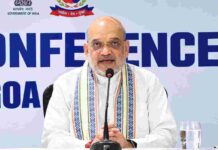
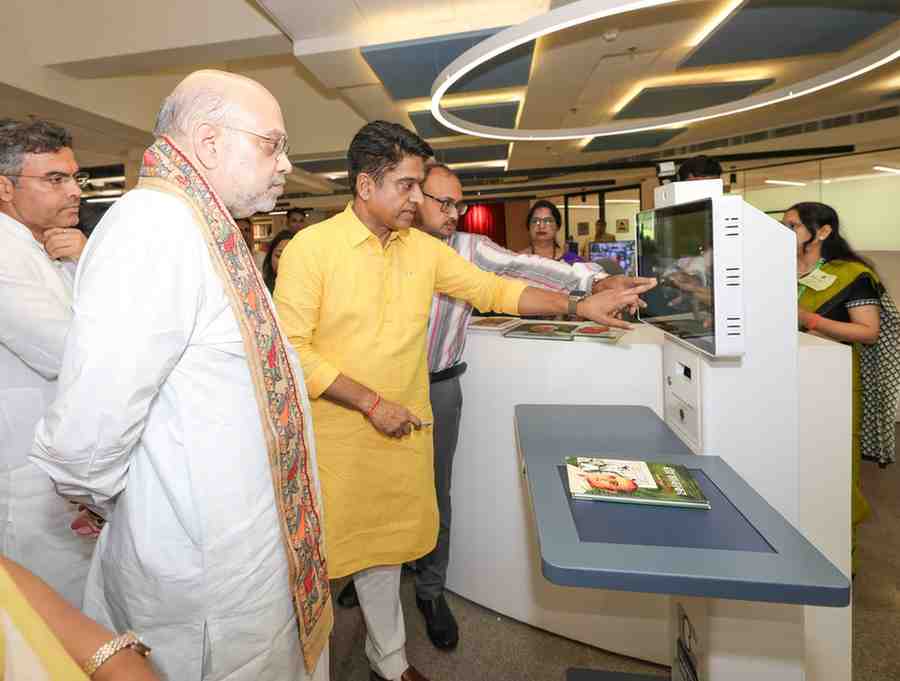
NEW DELHI: Union Home Minister Amit Shah on Saturday inaugurated the New Delhi Municipal Council’s (NDMC) state-of-the-art Jayaprakash Narayan (JPN) Public Library at Udyan Marg, describing libraries as the true foundation of a nation’s intellectual and cultural progress.
The newly developed public library combines modern digital infrastructure with traditional learning resources and is designed to promote reading, research, innovation, and lifelong learning among students, researchers, and the general public. Equipped with advanced technology, the library houses more than 35,000 books and provides access to over one crore digital books, making it one of the most comprehensive public knowledge centres in the national capital.
Delhi Chief Minister Rekha Gupta, Delhi Cabinet Minister Parvesh Sahib Singh, NDMC Chairman Keshav Chandra, Vice Chairman Kuljeet Singh Chahal, NDMC Secretary Rahul Singh and other senior officials attended the inauguration ceremony.
Libraries Shape the Future of a Nation: Amit Shah
Addressing the gathering, Amit Shah underlined the importance of libraries in shaping responsible citizens and building a stronger nation. He said that the progress of a country should not be judged merely by its markets, industries or agricultural output, but by the number of young people spending time in libraries.
According to Shah, knowledge and wisdom form the basis of national development, and libraries remain the most effective institutions for nurturing both. He urged young people to develop a lifelong relationship with books, saying that reading cultivates critical thinking, discipline and a balanced personality.
Sharing personal experiences, the Home Minister recalled growing up in a small town where a well-equipped public library had a lasting influence on his life. He said his journey from reading children’s stories eventually led him to explore India’s ancient scriptures, including the Vedas and Upanishads, broadening his intellectual outlook.
Reading Before Speaking Is the Key to Wisdom
During his speech, Shah referred to a quote displayed inside the auditorium that advised people to think before speaking because words cannot be taken back. Expanding on the idea, he remarked that meaningful thinking itself comes only after extensive reading.
He said libraries encourage people to think deeply, understand different perspectives and develop informed opinions. According to him, reading remains one of the strongest tools for personal growth and responsible citizenship.
Model Library Network Suggested for Delhi
Highlighting his own parliamentary constituency as an example, Shah said libraries have been established in nearly every village, each stocked with approximately 3,000 to 4,000 books. These village libraries are connected to a central library that houses more than 1.25 lakh books.
He explained that mobile library vans regularly transport requested books to villages, ensuring children have access to reading material without travelling long distances. Schools have also been linked with these libraries to encourage reading among students.
Shah urged the Delhi Government to prepare a comprehensive plan to interconnect all libraries across the city and integrate them with educational institutions. He also encouraged the staff of the Jayaprakash Narayan Public Library to actively engage with schools in nearby Assembly constituencies and motivate students to become regular readers.
Modern Infrastructure Designed for Students and Researchers
The Jayaprakash Narayan Public Library has been developed as a technologically advanced knowledge centre spread across 2,265.30 square metres in a ground-plus-two-storey building.
The facility can accommodate around 200 readers simultaneously and includes separate sections for children, researchers and general readers. It also features a modern auditorium, dedicated research spaces, contemporary reading halls and a digital learning environment.
One of its key attractions is a fully equipped e-library that provides access to more than one crore online books and digital catalogues through subscriptions to multiple online libraries. The entire building offers free Wi-Fi connectivity, enabling visitors to download study material, prepare notes and conduct research.
The library has also adopted an advanced RFID-based book management system, while its Online Public Access Catalogue (OPAC) will be integrated with the National Digital Library of India, allowing users to search and access a vast range of academic resources.
Tribute to Jayaprakash Narayan’s Legacy
During the event, Amit Shah paid tribute to Loknayak Jayaprakash Narayan, after whom the library has been named. He described JP as one of India’s most influential political thinkers and freedom fighters who dedicated his life to democracy, social reform and public service.
Shah recalled Jayaprakash Narayan’s role in the Quit India Movement and his decision not to join the government after Independence despite having opportunities to do so. Instead, he worked to strengthen socialist ideals, supported Vinoba Bhave’s Bhoodan movement and promoted Sarvodaya principles across rural India.
He also highlighted JP’s leadership during the Emergency, when he mobilised nationwide democratic movements and called for “Sampoorna Kranti” or Total Revolution. According to Shah, Jayaprakash Narayan’s commitment to democratic values continues to inspire generations.
Delhi Chief Minister Calls Library a Gift for Students
Delhi Chief Minister Rekha Gupta described the inauguration as a landmark occasion for the capital and said the new library would become an important educational resource for students and young professionals.
She noted that candidates preparing for UPSC and other competitive examinations would particularly benefit from the modern study facilities, peaceful environment and extensive collection of books and digital resources.
Congratulating all departments and officials associated with the project, the Chief Minister expressed confidence that the institution would encourage learning, innovation and academic excellence among Delhi’s youth.
NDMC Highlights Vision Behind the Project
NDMC Chairman Keshav Chandra said the library has been dedicated to the ideals of Loknayak Jayaprakash Narayan, whose philosophy of Total Revolution extended beyond politics to include education, ethics, social awareness and nation-building.
He said the institution has been created as a community knowledge hub that combines traditional reading culture with cutting-edge digital technology. With more than 35,000 books, journals and reference publications covering diverse subjects, the library is expected to serve students, researchers and citizens from all walks of life.
NDMC Vice Chairman Kuljeet Singh Chahal thanked Prime Minister Narendra Modi and Union Home Minister Amit Shah for their guidance and support in establishing the project. He assured that the civic body would implement all suggestions made during the inauguration and work towards making the library a model public institution.
Chahal also appealed to Resident Welfare Associations and local communities to actively promote the library so that it evolves into a vibrant centre of education, research, innovation and community engagement.
A Major Step Towards Building a Reading Culture
The inauguration of the Jayaprakash Narayan Public Library marks a significant milestone in Delhi’s public knowledge infrastructure. By combining physical collections with advanced digital access, research facilities and technology-driven services, the library aims to bridge the gap between conventional learning and modern educational needs.
As India moves towards its vision of becoming a developed nation by 2047, the newly inaugurated knowledge centre is expected to play an important role in encouraging reading habits, supporting academic excellence and fostering informed, responsible citizens through easy and inclusive access to knowledge.
Click here to join our WhatsApp Channel for real-time news updates and exclusive coverage.