
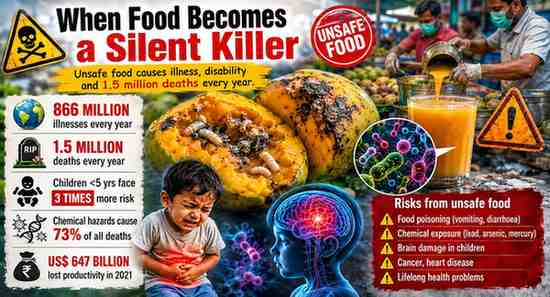
Food is meant to nourish life, yet for millions around the world it has become a hidden source of disease and death. A landmark analysis released by the World Health Organization (WHO) ahead of World Food Safety Day 2026 paints a disturbing picture of the global burden caused by unsafe food. The report warns that contaminated food remains one of the world’s most underestimated public health threats, affecting people across every continent and age group.
WHO estimates unsafe food causes 866 million illnesses and 1.5 million deaths every year worldwide.
The findings reveal that food contaminated with bacteria, viruses, parasites, fungi, toxins, and hazardous chemicals continues to exact an enormous human and economic cost. While many cases result in temporary illness, countless others lead to lifelong disabilities, chronic diseases, and premature death.
Children Bear the Heaviest Burden
Children under five years of age account for nearly one-third of all foodborne disease cases despite representing only 9% of the global population.
According to WHO, young children face almost three times the risk of foodborne illness compared with older children and adults. Their developing immune systems make them particularly vulnerable to severe diarrhoea, dehydration, malnutrition, and long-term developmental complications.
The dangers extend far beyond food poisoning. Chemical contaminants hidden in everyday foods can silently damage health for years before symptoms appear.
Chemical hazards were responsible for 73% of all foodborne deaths recorded in 2021
Among the most dangerous contaminants identified were inorganic arsenic and lead.
Inorganic arsenic contributed to 42% of chemical-related food deaths, while lead accounted for 31%.
Exposure to these substances increases the risk of cardiovascular disease, cancers, and neurological disorders. Lead and methylmercury are particularly dangerous for children because they can impair brain development, reduce learning ability, and cause lifelong cognitive problems.
Unsafe food is not merely a health crisis—it is also an economic burden.
Foodborne diseases caused an estimated US$310 billion in lost productivity in 2021, rising to US$647 billion after adjusting for cost-of-living differences.
The WHO analysis covered 42 major foodborne hazards across 194 countries from 2000 to 2021. It found that Africa and South-East Asia carry the highest burden, together accounting for nearly three-quarters of global foodborne illnesses and 60% of related deaths.
India, home to one of the world’s largest food systems, faces its own food safety challenges. Data from government agencies, public health studies, and food safety investigations reveal recurring concerns over adulteration, contamination, poor storage practices, and unhygienic food handling.
Recent enforcement action by the Food Safety and Standards Authority of India (FSSAI) highlighted the risks. Authorities in Gujarat’s Mehsana district seized large quantities of mangoes intended for juice production that were reportedly rotten, worm-infested, fungus-covered, and unsuitable for human consumption.
Many consumers mistakenly believe that the worm itself is the main threat. Experts say the greater danger lies in what the infestation represents. Once a fruit’s skin is damaged, harmful bacteria, moulds, and toxins can enter and multiply rapidly.
Juice prepared from heavily spoiled fruit may expose consumers to food poisoning organisms capable of causing nausea, vomiting, abdominal cramps, diarrhoea, fever, and dehydration. Individuals with weakened immunity, young children, pregnant women, and older adults face the greatest risks.
India has witnessed several foodborne disease outbreaks over the years linked to contaminated street food, improperly stored meals, unsafe drinking water, and adulterated products.
The WHO estimates that diarrhoeal diseases remain among the largest contributors to foodborne illness worldwide.
Food safety experts warn that climate change may worsen the situation. Rising temperatures, extreme weather events, flooding, and changing agricultural conditions can increase the spread of pathogens and contamination throughout food supply chains.
Another emerging concern is antimicrobial resistance.
Drug-resistant foodborne infections are becoming harder to treat, increasing the risk of severe illness and death.
The WHO is urging governments to adopt a “One Health” approach that connects human health, animal health, agriculture, food production, and environmental protection. Better surveillance systems, safer farming practices, stronger industrial controls, improved sanitation, and stricter food inspections are considered essential.
Consumers also play a critical role. Washing produce thoroughly, cooking food properly, avoiding visibly spoiled items, storing food safely, and purchasing products from trusted sources can significantly reduce risk.
The latest WHO assessment delivers a clear message: unsafe food is not an isolated problem affecting only a few unfortunate victims. It is a global challenge that touches nearly every household.
More than 1 million deaths annually are linked to dietary exposure to arsenic and lead alone.
As nations mark World Food Safety Day under the theme “From Burden to Solutions – Safe Food Everywhere,” experts say the evidence is now undeniable. The challenge is no longer identifying the problem. The challenge is acting quickly enough to prevent the next preventable illness, disability, or death from reaching the dinner table.